The Routledge Concise History of World Literature by D'haen Theo;
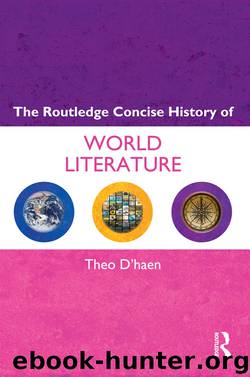
Author:D'haen, Theo;
Language: eng
Format: epub
Publisher: Routledge
The leading neo-Marxist American critic and literary theoretician Fredric Jameson, himself heavily influenced by Adorno, directs his critique specifically against postmodernism and instead defends the continuing oppositional relevance of the avant-garde along Modernist lines (Jameson 1984, 1991). With this stance Jameson is close to the German philosopher Jürgen Habermas, who upheld a similar position in his “Modernity, an Unfinished Project” (Habermas 1982), and the equally German writer and philosopher Walter Benjamin who in his “Six Theses on History” (1940) had argued the necessity to continuously re-think history from an oppositional perspective, oppositional that is to dominant power. In all this, of course, Lukács, Adorno, Jameson, and Benjamin subscribe to the role of the politically committed intellectual as a rootless and alienated individual, in the Marxist sense, in his (bourgeois or industrial capitalist) society. Benjamin and Adorno, along with Max Horkheimer (1895–1973), were leading figures of the so-called Frankfurt School at the Institute for Social Research of the University of Frankfurt in Germany. Habermas still is. Because they were inspired by Marxist thought but wanted to apply this in a critical spirit and not subject to the doctrinaire interpretations of orthodox communism as it had come to power in the Soviet Union and later in most of Eastern and Central Europe after WWII, they are usually referred to as neo-Marxists or Western Marxists. Their work has been very influential for the development of more recent cultural studies approaches.
While a PhD student at Yale University in the mid-1950s, Jameson studied under Auerbach, who in his essay “Philology and Weltliteratur” of 1952 had voiced suspicions similar to those of Adorno and Horkheimer with regard to “a standardized world” with as ultimate possible consequence “a single literary culture, only a few literary languages and perhaps even a single literary language,” as “herewith the notion of Weltliteratur would be … at once realized and destroyed” (Auerbach 2009 [1952]: 127). However, as he saw such a homogenization of world literature as not immediately imminent, Auerbach gives over most room to discussing the need to find a point of departure, what he called an Ansatzpunkt, from which to synthesize the overwhelming wealth of material world literature lays out before the researcher or literary historian. Damrosch (2003) and Apter (2006), and from other perspectives altogether Wai-Chee Dimock (2006a and 2006b) and Djelal Kadir (2011) have taken Auerbach’s lesson to heart. Damrosch (2003) finds his Ansatzpunkt in his elliptical or triangulated reading of the past and the distant or the present and the near. Apter (2006) finds it in translation. Dimock (2006b) finds it in American literature as world literature. Kadir (2011) finds it in looking for a number of literary, philosophical and academic exiles and wanderers making up a loose network of precursors to the eventual discipline of comparative literature. Both Apter and Kadir make Auerbach himself into an Ansatzpunkt when they cast him as the subject of one of their chapters. For all four, however different they otherwise might be, the method pursued is basically philological in that it consists of a close study of the texts analyzed.
Download
This site does not store any files on its server. We only index and link to content provided by other sites. Please contact the content providers to delete copyright contents if any and email us, we'll remove relevant links or contents immediately.
| Books & Reading | Comparative Literature |
| Criticism & Theory | Genres & Styles |
| Movements & Periods | Reference |
| Regional & Cultural | Women Authors |
4 3 2 1: A Novel by Paul Auster(12375)
The handmaid's tale by Margaret Atwood(7757)
Giovanni's Room by James Baldwin(7329)
Asking the Right Questions: A Guide to Critical Thinking by M. Neil Browne & Stuart M. Keeley(5759)
Big Magic: Creative Living Beyond Fear by Elizabeth Gilbert(5755)
Ego Is the Enemy by Ryan Holiday(5414)
The Body: A Guide for Occupants by Bill Bryson(5080)
On Writing A Memoir of the Craft by Stephen King(4935)
Ken Follett - World without end by Ken Follett(4723)
Adulting by Kelly Williams Brown(4566)
Bluets by Maggie Nelson(4547)
Eat That Frog! by Brian Tracy(4526)
Guilty Pleasures by Laurell K Hamilton(4439)
The Poetry of Pablo Neruda by Pablo Neruda(4097)
Alive: The Story of the Andes Survivors by Piers Paul Read(4020)
White Noise - A Novel by Don DeLillo(4002)
Fingerprints of the Gods by Graham Hancock(3996)
The Book of Joy by Dalai Lama(3976)
The Bookshop by Penelope Fitzgerald(3844)
