The Rise of the Civilizational State by Coker Christopher;
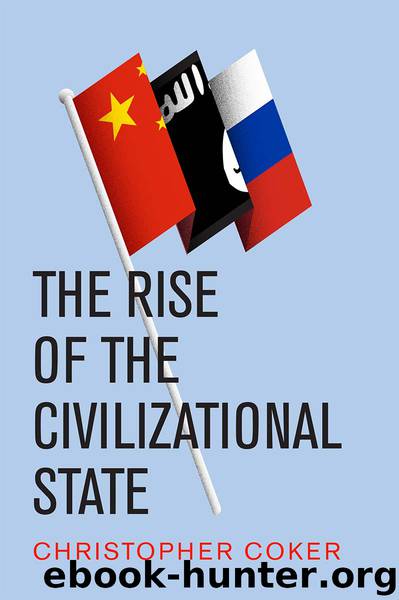
Author:Coker, Christopher;
Language: eng
Format: epub
ISBN: 9781509534647
Publisher: John Wiley & Sons, Inc.
Published: 2018-02-19T00:00:00+00:00
This is now a regular theme of Chinese propaganda. You can find a host of videos on the social media platform Weibo posted by state organizations such as the Communist Youth League which usually go viral as soon as they appear. A song called ‘Colour Revolution’ was posted in 2016 by a hip-hop group blaming US democracy-promotion for all the ills of the world. A prominent Shanghai businessman wrote an op-ed piece in the Washington Post warning of the dangers of ‘Maidanocracy’ (a reference to the central square in Kiev which served as the epicentre of the protests that brought down the former pro-Russian president) (Huang 2014). Remember that what really upset the leadership in 1989 when 6 million people took to the streets was the disturbing picture of a scaled-down Statue of Liberty in Tiananmen Square which the students erected to inspire them in their democratic demands.
The party is still fearful of the appeal of Western ideas, which is why it has fallen back on civilizational values. And indeed there is much to be mined from tradition, and much that China can contribute to the world. The country is just beginning to develop its own theories about its place in the world, based on what one Chinese commentator calls the country’s ‘geo-cultural birthmark’ (Yaqing 2011: 38). But there is also a tendency to follow the worst of Western practices and assert its own brand of exceptionalism. There is a tendency among some Chinese scholars, adopting a Confucian perspective, to claim that their country is not only unique, special or exceptional but actually superior in its moral standing. Because its political culture is deemed to represent the ‘Way of Humane Authority’, its role in the world centuries past is also deemed to have been more enlightened than that of any other Great Power (Qing 2013: 18). In the speeches of China’s former leaders, including Jiang Zemin and Hu Jintao, runs a common theme: Confucianism is seen as part of a pacifist tradition that underlies the country’s peaceful development. And it’s the continuity of that tradition despite sometimes violent changes in political dynasty that is deemed to represent the Chinese ‘differential’. Harmony at home has been accompanied by harmony abroad – no colonies, no civilizing mission, no neo-imperial fantasies. Only the development of what Deng Xiaoping once called a unique ‘spiritual civilization’ grounded in the Confucian tradition that has always had to fight its corner in history against ‘foreign barbaric forces’ (Callahan 2012: 24).
The Chinese state, declares China’s premier, has inherited from ancient times a fine tradition of honesty, harmony and good faith – values that China consistently abides by in the conduct of relations with other countries (Curtis 2016: 545). It’s a wonderful tale to tell others, and especially yourself – really to believe that you are the only Great Power to have broken the mould, to have behaved as no other Great Power has before – but you have to believe what you overhear yourselves telling others as well as yourself.
Download
This site does not store any files on its server. We only index and link to content provided by other sites. Please contact the content providers to delete copyright contents if any and email us, we'll remove relevant links or contents immediately.
| Arms Control | Diplomacy |
| Security | Trades & Tariffs |
| Treaties | African |
| Asian | Australian & Oceanian |
| Canadian | Caribbean & Latin American |
| European | Middle Eastern |
| Russian & Former Soviet Union |
The Secret History by Donna Tartt(19045)
The Social Justice Warrior Handbook by Lisa De Pasquale(12185)
Thirteen Reasons Why by Jay Asher(8889)
This Is How You Lose Her by Junot Diaz(6875)
Weapons of Math Destruction by Cathy O'Neil(6264)
Zero to One by Peter Thiel(5786)
Beartown by Fredrik Backman(5737)
The Myth of the Strong Leader by Archie Brown(5496)
The Fire Next Time by James Baldwin(5429)
How Democracies Die by Steven Levitsky & Daniel Ziblatt(5211)
Promise Me, Dad by Joe Biden(5141)
Stone's Rules by Roger Stone(5080)
A Higher Loyalty: Truth, Lies, and Leadership by James Comey(4948)
100 Deadly Skills by Clint Emerson(4919)
Rise and Kill First by Ronen Bergman(4777)
Secrecy World by Jake Bernstein(4740)
The David Icke Guide to the Global Conspiracy (and how to end it) by David Icke(4699)
The Farm by Tom Rob Smith(4502)
The Doomsday Machine by Daniel Ellsberg(4484)
