The Rise of Abraham Cahan by Seth Lipsky
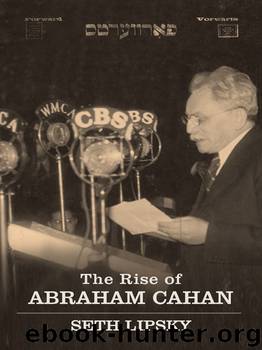
Author:Seth Lipsky [Lipsky, Seth]
Language: eng
Format: epub
ISBN: 978-0-8052-4310-9
Publisher: Knopf Doubleday Publishing Group
Published: 2013-10-15T04:00:00+00:00
A few days later voters filled Madison Square Garden to celebrate. “I do not expect to work wonders in Congress,” London said at the event. “I shall, however, say a new word and I shall accomplish one thing that is not in the platform of the Socialist Party. I hope that my presence will represent an entirely different type of Jew from the kind Congress is accustomed to see.” This was in marked contrast to Hillquit, who in his 1908 campaign made clear that he would principally represent the Socialist Party and would not be “the special representative of the alleged special interests of this district”—which is to say, the Jews of the Lower East Side.
London’s victory was soon overshadowed by the groundswell of international events. World War I was about to shatter Europe, and it would make America a great world power. The war would dwarf the local and national issues that concerned the Lower East Side residents of the twelfth congressional district; it would also push to the side Cahan’s passions for the spread of socialism throughout the world. The war presented American Jews, and the Forward, with a peculiar challenge. Americans generally sympathized with the Allies (led by Britain, France, Russia, and Italy), while American Jews tended to be more sympathetic to the Central Powers (led by Germany and Austria-Hungary). It was in Germany that Cahan, as his train passed through Breslau back in 1882, felt that “for the first time I could see the marks of a highly civilized nation.” And Germany was, after all, the enemy of the Russian czar. The socialists were generally opposed to any American involvement in the war, but they were also tugged in the direction of Germany, which was, as Pollock puts it, the “fountainhead of socialist thought and doctrine.… Even when Germany invaded Belgium and bombed Antwerp, these aggressive acts were overshadowed in Jewish minds by the Russian threat to devour Galicia, with its large Jewish population.”
In his semiautobiographical novel Mercy of a Rude Stream, Henry Roth captures this sentiment in the scene where Ira Stigman’s immigrant mother reacts to news of the outbreak of war and reports of German brutality:
The Great War came closer. The Huns impaled babies on their bayonets—though Mom ridiculed stories of German atrocities. “What, the Russ is better? Czar kolki iz a feiner mensch? [The bullet czar is a better person?] Who in all the world is more benighted than the Russian mujik [peasant]? Who doesn’t remember their pogroms, the Kishinev pogroms, in 1903? … More likely the Russ impaled the infant on his bayonet.”
Download
This site does not store any files on its server. We only index and link to content provided by other sites. Please contact the content providers to delete copyright contents if any and email us, we'll remove relevant links or contents immediately.
4 3 2 1: A Novel by Paul Auster(12405)
The handmaid's tale by Margaret Atwood(7773)
Giovanni's Room by James Baldwin(7354)
Big Magic: Creative Living Beyond Fear by Elizabeth Gilbert(5780)
Asking the Right Questions: A Guide to Critical Thinking by M. Neil Browne & Stuart M. Keeley(5779)
Ego Is the Enemy by Ryan Holiday(5456)
The Body: A Guide for Occupants by Bill Bryson(5104)
On Writing A Memoir of the Craft by Stephen King(4948)
Ken Follett - World without end by Ken Follett(4740)
Adulting by Kelly Williams Brown(4582)
Bluets by Maggie Nelson(4566)
Eat That Frog! by Brian Tracy(4547)
Guilty Pleasures by Laurell K Hamilton(4455)
The Poetry of Pablo Neruda by Pablo Neruda(4113)
Alive: The Story of the Andes Survivors by Piers Paul Read(4037)
White Noise - A Novel by Don DeLillo(4019)
Fingerprints of the Gods by Graham Hancock(4009)
The Book of Joy by Dalai Lama(3996)
The Bookshop by Penelope Fitzgerald(3857)
