The Rise and Fall of the Caucasian Race by Baum Bruce;
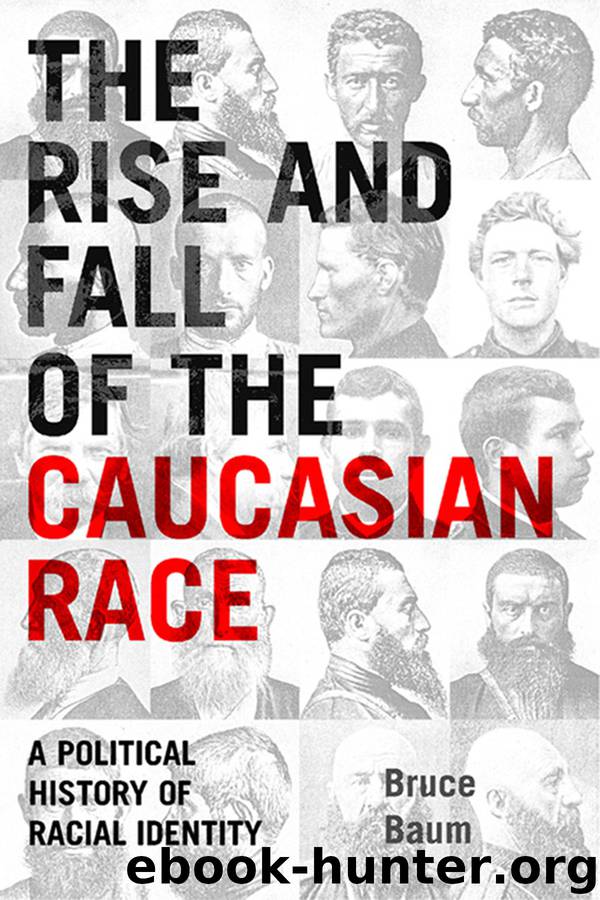
Author:Baum, Bruce;
Language: eng
Format: epub
Publisher: New York University Press
Published: 2006-07-19T16:00:00+00:00
The Decline of Scientific Racism
One significant development in the scholarly study of race emerged in the United States in the 1920s. Park and Burgess pioneered the sociological “race relations” paradigm in An Introduction to the Science of Sociology (1921).86 Park later defined race relations as “the relations existing between peoples distinguished by marks of racial descent, particularly when these racial differences enter into the consciousness of the individuals and groups so distinguished, and by doing so determine in each case the individual’s conception of himself as well as his status in the community.”87“Race relations” research, including Gunnar Myrdal’s analysis of U.S. racism in An American Dilemma, challenged received notions about the innate character of “race prejudice.” Yet it also accepted the prevailing notion of race differences—that is, that human groups were “distinguished by marks of racial descent” even before social practices constituted certain physical traits as racial.88 Nonetheless, race relations theory partly shifted the scholarly study of race from the terrain of biology to that of social and political relations.89 In the wake of Hitler’s rise to power in 1933, various writers advanced critiques of racism. German Jewish social scientist and champion of homosexual rights Magnus Hirschfeld introduced the term racism in “Rassismus,” published in English as Racism in 1938.90 In 1937, the French-born U.S. cultural historian Jacques Barzun published Race: A Study in Modern Superstition.
By this time physical anthropology was losing its hold over the scientific study of race. Physical anthropologists, Elazar Barkan explains, had “accumulated data which had no epistemological justification,” and their focus on visible physical differences had produced no consistent racial typologies. The study of race differences was addressed increasingly by the new sciences of genetics, social and cultural anthropology, sociology, and psychology.91 In 1931, English biologist Lancelot Hogben summarized the growing confusion among scientists: “Geneticists believe that anthropologists have decided what race is. Ethnologists assume that their classifications embody principles which genetic science has proved correct. Politicians believe that their prejudices have the sanction of genetic laws and the findings of physical anthropology to sustain them.”92 More and more, scientists in this period challenged the notion of racial inequality, but without rejecting the concept of race. Since the notion of race difference was ultimately biological, the controversial ideal of basic human equality, as Barkan says, “had to be established on biological grounds.”93
Developments in the science of race between 1935 and 1951 bear directly on the question of the relationship between science and politics, or truth and power. From a contemporary perspective, we might be tempted to see the refutation of scientific racism within science as straightforward evidence of the self-correcting character of the scientific method. On this view, once a sufficient number of scientists in the 1930s and 1940s distanced themselves from a priori racist assumptions, they were able to produce objective research that refuted scientific racism. But politics and science remained strongly intertwined in the study of race.94 In Nancy Stepan’s words, while science, “as always, depended for its character on empirical tests of its ideas, .
Download
This site does not store any files on its server. We only index and link to content provided by other sites. Please contact the content providers to delete copyright contents if any and email us, we'll remove relevant links or contents immediately.
| Anthropology | Archaeology |
| Philosophy | Politics & Government |
| Social Sciences | Sociology |
| Women's Studies |
Nudge - Improving Decisions about Health, Wealth, and Happiness by Thaler Sunstein(7711)
The Fire Next Time by James Baldwin(5452)
iGen by Jean M. Twenge(5418)
Adulting by Kelly Williams Brown(4580)
The Sports Rules Book by Human Kinetics(4393)
The Hacking of the American Mind by Robert H. Lustig(4386)
The Ethical Slut by Janet W. Hardy(4261)
Captivate by Vanessa Van Edwards(3842)
Mummy Knew by Lisa James(3694)
In a Sunburned Country by Bill Bryson(3545)
The Worm at the Core by Sheldon Solomon(3489)
Ants Among Elephants by Sujatha Gidla(3468)
The 48 laws of power by Robert Greene & Joost Elffers(3294)
Suicide: A Study in Sociology by Emile Durkheim(3024)
The Slow Fix: Solve Problems, Work Smarter, and Live Better In a World Addicted to Speed by Carl Honore(3012)
The Tipping Point by Malcolm Gladwell(2929)
Humans of New York by Brandon Stanton(2875)
Get What's Yours for Medicare: Maximize Your Coverage, Minimize Your Costs by Philip Moeller(2756)
Handbook of Forensic Sociology and Psychology by Stephen J. Morewitz & Mark L. Goldstein(2705)
