The Reds: The Communist Party of Australia From Origins to Illegality by Macintyre Stuart;
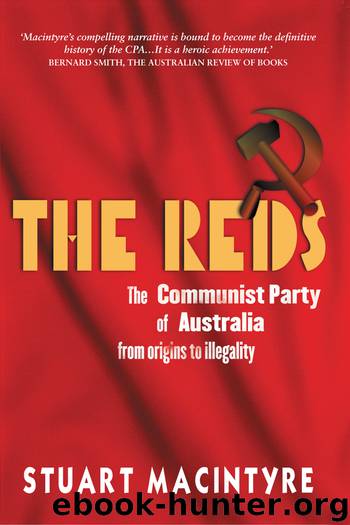
Author:Macintyre, Stuart;
Language: eng
Format: epub
ISBN: 9781743432358
Publisher: Allen & Unwin
Published: 2017-02-20T16:00:00+00:00
The success of the united front is commonly represented as broadening the ambit of communism from the narrow confines of the Third Period. An oppositional sect of mostly unemployed workers in the first half of the 1930s is contrasted with the larger, more diverse movement that reached out in the second half of the decade to engage with progressive groups in a range of common concerns.30 It is undoubtedly true that the united front took the party into new associations and that growth enabled it to sustain a level of activity beyond its earlier capacity. In relating the transition in these terms, however, there is a danger of oversimplification. Third Period communism carried proletarian struggle into a number of fields of practice. The richness of activity around the united front was always constrained by party control. The move from the one to the other brought significant reorientation that closed off certain political forms while it opened up new ones.
An early casualty was communist work among the unemployed. It was noted in Chapter 8 how the party leadership moved as early as the end of 1931 from a style of confrontational activism, now deemed ‘sectarian’, in favour of attention to the ‘concrete problems of the unemployed’, especially questions of relief. The Unemployed Workers’ Movement yielded to a series of organisations more closely modelled on unions (the Relief and Sustenance Workers’ Union was one of these), which employed analogous methods of collective representation to press the authorities for a better deal. The party abandoned its reckless street demonstrations and paramilitary support of eviction resistance. More than this, it discouraged the acts of defiance whereby the militant unemployed drew attention to their plight. The smashing of city shop-windows, the ordering of an expensive meal in a restaurant and then instructing the proprietor to charge it up to the premier—these demonstrative exercises in political street theatre were now condemned as anarchism, symptomatic of the insubordinate temper that had overtaken Sylvester, Lovegrove and other renegades. Those households of single unemployed, such as Sylvester had encouraged in Sydney’s Balmain as an experiment in alternative communal practices, lapsed. The constantly moving army of men and women on the track were no longer flag-bearers of proletarian revolt; they were maimed victims of capitalism, to be redeemed by the discipline of wage labour. ‘The Communist Party cannot be based on bagmen’, Miles told the Eleventh Congress. The Number 2 District organiser insisted that all members, even those on the dole, must keep themselves ‘clean and presentable’, and remember the party was not a ‘philanthropic society for the rehabilitation of the demoralised’. Tom Hills, a Port Melbourne activist who lost his job as a wharfie in the 1928 strike and did not get it back until 1937, put the change of policy more succinctly: henceforth it was ‘faces to the factory and arseholes to the unemployed’.31 The unemployed workers became a substratum of the working class, their lack of employment an injury that maimed them as much as it disgraced the society in which they lived.
Download
This site does not store any files on its server. We only index and link to content provided by other sites. Please contact the content providers to delete copyright contents if any and email us, we'll remove relevant links or contents immediately.
| Anarchism | Communism & Socialism |
| Conservatism & Liberalism | Democracy |
| Fascism | Libertarianism |
| Nationalism | Radicalism |
| Utopian |
The Secret History by Donna Tartt(19052)
The Social Justice Warrior Handbook by Lisa De Pasquale(12187)
Thirteen Reasons Why by Jay Asher(8893)
This Is How You Lose Her by Junot Diaz(6877)
Weapons of Math Destruction by Cathy O'Neil(6265)
Zero to One by Peter Thiel(5786)
Beartown by Fredrik Backman(5737)
The Myth of the Strong Leader by Archie Brown(5499)
The Fire Next Time by James Baldwin(5431)
How Democracies Die by Steven Levitsky & Daniel Ziblatt(5215)
Promise Me, Dad by Joe Biden(5141)
Stone's Rules by Roger Stone(5081)
A Higher Loyalty: Truth, Lies, and Leadership by James Comey(4954)
100 Deadly Skills by Clint Emerson(4921)
Rise and Kill First by Ronen Bergman(4779)
Secrecy World by Jake Bernstein(4741)
The David Icke Guide to the Global Conspiracy (and how to end it) by David Icke(4707)
The Farm by Tom Rob Smith(4502)
The Doomsday Machine by Daniel Ellsberg(4484)
