The Ragged Road to Abolition by Gigantino II James J.;
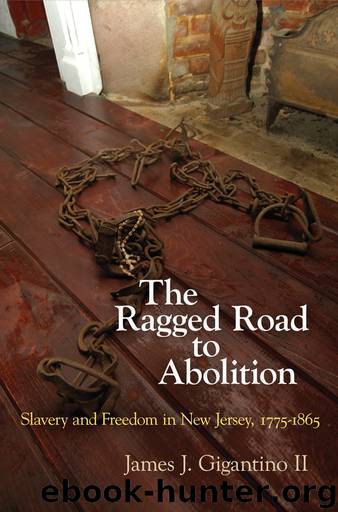
Author:Gigantino II, James J.;
Language: eng
Format: epub
Publisher: University of Pennsylvania Press
Published: 2014-04-10T04:00:00+00:00
CHAPTER EIGHT
Creating a Free Life
Slavery’s persistence in antebellum New Jersey worked to limit free African Americans’ ability to succeed in the abolition period and placed them outside the body politic. Stripped of their right to vote, marginalized as slaves despite their free status, and declared “undesirable” by the colonization society, blacks tried to integrate into white political, economic, and social structures through a complex process of identity construction by which elite blacks challenged racial inequality through demonstrating their suitability for citizenship. Eventually they created their own communities to find respectability in a white-dominated republic. This fight for civil rights and the creation of free communities during slavery’s slow death allowed free blacks to interact daily with the enslaved and forced them to battle against slavery’s entrenched boundaries as they simultaneously fought to develop their own free lives. Slavery’s shadow, therefore, hung over any attempt at advancement.1
The 1830s represented a turning point for African Americans in the abolition period since by then the gradual abolition law had produced a steady stream of free blacks who joined the children of the first generation of manumitted slaves to create a far larger and stronger free black community. In 1830, for example, roughly a quarter of Jersey blacks remained either slaves or slaves for a term with that number continuing to decline over the next two decades. Free blacks after 1830 more readily achieved economic success, lived independently, created their own schools and benevolent institutions, founded their own churches, and used all of them to combat white resistance to black equality. They simultaneously joined with the new radical abolition movement to reject the continuation of slavery and the continued graduated notions of abolition espoused by the colonization society.2
The growing influence of free blacks in New Jersey forced a legal change in their status, which made the 1830s a true tipping point toward freedom in the state. Although slavery still remained strong, the presence of a larger free black population caused the State Supreme Court to reverse itself in 1836. They found that blacks would no longer be considered prima facie slaves; freedom became African American’s default legal category. The demographic and legal shift to freedom, however, exacerbated racial tensions and forced Jersey whites to draw even stronger lines of demarcation as white fears of black economic competition, miscegenation, and the general threat to the racial order culminated in a series of race riots that swept New Jersey and the rest of the North. Gradualism and a rejection of African American freedom, hallmarks of the abolition period’s first twenty years, remained strong despite blacks’ best efforts to establish their independence.
* * *
In the 1810s and 1820s, Newark’s white residents became anxious over the growing presence of free blacks, a feeling that led them to use the state’s 1798 Slave Code provision that prohibited free blacks from traveling across county lines without permission from at least two local judges to limit black population growth. Originally designed to enforce order in the state when the slave population
Download
This site does not store any files on its server. We only index and link to content provided by other sites. Please contact the content providers to delete copyright contents if any and email us, we'll remove relevant links or contents immediately.
| Anthropology | Archaeology |
| Philosophy | Politics & Government |
| Social Sciences | Sociology |
| Women's Studies |
Nudge - Improving Decisions about Health, Wealth, and Happiness by Thaler Sunstein(7794)
The Fire Next Time by James Baldwin(5542)
iGen by Jean M. Twenge(5481)
Adulting by Kelly Williams Brown(4649)
The Sports Rules Book by Human Kinetics(4478)
The Hacking of the American Mind by Robert H. Lustig(4446)
The Ethical Slut by Janet W. Hardy(4325)
Captivate by Vanessa Van Edwards(3889)
Mummy Knew by Lisa James(3746)
In a Sunburned Country by Bill Bryson(3606)
The Worm at the Core by Sheldon Solomon(3537)
Ants Among Elephants by Sujatha Gidla(3507)
The 48 laws of power by Robert Greene & Joost Elffers(3419)
Get What's Yours for Medicare: Maximize Your Coverage, Minimize Your Costs by Philip Moeller(3293)
Suicide: A Study in Sociology by Emile Durkheim(3062)
The Slow Fix: Solve Problems, Work Smarter, and Live Better In a World Addicted to Speed by Carl Honore(3058)
The Tipping Point by Malcolm Gladwell(2986)
Humans of New York by Brandon Stanton(2943)
Handbook of Forensic Sociology and Psychology by Stephen J. Morewitz & Mark L. Goldstein(2759)
