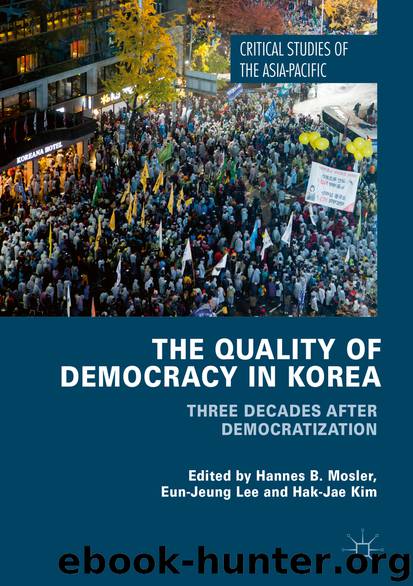
The Quality of Democracy in Korea by Hannes B. Mosler Eun-Jeung Lee & Hak-Jae Kim
Author:Hannes B. Mosler, Eun-Jeung Lee & Hak-Jae Kim
Language: eng
Format: epub
Publisher: Springer International Publishing, Cham
Public Opinion and Electoral Politics
The Post-1997 Regime and Roh Moo-hyun’s Political Answer
The growing economic inequality and insecurity after the financial crisis in 1997 was followed by a fundamental change in the perception of the public about the situations and prospects of their own life and the national economy. Despite the long period of the labor-repressive modernization in this country, the majority of Koreans seems to have believed before the outbreak of the 1997 crisis that economic poverty and disparity are being reduced and will continue to be. A survey conducted by Gallup Korea in 1990 (#1) reported that 42.8% of respondents had the opinion that the poor households are decreasing, while 39.6% believed they are increasing. According to another survey of the same year (#2), 44.5% of the respondents answered the earning gap between blue- and white-collar workers has been reduced, while only 20.9% responded it has been widened. However, after the 1997 crisis the mood has been radically changed. In a survey conducted by Gallup Korea in 1999 (#3), as many as 75.6% of the respondents viewed the gap between rich and poor in their country as “very serious” and 17.8% as “somewhat serious.” Inequality became a matter of grave concern for most Koreans.
To whom, then, did the people attribute the problem they suffer? The performance of the Kim Dae-jung government, which began its term right after the crisis, was ambivalent. It lowered the unemployment rate, which had soared up to 7.0% in 1998, to 4.4% in 2000. The growth rate of real GDP plummeted from 5.8% in 1997 to −5.7% in 1998, but recovered very quickly to 10.7% in 1999, which was substantially higher than the OECD average growth rate of 3.3% that year (OECD Economic Outlook, annual data). Equally significant, however, is the fact that “the central problem in [Korean] labor market in the 2000s shifted from the problem of high unemployment to that of polarization of employment system and the working poor” (Cheon 2014, 455). This ambivalence notwithstanding, the majority of Koreans were extremely discontent with the economic performance of the Kim Dae-Jung government. In a survey by Gallup Korea in August 2000 (#4), only 12.6% answered positively to the question whether they think the president had been doing well in narrowing the gap between rich and poor.
In this context, it is remarkable that the hottest issues in the 2002 presidential election were a far cry from resolving the enormous gap between the public concern about economic difficulties and the dissatisfaction with the government responsiveness . The Grand National Party, the then-largest opposition party, and its candidate Lee Hoe-chang took a passive strategy of maintaining the public discontent with President Kim Dae-jung and concentrated on the corruption scandals of the Kim government. Meanwhile, the ruling Democratic Party and its candidate Roh Moo-hyun brought the slogan “New Political Generation” and “End to Outdated Politics” to the fore. It reflected their strategy both to distance themselves from the Kim Dae-Jung administration and to attack the strong rival Lee Hoe-chang, who had been regarded as a symbolic figure of established elites.
Download
This site does not store any files on its server. We only index and link to content provided by other sites. Please contact the content providers to delete copyright contents if any and email us, we'll remove relevant links or contents immediately.
| Anthropology | Archaeology |
| Philosophy | Politics & Government |
| Social Sciences | Sociology |
| Women's Studies |
The Secret History by Donna Tartt(19387)
The Social Justice Warrior Handbook by Lisa De Pasquale(12267)
Thirteen Reasons Why by Jay Asher(9058)
This Is How You Lose Her by Junot Diaz(7008)
Weapons of Math Destruction by Cathy O'Neil(6419)
Zero to One by Peter Thiel(5901)
Beartown by Fredrik Backman(5880)
The Myth of the Strong Leader by Archie Brown(5591)
The Fire Next Time by James Baldwin(5544)
How Democracies Die by Steven Levitsky & Daniel Ziblatt(5299)
Promise Me, Dad by Joe Biden(5208)
Stone's Rules by Roger Stone(5158)
A Higher Loyalty: Truth, Lies, and Leadership by James Comey(5048)
100 Deadly Skills by Clint Emerson(4994)
Rise and Kill First by Ronen Bergman(4864)
Secrecy World by Jake Bernstein(4826)
The David Icke Guide to the Global Conspiracy (and how to end it) by David Icke(4804)
The Doomsday Machine by Daniel Ellsberg(4585)
The Farm by Tom Rob Smith(4574)
