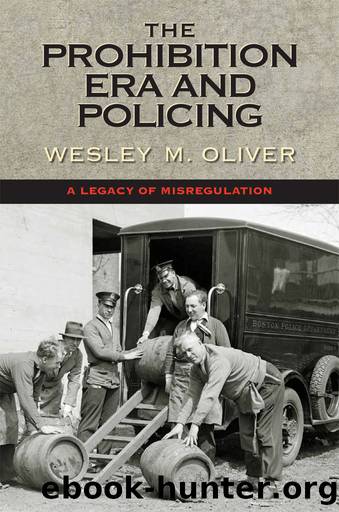
The Prohibition Era and Policing: A Legacy of Misregulation by Wesley M. Oliver
Author:Wesley M. Oliver
Language: eng
Format: epub
Publisher: Vanderbilt University Press
Published: 2018-12-15T00:00:00+00:00
7
PERMITTING SUSPECTS TO CONSENT TO COERCIVE AND DECEPTIVE INTERROGATION PRACTICES
Even though concerns about reliability were consistently recognized by courts to be the sole basis for excluding confessions until after Prohibition, Anglo-American law long found a factor unrelated to reliability to be relevant to a confessionâs admissibilityâthe suspectâs knowledge of his right to remain silent. Cautioning a suspect that anything he said could be used against him was historically regarded to overcome most coercive pressures that were feared to lead a suspect to falsely confess. The Warren Court in Miranda v. Arizona merely placed more emphasis on a suspectâs waiver of his right to silence, formally elevating the waiver to a necessary condition for admissibility and practically elevating the waiver to a sufficient condition. This was no insubstantial shift in focus. Long before Miranda, reliability was abandoned as a basis for constitutional limits on confessions, but pre-Miranda, factors indicating coercion also demonstrated concerns about the confessionâs reliability. Practically speaking, after Miranda, concerns about coercion continued to be regulated by the Constitution only to the extent they intersected with issues of waiver. Law enforcement groups were outraged by the Miranda decision, but the real losers in the opinion were the weak and innocent who were subjected to effectively unregulated interrogations once they agreed to speak with police officers.
The Supreme Court in Miranda drew on a long tradition of informing suspects of their rights to silence before interrogations. Interestingly, though, that tradition developed as a means of admitting confessions despite improper interrogation techniques. In the late 1700s, magistrates, who interrogated suspects, began to warn suspects that they had the right to remain silent and that anything they said could be used against them. The rationale for the warning was quite simpleâto ensure that the trial court would not subsequently find that the method of extracting the confession was involuntary, that is, that the statement had not been produced by a promise or a threat. The warnings historically were less about giving the suspect the opportunity to end an interrogation and more about ensuring the admissibility of confessions that were so obtained.1
A similar irony accompanied the Supreme Courtâs resurrection of the warnings in 1966. In requiring warnings prior to interrogations in Miranda v. Arizona, Chief Justice Earl Warren claimed to be protecting the interests of vulnerable suspects in interrogation rooms.2 The decision actually took the focus of judges off of considerations that protected vulnerable suspects from coercion or providing false confessions and enabled law enforcement to more easily admit most confessions, while allowing sophisticated suspects to avoid the interrogation process entirely. With exceptions of a few savvy defendants, the Miranda decision, like its historical antecedents, has had the primary effect of allowing the admission of otherwise improperly obtained confessions.
Suspects have routinely been warned that their statements could be used against them for far longer than is typically recognized. As early as 1760, suspects were given warnings that were strikingly similar to what we now know as the Miranda warnings. Interrogations, conducted by magistrates prior
Download
This site does not store any files on its server. We only index and link to content provided by other sites. Please contact the content providers to delete copyright contents if any and email us, we'll remove relevant links or contents immediately.
| Anthropology | Archaeology |
| Philosophy | Politics & Government |
| Social Sciences | Sociology |
| Women's Studies |
The Secret History by Donna Tartt(19053)
The Social Justice Warrior Handbook by Lisa De Pasquale(12187)
Thirteen Reasons Why by Jay Asher(8893)
This Is How You Lose Her by Junot Diaz(6877)
Weapons of Math Destruction by Cathy O'Neil(6265)
Zero to One by Peter Thiel(5787)
Beartown by Fredrik Backman(5737)
The Myth of the Strong Leader by Archie Brown(5500)
The Fire Next Time by James Baldwin(5431)
How Democracies Die by Steven Levitsky & Daniel Ziblatt(5215)
Promise Me, Dad by Joe Biden(5141)
Stone's Rules by Roger Stone(5081)
A Higher Loyalty: Truth, Lies, and Leadership by James Comey(4954)
100 Deadly Skills by Clint Emerson(4921)
Rise and Kill First by Ronen Bergman(4780)
Secrecy World by Jake Bernstein(4741)
The David Icke Guide to the Global Conspiracy (and how to end it) by David Icke(4709)
The Farm by Tom Rob Smith(4502)
The Doomsday Machine by Daniel Ellsberg(4484)
