The Problem of the Color Line at the Turn of the Twentieth Century by Du Bois W. E. B.; Chandler Nahum Dimitri;
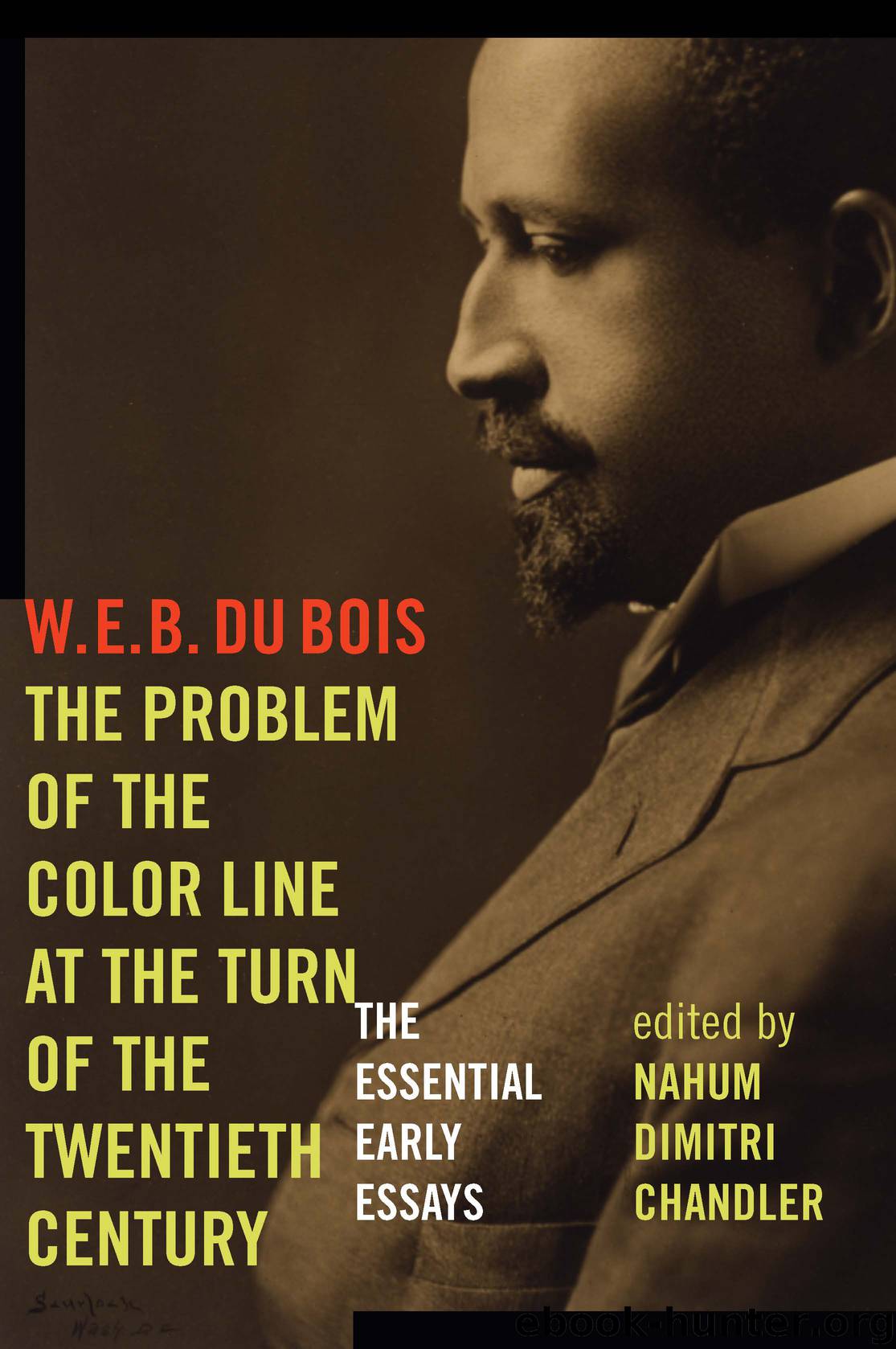
Author:Du Bois, W. E. B.; Chandler, Nahum Dimitri;
Language: eng
Format: epub
Publisher: Fordham University Press
THE RELATION OF THE NEGROES TO THE WHITES IN THE SOUTH
1901
* * *
[1] In the discussion of great social problems it is extremely difficult for those who are themselves actors in the drama to avoid the attitude of partisans and advocates. And yet I take it that the examination of the most serious of the race problems of America is not in the nature of a debate but rather a joint endeavor to seek the truth beneath a mass of assertion and opinion, of passion and distress. And I trust that whatever disagreement may arise between those who view the situation from opposite sides of the color line will be rather in the nature of additional information than of contradiction.
[2] The world-old phenomenon of the contact of diverse races of men is to have new exemplification during the new century. Indeed the characteristic of the age is the contact of European civilization with the world’s undeveloped peoples. Whatever we may say of the results of such contact in the past, it certainly forms a chapter in human action not pleasant to look back upon. War, murder, slavery, extermination and debauchery—this has again and again been the result of carrying civilization and the blessed gospel to the isles of the sea and the heathen without the law. Nor does it altogether satisfy the conscience of the modern world to be told complacently that all this has been right and proper, the fated triumph of strength over weakness, of righteousness over evil, of superiors over inferiors. It would certainly be soothing if one could readily believe all this, and yet there are too many ugly facts, for everything to be thus easily explained away. We feel and know that there are many delicate differences in race psychology, numberless changes which our crude social measurements are not yet able to follow minutely, which explain much of history and social development. At the same time, too, we know that these considerations have never adequately explained or excused the triumph of brute force and cunning over weakness and innocence.
[3] It is then the strife of all honorable men of the twentieth century to see that in the future competition of races, the survival of the fittest shall mean the triumph of the good, the beautiful and the true; that we may be able to preserve for future civilization all that is really fine and noble and strong, and not continue to put a premium on greed and impudence and cruelty. To bring this hope to fruition we are compelled daily to turn more and more to a conscientious study of the phenomena of race contact—to a study frank and fair, and not falsified and colored by our wishes or our fears. And me have here in the South as fine a field for such a study as the world affords: a field to be sure which the average American scientist deems somewhat beneath his dignity, and which the average man who is not a scientist
Download
This site does not store any files on its server. We only index and link to content provided by other sites. Please contact the content providers to delete copyright contents if any and email us, we'll remove relevant links or contents immediately.
| Anthropology | Archaeology |
| Philosophy | Politics & Government |
| Social Sciences | Sociology |
| Women's Studies |
Nudge - Improving Decisions about Health, Wealth, and Happiness by Thaler Sunstein(7694)
The Fire Next Time by James Baldwin(5432)
iGen by Jean M. Twenge(5409)
Adulting by Kelly Williams Brown(4567)
The Sports Rules Book by Human Kinetics(4379)
The Hacking of the American Mind by Robert H. Lustig(4375)
The Ethical Slut by Janet W. Hardy(4243)
Captivate by Vanessa Van Edwards(3838)
Mummy Knew by Lisa James(3686)
In a Sunburned Country by Bill Bryson(3537)
The Worm at the Core by Sheldon Solomon(3486)
Ants Among Elephants by Sujatha Gidla(3463)
The 48 laws of power by Robert Greene & Joost Elffers(3254)
Suicide: A Study in Sociology by Emile Durkheim(3019)
The Slow Fix: Solve Problems, Work Smarter, and Live Better In a World Addicted to Speed by Carl Honore(3007)
The Tipping Point by Malcolm Gladwell(2914)
Humans of New York by Brandon Stanton(2868)
Handbook of Forensic Sociology and Psychology by Stephen J. Morewitz & Mark L. Goldstein(2704)
The Happy Hooker by Xaviera Hollander(2687)
