The Politics of Genocide by Edward S. Herman & David Peterson
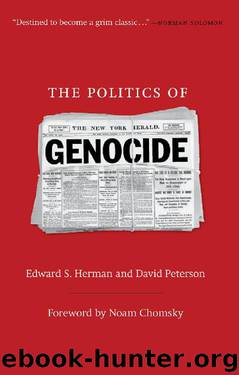
Author:Edward S. Herman & David Peterson [Herman, Edward S.]
Language: eng
Format: epub, mobi, azw3
Publisher: Monthly Review Press
Published: 2010-03-31T22:00:00+00:00
3. CROATIA’S OPERATION STORM
In the course of its struggle to break away from the Socialist Federal Republic of Yugoslavia, Croatia made a determined effort to crush and to ethnically cleanse the very large number of Serbs remaining in Croatian territory. They first did this to the Serb inhabitants of Western Slavonia via Operation Flash in May 1995. Later and far more extensively, in August 1995, Croatia launched Operation Storm against the Serbs living in the Krajina region, where Croatia shares a very long border with Bosnia and Herzegovina. These operations received critical U.S. support in terms of material aid and intelligence, the training of both Croat and Bosnian Muslim troops by corporate U.S. mercenaries such as MPRI (Military Professional Resources Inc.), and by diplomatic protection.195 Coming less than one month after the Srebrenica massacre, Operation Storm drove some 250,000 ethnic Serbs out of the Krajina along both sides of the Croatia-Bosnia border, killing several thousand, including several hundred women and children. On the day in August when the Security Council took up the situations in both Bosnia and Croatia, U.S. Ambassador Madeleine Albright spoke in graphic terms about how “important” it was to “focus international attention on the plight of the refugee population from Srebrenica and Zepa,” numbering some thirteen thousand by her reckoning, who the “Pale Serbs beat, raped and murdered.” But she said nothing comparable about the twenty times larger cleansing of Serbs from the Krajina, using Srebrenica as a cover for this still ongoing operation carried out with blitzkrieg-like efficiency.196
This ethnic cleansing of 250,000 Serbs was the single largest event of its kind in the Balkan wars. On ICTY logic, the Croat leaders of Operation Storm could have been prosecuted for genocide. Consider the ICTY’s reasoning in its Judgment for its first case related to Srebrenica, where it accepted that the “intent to eradicate a group within a limited geographical area such as the region of a country or even a municipality may be characterized as genocide.”197 Indeed, Operation Storm was nothing if not intended to kill or remove all Serbs from the Krajina, an area vastly larger than Srebrenica. In his testimony during the one Operation Storm–related case to be prosecuted at the ICTY, Peter Galbraith, the U.S. Ambassador to Croatia at the time, specifically recalled that “He [Franjo Tudjman] believed that … European states were much better off if they were ethnically homogeneous,” and that Tudjman “saw because of their geography that the Krajina Serbs were a particular threat … located, after all, in such a way that they almost divided the northern part of Croatia from the coast.” Galbraith also recalled a conversation with one of Tudjman’s closest aides, who told him: “We cannot accept them to come back. They are a cancer in the stomach of Croatia.”198
But as Operation Storm was both U.S.-sponsored and helped clear up Croatia’s Serb problem, it was minimally newsworthy and has been treated neither as a massacre nor as genocide, as we can see in Table 3. In
Download
The Politics of Genocide by Edward S. Herman & David Peterson.mobi
The Politics of Genocide by Edward S. Herman & David Peterson.azw3
This site does not store any files on its server. We only index and link to content provided by other sites. Please contact the content providers to delete copyright contents if any and email us, we'll remove relevant links or contents immediately.
| Anthropology | Archaeology |
| Philosophy | Politics & Government |
| Social Sciences | Sociology |
| Women's Studies |
The Secret History by Donna Tartt(19387)
The Social Justice Warrior Handbook by Lisa De Pasquale(12267)
Thirteen Reasons Why by Jay Asher(9058)
This Is How You Lose Her by Junot Diaz(7008)
Weapons of Math Destruction by Cathy O'Neil(6417)
Zero to One by Peter Thiel(5901)
Beartown by Fredrik Backman(5880)
The Myth of the Strong Leader by Archie Brown(5591)
The Fire Next Time by James Baldwin(5544)
How Democracies Die by Steven Levitsky & Daniel Ziblatt(5299)
Promise Me, Dad by Joe Biden(5208)
Stone's Rules by Roger Stone(5158)
A Higher Loyalty: Truth, Lies, and Leadership by James Comey(5048)
100 Deadly Skills by Clint Emerson(4994)
Rise and Kill First by Ronen Bergman(4864)
Secrecy World by Jake Bernstein(4826)
The David Icke Guide to the Global Conspiracy (and how to end it) by David Icke(4804)
The Doomsday Machine by Daniel Ellsberg(4585)
The Farm by Tom Rob Smith(4574)
