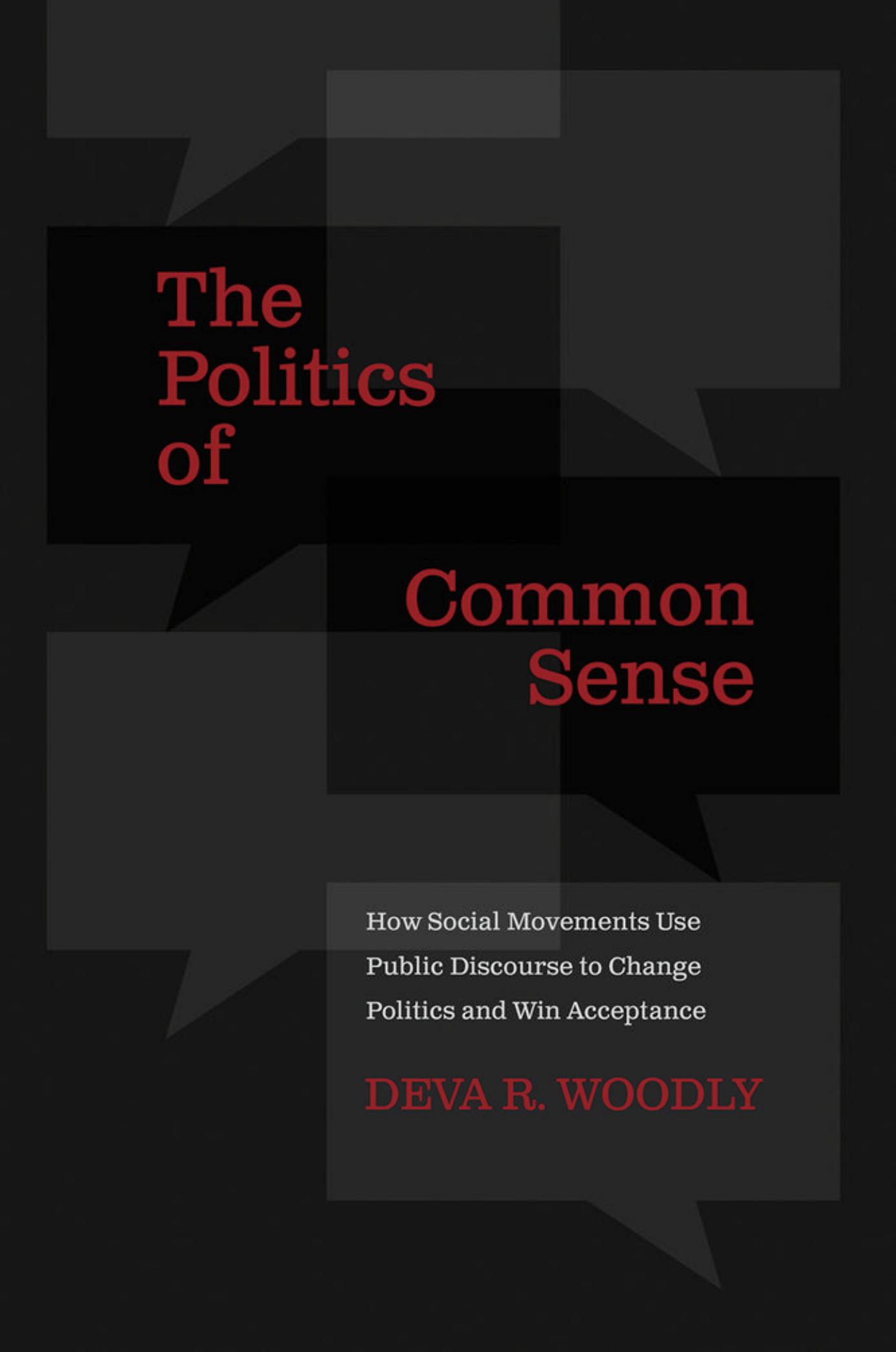
The Politics of Common Sense: How Social Movements Use Public Discourse to Change Politics and Win Acceptance by Deva R. Woodly
Author:Deva R. Woodly [Woodly, Deva R.]
Language: eng
Format: azw3, pdf
Publisher: Oxford University Press
Published: 2015-05-31T16:00:00+00:00
The Top-Down Perspective of Political Communication
Although mass media receive quite a lot of criticism from all corners, much of it deserved, it is the existence of this apparatus, the arbiter of mainstream information and opinion, that can make it possible for the voices and ideas of marginalized people with relatively little access to official power to have great effect. Still, most of the time this is not what occurs. And while the increasingly anemic interest of most Americans in politics is certainly not all the fault of news media, it is the case that it may be a symptom of some systematic ailments of the press. These ailments include not only the widely acknowledged difficulty the press has in living up to the democratic hope for the fabled fourth branch, but also the professional expectations that have developed within the institution.
The scholarly literature on political communication has done a thorough job of tracing the paths that mainstream news discourse usually follows. If one were to imagine the flow of discourse in a shape, it would be a triangle, with ideational and policy content flowing from the top and down the sides to the base—from the White House, Congress or other top officials, through reporters and pundits, to interested citizens and finally the general populace (Bennett [1983] 2011, Bennett and Entman 2000, Schudson 1995, 2001, Entman 2004, Woodly 2008).
The triangular shape of public discourse is reinforced and maintained by the normal routines of reporting in the press and manifests in news content as elite bias (Parenti 1993, Jamieson and Waldman 2003). Longtime observers of political communication have noted that this elite bias is not necessarily the result of normative preference for the opinions of officials, but instead the consequence of a number of constraints and standard operating procedures that are characteristic of the modern press (Entman 1989, Gans 2005).
It is important to follow this symptom to its source because elite bias affects the news in at least three ways. First, the range of issues that the mainstream news media regard as newsworthy and from which they subsequently choose stories often determines which issues the general public comes to regard as politically important. Second, the way that media represents these important issues establishes which people are authorized to speak and which viewpoints are offered as germane to the explanation of problems as well as the alternative solutions that both elites and the general public come to regard as credible. Third, these two aspects, selection and representation, prescribe the contours of common national political discourses, constraining the practical and rhetorical options that are available to political actors who wish to influence policy outcomes (Iyengar 1991, Ansoblehere, Behr, and Iyengar 1993, Gitlin [1980] 2003).
Scholars of political communication have specified the mechanisms of elite bias in two main ways, expressed in “hegemonic” and “indexical” theories of political communication. Hegemony theorists like Todd Gitlin and Michael Parenti see the overabundance of news stories and news frames that originate with public officials in mainstream media as a symptom of the way that hegemony, as understood by Gramsci, functions in contemporary politics.
Download
The Politics of Common Sense: How Social Movements Use Public Discourse to Change Politics and Win Acceptance by Deva R. Woodly.pdf
This site does not store any files on its server. We only index and link to content provided by other sites. Please contact the content providers to delete copyright contents if any and email us, we'll remove relevant links or contents immediately.
| Anthropology | Archaeology |
| Philosophy | Politics & Government |
| Social Sciences | Sociology |
| Women's Studies |
The Secret History by Donna Tartt(19395)
The Social Justice Warrior Handbook by Lisa De Pasquale(12271)
Thirteen Reasons Why by Jay Asher(9060)
This Is How You Lose Her by Junot Diaz(7010)
Weapons of Math Destruction by Cathy O'Neil(6426)
Zero to One by Peter Thiel(5905)
Beartown by Fredrik Backman(5888)
The Myth of the Strong Leader by Archie Brown(5597)
The Fire Next Time by James Baldwin(5547)
How Democracies Die by Steven Levitsky & Daniel Ziblatt(5300)
Promise Me, Dad by Joe Biden(5210)
Stone's Rules by Roger Stone(5165)
A Higher Loyalty: Truth, Lies, and Leadership by James Comey(5054)
100 Deadly Skills by Clint Emerson(5001)
Rise and Kill First by Ronen Bergman(4869)
Secrecy World by Jake Bernstein(4834)
The David Icke Guide to the Global Conspiracy (and how to end it) by David Icke(4810)
The Doomsday Machine by Daniel Ellsberg(4587)
The Farm by Tom Rob Smith(4576)
