The Phoenix of Philosophy by Epstein Mikhail;
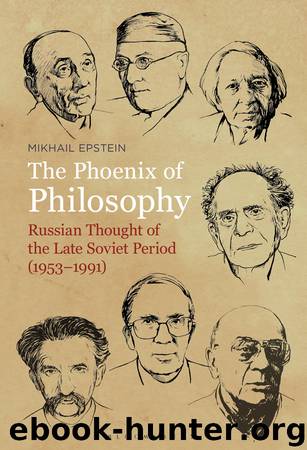
Author:Epstein, Mikhail;
Language: eng
Format: epub
Publisher: Bloomsbury USA
8. The Paradoxalist Boris Paramonov. Sexual Liberation against Nationalism
Boris Paramonov (born 1937) is probably the most exemplary manifestation of Vasilii Rozanov’s tradition of philosophical extravagance in late- and post-Soviet thought. He returns to several themes raised by Rozanov and subsequently suppressed as “indecent” by all schools of Russian philosophy for half a century, particularly sexuality and Jewishness. Paramonov taught courses on the history of philosophy at Leningrad State University until his emigration to the United States in 1978. The author of numerous controversial articles, Paramonov has been best known as a philosophical commentator for Radio Liberty in New York, where he hosted a program called “The Russian Idea,” later retitled “Russian Questions.” This program was widely discussed in Russian intellectual circles as one of the most provocative forums for theorizing the fates of Russian culture.
Like other personalists, Paramonov formulates his own views via a critique of Russian intellectual traditions based on the tendencies of collectivism and utopianism. He argues that communism was the natural successor of Russian Orthodoxy—both emphasized a collectivist spirituality, sobornost’ (“togetherness”) at the expense of individuality. The originality of Paramonov’s criticism is its reliance on psychoanalytic theory, which he applies to the “collective unconscious” of the entire Russian nation. In his view, Russians have not yet reached the stage where the ego, or self, becomes differentiated from the id of the national soul. This is why Russian culture is so rich in mythical and artistic creations but so poor in the capacity for rational self-reflection. Collective archetypes still dominate the Russian imagination, which prevents the country from developing a technological and democratic mentality.
Paramonov critiques Russian culture for its “logocentrism” and even the specific literary obsessiveness that inspired its revolutionary movements—communism itself amounting to a literary utopia that places the idea before reality. In Paramonov’s view, great tyrants and great artists appear in the same social climate, where mystery and imagination are sanctified, while the material aspects of reality are largely ignored. Essentially, a great tyrant is nothing but an artist who succeeds in molding his country according to an inspired vision.97 “The emotions of the repressed society are projected on the genius, and this process, properly speaking, institutes this very genius. In our country, a person of genius is compensation for society’s deficiency.”98 Paramonov notes that as social conditions in Russia improved, the type of the genius withered away proportionally; then revived with the emergence of a new oppressive regime. Only by abandoning her visionary impulses, then, will Russia ever succeed in entering the circle of pragmatic Western civilization. Russia must sacrifice her ideological and prophetic ambitions, give up her claims of spiritual superiority over the “cynical” West, in order to meet the practical needs of her suffering population.
Paramonov generally prefers Freud’s version of psychoanalysis to Jung’s because the former deals with individuals and does not romanticize the archetypal images of the collective unconscious. At the same time, Freud’s rationalism, aimed at the desublimation of unconscious impulses, appeals to Paramonov as a kind of therapy that should be applied to the whole of Russian society.
Download
This site does not store any files on its server. We only index and link to content provided by other sites. Please contact the content providers to delete copyright contents if any and email us, we'll remove relevant links or contents immediately.
4 3 2 1: A Novel by Paul Auster(12367)
The handmaid's tale by Margaret Atwood(7752)
Giovanni's Room by James Baldwin(7319)
Big Magic: Creative Living Beyond Fear by Elizabeth Gilbert(5753)
Asking the Right Questions: A Guide to Critical Thinking by M. Neil Browne & Stuart M. Keeley(5752)
Ego Is the Enemy by Ryan Holiday(5412)
The Body: A Guide for Occupants by Bill Bryson(5077)
On Writing A Memoir of the Craft by Stephen King(4925)
Ken Follett - World without end by Ken Follett(4720)
Adulting by Kelly Williams Brown(4564)
Bluets by Maggie Nelson(4544)
Eat That Frog! by Brian Tracy(4519)
Guilty Pleasures by Laurell K Hamilton(4437)
The Poetry of Pablo Neruda by Pablo Neruda(4090)
Alive: The Story of the Andes Survivors by Piers Paul Read(4017)
White Noise - A Novel by Don DeLillo(4001)
Fingerprints of the Gods by Graham Hancock(3986)
The Book of Joy by Dalai Lama(3970)
The Bookshop by Penelope Fitzgerald(3843)
