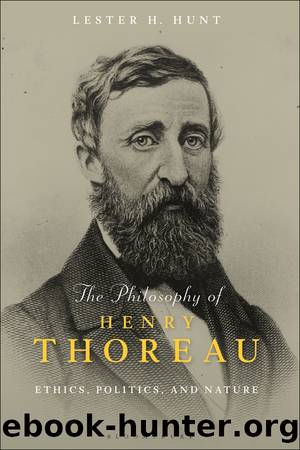
The Philosophy of Henry Thoreau by Lester H. Hunt;
Author:Lester H. Hunt;
Language: eng
Format: epub
Publisher: Bloomsbury UK
3. Higher Laws and Lower
A key to understanding Thoreau’s asceticism can be found at an important juncture in “Economy,” where he has just made the declaration, which I discussed earlier (II.3), that the alternative to obtaining necessities is not to obtain superfluities “as more and richer food, larger and more splendid houses, finer and more abundant clothing, more numerous, incessant, and hotter fires, and the like” but to “adventure on life.” He explains his preference for the “adventure” alternative: “The soil, it appears, is suited to the seed, for it has sent its radicle downward, and it may now send its shoot upward also with confidence. Why has man rooted himself thus firmly in the earth, but that he may rise in the same proportion into the heavens above?” (335.6–10). He is drawing an analogy here, in which the human being is compared to a seed planted in soil. The soil represents the comparatively worldly concerns of seeking food, clothing, and shelter, while the air above the soil indicates the higher concerns, which in comparison are non-worldly. He then elaborates on the analogy somewhat:
for the nobler plants are valued for the fruit they bear at last in the air and light, far from the ground, and are not treated like the humbler esculents, which, though they may be biennials, are cultivated only till they have perfected their root, and often cut down at top for this purpose, so that most would not know them in their flowering season. (335.10–16)
Supposing that this analogy is in fact an analogical argument, it seems on its face to be quite implausible. In particular, the last-quoted part seems to be based on the quaint notion that we can distinguish between “nobler” and “humbler” plants.
However, I think the earlier part of this passage, the one in which the human being is explicitly likened to a seed, works rather differently and is more effective. It can also be seen as an analogical argument, but the assumptions that underlie it are more plausible. It might be spelled out along the following lines. He is claiming, implicitly, that in plant life, the functions that develop first are ones that serve to support the physical survival of the individual plant, though they derive their real importance from the fact that they support certain later-developing functions, which promote quite different results. He wants us to apply this same idea to human life: that the activities in which we interact with nature to support our survival are genuinely important but only because they support other functions which mature later and are of a fundamentally different nature. What serves to connect his premise about plant life with the conclusion about human life that he wishes to persuade us of is the unstated hypothesis that serves to explain why his comment about plant life is true. The reason why plant life has this character is that living organisms in general necessarily have the same character: all organisms survive by interacting with the physical world,
Download
This site does not store any files on its server. We only index and link to content provided by other sites. Please contact the content providers to delete copyright contents if any and email us, we'll remove relevant links or contents immediately.
4 3 2 1: A Novel by Paul Auster(12554)
The handmaid's tale by Margaret Atwood(7867)
Giovanni's Room by James Baldwin(7475)
Big Magic: Creative Living Beyond Fear by Elizabeth Gilbert(5858)
Asking the Right Questions: A Guide to Critical Thinking by M. Neil Browne & Stuart M. Keeley(5858)
Ego Is the Enemy by Ryan Holiday(5573)
The Body: A Guide for Occupants by Bill Bryson(5213)
On Writing A Memoir of the Craft by Stephen King(5018)
Ken Follett - World without end by Ken Follett(4817)
Adulting by Kelly Williams Brown(4647)
Bluets by Maggie Nelson(4640)
Eat That Frog! by Brian Tracy(4633)
Guilty Pleasures by Laurell K Hamilton(4536)
The Poetry of Pablo Neruda by Pablo Neruda(4195)
Alive: The Story of the Andes Survivors by Piers Paul Read(4102)
Fingerprints of the Gods by Graham Hancock(4080)
The Book of Joy by Dalai Lama(4067)
White Noise - A Novel by Don DeLillo(4060)
The Bookshop by Penelope Fitzgerald(3912)
