The Last Professors by Donoghue Frank;
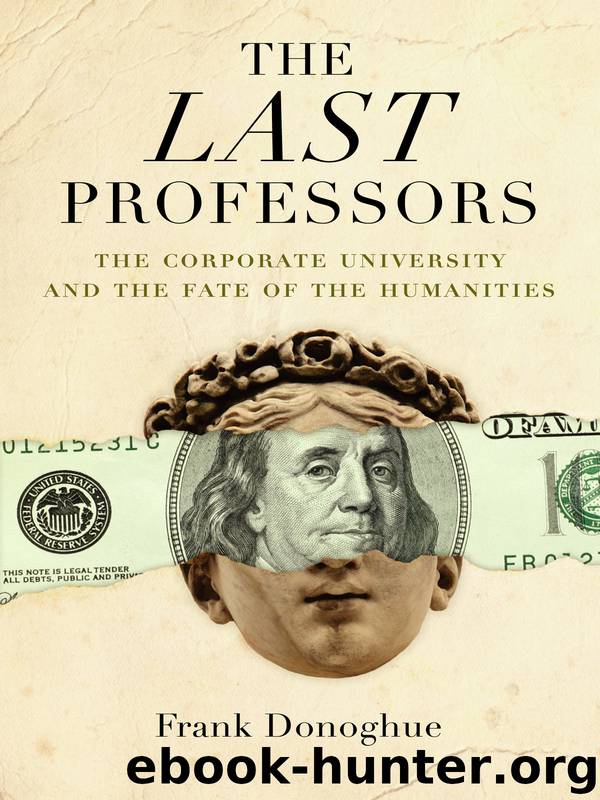
Author:Donoghue, Frank;
Language: eng
Format: epub
Publisher: Fordham University Press
Published: 2008-04-06T04:00:00+00:00
Clearly, the changing student demographics guide us to look closely at for-profit universities. To get a sense of the for-profit revolution in higher education, one can hardly do better than to look at the sports pages. After leaving Louisiana State University for the NBA in 1992, Shaquille O’Neal continued to take courses and returned with great fanfare to receive his B.A. in 2001. He attended LSU’s commencement ceremony, rechristening his alma mater Love Shaq University. Four years later, in July of 2005, ESPN and other sports and entertainment outlets reported that O’Neal had earned an M.B.A. What the reports (or at least their headlines) failed to note was that he earned the degree entirely online from the University of Phoenix, the nation’s largest for-profit university. The omission of these two details (the virtual degree and its grantor), as I see it, accords the for-profit education sector unprecedented legitimacy. The University of Phoenix only added to its luster in 2006 when it bought the naming rights to a stadium which would be home to the NFL’s Arizona Cardinals. ESPN.com’s story announcing the move simply calls the University of Phoenix “the nation’s largest private university.” Though subsequent paragraphs mention that it is operated for profit and has been the subject of SEC investigations, for ESPN’s vast audience such details pale in comparison to the revelation that the 2008 Super Bowl will be played at the “University of Phoenix Stadium.”27 David Noble, the for-profits’ most vocal critic, has long compared them to the fly-by-night correspondence schools that flourished in the 1920s. That no one thought to suggest that Shaq’s online M.B.A. was somehow spurious, or thought to object that the University of Phoenix is neither a university nor in Phoenix, reveals those correspondence school comparisons to be wishful thinking on Noble’s part. The for-profits are a serious and permanent phenomenon.
The for-profits themselves insist on both the clarity of their mission and their right to a place in the world of higher education. Ronald Taylor, the chief operator and co-founder of DeVry, the second-largest, for-profit, higher-education provider, says, “The colossally simple notion that drives DeVry’s business is that if you ask employers what they want and then provide what they want, the people you supply to them will be hired.”28 John Sperling, founder of Apollo Group (the University of Phoenix’s parent company), casts his competition with traditional higher education in explicitly warlike terms. Chronicling his company’s long struggle for legitimacy, he says that his various efforts to expand Apollo’s accreditation status “were largely proxies for cultural battles between defenders of 800 years of educational (and largely religious) traditions, and innovation that was based on the ideas of the marketplace—transparency, efficiency, productivity, and accountability.”29 Taylor and Sperling speak to the twin ruling principles of the for-profit revolution in higher education: that the only mission of for-profit universities is job training, and that the universities themselves operate according to the conventions and values of the business universe that they supply with employees. One would be hard-pressed to find such uniformity or certainty in the world of traditional, non-profit education.
Download
This site does not store any files on its server. We only index and link to content provided by other sites. Please contact the content providers to delete copyright contents if any and email us, we'll remove relevant links or contents immediately.
| Anthropology | Archaeology |
| Philosophy | Politics & Government |
| Social Sciences | Sociology |
| Women's Studies |
The Secret History by Donna Tartt(19092)
The Social Justice Warrior Handbook by Lisa De Pasquale(12190)
Thirteen Reasons Why by Jay Asher(8912)
This Is How You Lose Her by Junot Diaz(6888)
Weapons of Math Destruction by Cathy O'Neil(6281)
Zero to One by Peter Thiel(5802)
Beartown by Fredrik Backman(5756)
The Myth of the Strong Leader by Archie Brown(5509)
The Fire Next Time by James Baldwin(5447)
How Democracies Die by Steven Levitsky & Daniel Ziblatt(5219)
Promise Me, Dad by Joe Biden(5154)
Stone's Rules by Roger Stone(5088)
A Higher Loyalty: Truth, Lies, and Leadership by James Comey(4964)
100 Deadly Skills by Clint Emerson(4926)
Rise and Kill First by Ronen Bergman(4790)
Secrecy World by Jake Bernstein(4753)
The David Icke Guide to the Global Conspiracy (and how to end it) by David Icke(4720)
The Farm by Tom Rob Smith(4514)
The Doomsday Machine by Daniel Ellsberg(4490)
