The Last American Diplomat: John D Negroponte and the Changing Face of US Diplomacy by George W. Liebmann
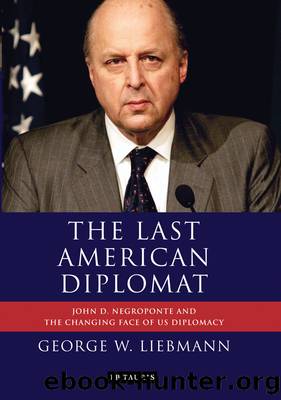
Author:George W. Liebmann [Liebmann, George W.]
Language: eng
Format: epub
Tags: Biography & Autobiography, Political, Political Science, International Relations, Diplomacy, History, Americas (North; Central; South; West Indies)
ISBN: 9781848858695
Google: GR9KYgEACAAJ
Goodreads: 12633663
Publisher: I. B. Tauris
Published: 2012-01-27T10:34:23+00:00
14
THE PHILIPPINES
Today you hear much talk of absolutes ⦠people say that two systems as different as ours cannot exist in the same world ⦠that one is good and one is evil, and good and evil cannot exist in the world. Good and evil have existed in this world since Adam and Eve went out of the Garden of Eden.
The proper search is for limited ends which soon enough educate us in the complexities of the tasks that face us. That is what all of us must learn to do in the United States, to limit objectives, to get ourselves away from the search for the absolute, to find out what is within our powers â¦. We must respect our opponents. We must understand that for a long period of time they will continue to believe as they do and that for a long long period of time we will both inhabit this spinning ball in the great void of the universe.
â Dean Acheson, quoted in D. McLellan, Dean Acheson: The State Department Years (New York: Dodd Mead, 1976), 173â4
John Negroponte had begun to look for a job in the private sector after the Clinton administration got off to a slow start in filling ambassadorships. In June 1993, The New York Times ran an editorial lamenting the numerous unfilled embassies; by coincidence or for better reason, Negroponte was offered the Philippine embassy on the following day. At the start of the Clinton administration, Carlos Salinas reportedly called Bill Clinton asking him to retain Negroponte in Mexico.
Exit from Empire
Negroponteâs service in the Philippines was uneventful; he found the post much less high pressure than his earlier and later assignments. The United States had exited from its two major Philippine bases, Clark Field and Subic Bay, before his arrival. A treaty that would have allowed it to retain bases had been defeated in the Philippine Senate in 1991, partly, it was said, because of the abrasive style of Richard Armitage as the US negotiator. Thereafter, the US Navy âpulled out everything that could float (including three dry docks) and anything that could be unscrewed.â1 The outgoing ambassador, Richard Solomon, had publicly stated that the 1950s era Mutual Defense Treaty, which was still in force, âdoes not require a permanent US military presence on Philippine soil.â Clark Field had been largely destroyed by a volcanic eruption; Subic Bay was converted into a recreational, industrial, and commercial complex. Although the remaining base facilities were said to have been looted by well-connected Filipinos,2 the reconstruction at Subic Bay, including the last-minute demolition of thousands of houses occupied by âsquatters,â had been sufficiently completed by November of 1996, three months after Negroponteâs departure, to allow the ASEAN Conference to be held there.3
Negroponteâs tenure in the Philippines involved the renunciation of the remnants of Americaâs imperial role and the placement of the relationship on new economic foundations. These are unusual in that the foundation of the Philippine economy is the export of skilled labor rather than economic development within the Philippines.
Download
This site does not store any files on its server. We only index and link to content provided by other sites. Please contact the content providers to delete copyright contents if any and email us, we'll remove relevant links or contents immediately.
| Arms Control | Diplomacy |
| Security | Trades & Tariffs |
| Treaties | African |
| Asian | Australian & Oceanian |
| Canadian | Caribbean & Latin American |
| European | Middle Eastern |
| Russian & Former Soviet Union |
The Secret History by Donna Tartt(19058)
The Social Justice Warrior Handbook by Lisa De Pasquale(12187)
Thirteen Reasons Why by Jay Asher(8894)
This Is How You Lose Her by Junot Diaz(6877)
Weapons of Math Destruction by Cathy O'Neil(6267)
Zero to One by Peter Thiel(5789)
Beartown by Fredrik Backman(5737)
The Myth of the Strong Leader by Archie Brown(5500)
The Fire Next Time by James Baldwin(5432)
How Democracies Die by Steven Levitsky & Daniel Ziblatt(5216)
Promise Me, Dad by Joe Biden(5144)
Stone's Rules by Roger Stone(5081)
A Higher Loyalty: Truth, Lies, and Leadership by James Comey(4954)
100 Deadly Skills by Clint Emerson(4921)
Rise and Kill First by Ronen Bergman(4780)
Secrecy World by Jake Bernstein(4742)
The David Icke Guide to the Global Conspiracy (and how to end it) by David Icke(4709)
The Farm by Tom Rob Smith(4502)
The Doomsday Machine by Daniel Ellsberg(4485)
