The Global Jihad Movement by Gunaratna Rohan;Oreg Aviv;
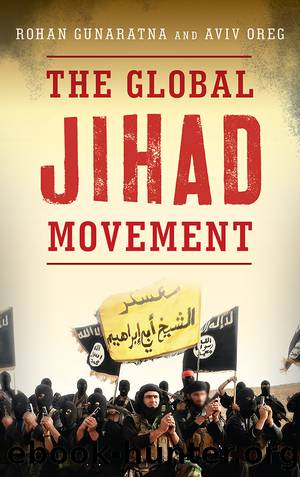
Author:Gunaratna, Rohan;Oreg, Aviv; [Gunaratna, Rohan]
Language: eng
Format: epub
Publisher: Rowman & Littlefield Publishers
Published: 2015-08-15T00:00:00+00:00
Assessment
Even though the IJU is relatively a small group, it is a good example of a local jihadi group operating in the international arena. It is an Uzbek national outfit that is deployed in the FATA under the patronage of al-Qaeda and the Taliban and is operationally and logistically active in Western Europe, mostly in Germany. In spite of its small number of activists, IJU poses a significant threat to Western forces and facilities inside the FATA and in the international arena. According to our assessment, the organization is rising in popularity among Uzbek nationals inside Uzbekistan and Turkish emigrants across Europe, especially Germany. In Germany, the group possesses a significant logistical infrastructure, which mainly provides the organization with new recruits. Based on these factors, we believe that the IJU will try to increase its activity on all fronts, particularly inside Uzbekistan, using suicide attacks against the West as well as international and local targets. By using new recruits, especially German Muslim converts, we believe that the group will try to extend its operational activities to more countries, including the United States and Israel as well as those in Western Europe.
Libyan Islamic Fighting Group (LIFG)
The Libyan Islamic Fighting Group (LIFG) is probably al-Qaedaâs closest affiliate in Afghanistan. LIFG fighters were among the first to arrive in Afghanistan to fight the Soviets and many of them remained in the country after the war. LIFG members in Afghanistan collaborate with al-Qaeda and occupy leadership positions within al-Qaeda.
Background
Libya gained independence from Italy by the end of World War II and declared itself a constitutional monarchy under King Idris. On September 1969, Colonel Muammar al-Qadhafi staged a military coup dâétat in Libya and established an Arab nationalist regime that adhered to an ideology of âIslamic socialism.â Since then Qadhafi has been Libyaâs only leader until the recent âArab Springâ uprising that resulted in the overthrowing of the Qadhafi regime during the autumn of 2011. His regime generated resentment among Islamic circles in Libya, which led to an Islamist revival since the late 1970s. This Islamist revival has been composed of several Islamist movements:
The Muslim Brotherhood
The Muslim Brotherhood first appeared in Libya in the 1950s. The king allowed it some freedom to spread its ideology, and the movement soon attracted local adherents.451 Qadhafi took a less accommodating stance, regarding the Brotherhood as a potential source of opposition.452 Soon after coming to power, he arrested several Brothers and repatriated them to Egypt. In 1973, the security services arrested and tortured members of the Brotherhood, who, under pressure, agreed to dissolve the organization. The Brotherhood remained silent throughout the remainder of the 1970s.
In the early 1980s, the Brotherhood (which by then had renamed itself the Libyan Islamic Group or al-Jemaah al-Islamiyah al-Libya) revived its aspirations to replace the existing secular regime with Sharia law through peaceful means, and was once again beginning to gather popular support. The group gained popularity through its charity and welfare work. The movement attracted members of the middle class and was especially
Download
This site does not store any files on its server. We only index and link to content provided by other sites. Please contact the content providers to delete copyright contents if any and email us, we'll remove relevant links or contents immediately.
The Secret History by Donna Tartt(19092)
The Social Justice Warrior Handbook by Lisa De Pasquale(12190)
Thirteen Reasons Why by Jay Asher(8912)
This Is How You Lose Her by Junot Diaz(6889)
Weapons of Math Destruction by Cathy O'Neil(6281)
Zero to One by Peter Thiel(5802)
Beartown by Fredrik Backman(5756)
The Myth of the Strong Leader by Archie Brown(5509)
The Fire Next Time by James Baldwin(5447)
How Democracies Die by Steven Levitsky & Daniel Ziblatt(5219)
Promise Me, Dad by Joe Biden(5154)
Stone's Rules by Roger Stone(5088)
A Higher Loyalty: Truth, Lies, and Leadership by James Comey(4964)
100 Deadly Skills by Clint Emerson(4926)
Rise and Kill First by Ronen Bergman(4790)
Secrecy World by Jake Bernstein(4753)
The David Icke Guide to the Global Conspiracy (and how to end it) by David Icke(4720)
The Farm by Tom Rob Smith(4514)
The Doomsday Machine by Daniel Ellsberg(4490)
