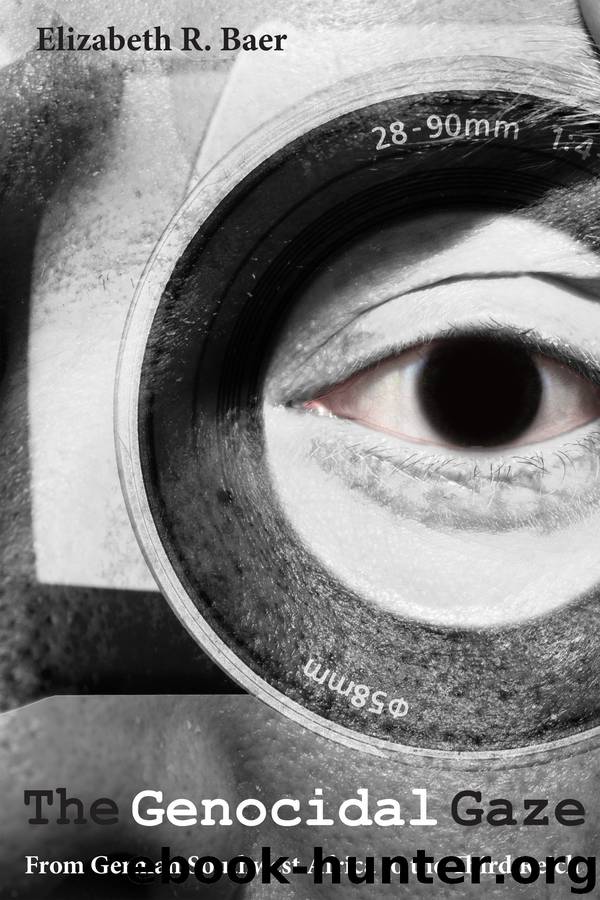
The Genocidal Gaze by Baer Elizabeth R.;
Author:Baer, Elizabeth R.;
Language: eng
Format: epub
Publisher: Wayne State University Press
ANIMAL IMAGERY AS AN ASPECT OF THE GENOCIDAL GAZE
“How can we expect to colonize a land if we don’t take the trouble to understand the natives?” Gottschalk once asked…. “With the aid of an interpreter and a hippo-hide whip,” Lieutenant Schwanebach replied.” (82)
The first forty pages of the novel are rife with German soldiers’ references to the Herero and Nama as animals. Here are a few examples of this dominant trope. When the physician onboard is ordered to examine the “natives” who had boarded in Liberia, Schwanebach jokes, “That’s a task for our two veterinarians…. Everyone laughed” (10). Captain Moll describes the Nama women to Gottschalk as he arrives in Windhoek: “The women are fantastic… completely immoral, total animals, but unfortunately syphilitic” (17). As Gottschalk marches toward Rehoboth, a lieutenant who had been in Africa for six years explains: “The Hottentots were much more dangerous than the Hereros. They let themselves be slaughtered in battle, but had few scruples when it came to prisoners. They stuffed a dead man’s mouth with his own severed genitals. ‘Animals,’ Schwanebach said” (37). To which the lieutenant replies, “It was probably because the German troops had raped and mistreated the Herero women during their advance” (37). Yet another incident with Lt. Schwanebach involves his command to Gottschalk to “make sure the baboon [a Nama man] was dead” (40). Gottschalk at first is tempted to demur by saying he was only a veterinarian. “But he… said nothing, afraid that Schwanebach might reply, exactly, that’s just the point” (40). This pattern of the Schutztruppe not only referring to the Herero and Nama as bestial but actually placing them at the bottom of the racial hierarchy, as less than human, continues throughout the novel. Such language characterizes the imperial gaze and sets up the Schutztruppe for the transition to the genocidal gaze. Viewing other human beings as animals, as unworthy of life, becomes yet another justification of genocide, and another link to the Nazis and their characterization of Jews as subhuman, as parasites.
Schwanebach is often the mouthpiece of the genocidal gaze. Behind his back, he is called Schwinebelly by Gottschalk and others, with the pun carrying heavy irony. Then comes a surreal moment in the novel when Schwanebach reveals himself to be quite “bestial.” Unusual rain has arrived in GSWA and the men run outside naked to bathe. “Schwinebelly was seen naked for the first time. They stared at him in shock. He was incredibly hairy, like a black monkey” (52). A joke begins to make the rounds of the officers’ mess: Schwinebelly’s fourth child went missing at her baptismal ceremony and was found perched on the curtain rod: “There sits the little one, black and hairy as a monkey. And she has prehensile feet” (54). Timm turns the tables on Schwanebach, demonstrating that arraying humans on a racist hierarchy is not only offensive but inaccurate. No distinctions exist between the Germans and the Nama, at least as far as biology is concerned.
When Gottschalk reaches a crucial turning point, acknowledging that he “no longer asked himself if the war was unjust.
Download
This site does not store any files on its server. We only index and link to content provided by other sites. Please contact the content providers to delete copyright contents if any and email us, we'll remove relevant links or contents immediately.
| African | Asian |
| Australian & Oceanian | Canadian |
| Caribbean & Latin American | European |
| Jewish | Middle Eastern |
| Russian | United States |
4 3 2 1: A Novel by Paul Auster(12364)
The handmaid's tale by Margaret Atwood(7750)
Giovanni's Room by James Baldwin(7318)
Asking the Right Questions: A Guide to Critical Thinking by M. Neil Browne & Stuart M. Keeley(5752)
Big Magic: Creative Living Beyond Fear by Elizabeth Gilbert(5749)
Ego Is the Enemy by Ryan Holiday(5412)
The Body: A Guide for Occupants by Bill Bryson(5075)
On Writing A Memoir of the Craft by Stephen King(4925)
Ken Follett - World without end by Ken Follett(4719)
Adulting by Kelly Williams Brown(4564)
Bluets by Maggie Nelson(4542)
Eat That Frog! by Brian Tracy(4518)
Guilty Pleasures by Laurell K Hamilton(4437)
The Poetry of Pablo Neruda by Pablo Neruda(4090)
Alive: The Story of the Andes Survivors by Piers Paul Read(4017)
White Noise - A Novel by Don DeLillo(4000)
Fingerprints of the Gods by Graham Hancock(3985)
The Book of Joy by Dalai Lama(3970)
The Bookshop by Penelope Fitzgerald(3843)
