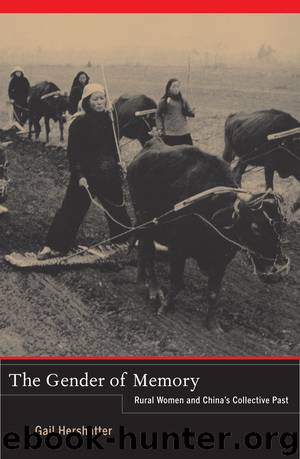
The Gender of Memory by Hershatter Gail;
Author:Hershatter, Gail;
Language: eng
Format: epub
Publisher: University of California Press
Published: 2012-01-23T05:00:00+00:00
WRITING
Labor models were made, not born, and in the paper trail their careers left behind we can discern the process of their creation. From the early years of the People’s Republic, local cadres were instructed to write accounts of labor model achievements in the dry mode of bureaucratic data collection. A 1951 Shaanxi provincial government directive specified that such accounts should first clarify what sort of model the person was: “The basic types can be divided into pest-control model, flood-fighting model, manure accumulation model, intensive cultivation model, disaster relief and famine-fighting model, production model, . . . ordinary model, and other kinds of model mutual aid groups, model villages, and so on.” Second, the writer should include concrete experiences: How much manure had the model applied to the soil? How deep was the plowing? How often were crops rotated, irrigated, fumigated? What was the average output? By how much did it surpass the average output in the area? Third, what was the makeup of the village, its method of organizing labor and keeping accounts, its output, its penchant for production competitions? Fourth, what were the patriotic activities and improvements in political consciousness fostered by the labor models? Finally, the writers were exhorted, “Try your best to be comprehensive, material, and detailed.”72 Material about women labor models, who were being mobilized for tasks that they had not routinely performed before, was a subset of this larger bureaucratically defined genre.73
By 1956, when advanced producers from across Shaanxi Province gathered for a meeting, the documentation of labor model exploits had grown more elaborate, refined, and dramatic. Archival records of the meeting contain stories with a visual specificity missing in the earlier reports, although the virtues of the labor models were similar. Zhang Qiuxiang was praised for her compassion as a village head, helping to obtain relief grain for families who ran out of food in 1953 and feeding her own children beans after the family ran out of grain, rather than taking them to the county seat where her husband was working. She also drew notice for her patient work to convince several other women to join her in hoeing the winter wheat fields, a task that was not yet a part of the village routine. Predictably the result was an outstanding harvest, resulting in the adoption of winter hoeing by the entire village—and an implicit message that drawing women into the fields would increase the intensity of cultivation and improve the results.74
Shan Xiuzhen’s 1956 file described three heroic moments in her work as co-op head. In the first, an upper-middle peasant who wanted to withdraw from the collective in 1955 tried to embarrass her by kneeling to her in public and demanding money the collective owed him. Drawing on her Party education, Xiuzhen defused the situation with gentle words and patient explanations. In the second incident, the collective decided in 1954 to send fifteen laborers into hilly territory to cut green fertilizer for the cotton crop. The men doing the cutting needed
Download
This site does not store any files on its server. We only index and link to content provided by other sites. Please contact the content providers to delete copyright contents if any and email us, we'll remove relevant links or contents immediately.
| Anthropology | Archaeology |
| Philosophy | Politics & Government |
| Social Sciences | Sociology |
| Women's Studies |
Born to Run: by Christopher McDougall(7132)
The Leavers by Lisa Ko(6950)
iGen by Jean M. Twenge(5419)
Sapiens by Yuval Noah Harari(5375)
Spare by Prince Harry The Duke of Sussex(5202)
The Kite Runner by Khaled Hosseini(5188)
Machine Learning at Scale with H2O by Gregory Keys | David Whiting(4317)
Bullshit Jobs by David Graeber(4197)
Never by Ken Follett(3963)
Goodbye Paradise(3813)
Livewired by David Eagleman(3778)
Fairy Tale by Stephen King(3403)
A Dictionary of Sociology by Unknown(3088)
Harry Potter 4 - Harry Potter and The Goblet of Fire by J.K.Rowling(3077)
The Social Psychology of Inequality by Unknown(3039)
Will by Will Smith(2930)
The Club by A.L. Brooks(2928)
0041152001443424520 .pdf by Unknown(2850)
People of the Earth: An Introduction to World Prehistory by Dr. Brian Fagan & Nadia Durrani(2740)
