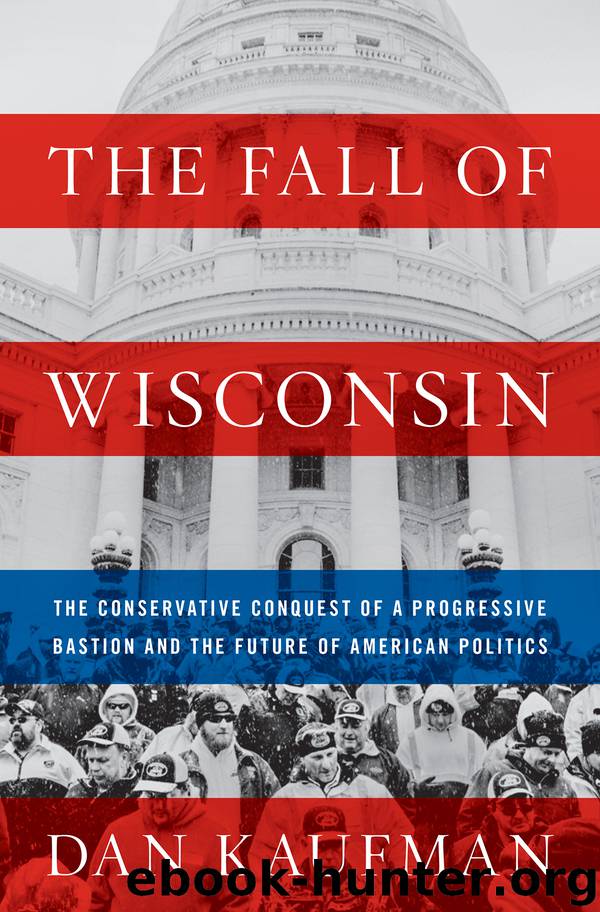
The Fall of Wisconsin by Dan Kaufman
Author:Dan Kaufman
Language: eng
Format: epub
Publisher: W. W. Norton & Company
RANDY BRYCE RESPONDED to Walker’s push for a right-to-work bill characteristically: by organizing. Since Walker’s election in 2010, he had worried about Wisconsin becoming a right-to-work state, and after the 2014 election, his fears intensified. As soon as Fitzgerald raised the idea on talk radio, Bryce began traveling to job sites across southeastern Wisconsin to warn his fellow union members about what he believed was coming. It was an old-fashioned organizing effort, talking to workers one on one, made more difficult by a bitterly cold Wisconsin winter. The men respected Bryce’s passion, even if they didn’t share it, and they would shinny down the skeletal building frames in subzero temperatures to take some of the flyers he’d prepared. Bryce would tell them what right-to-work meant, and that he might ask them to join him at the capitol one day soon.
In February, that day came. Bryce went to the state capitol in Madison to testify against the right-to-work bill Fitzgerald had just introduced. Bryce had finally picked up some work after months of unemployment. He was unloading truckloads of steel beams to build a warehouse near Kenosha, and he needed the job. His son, Ben, was eight years old, his debts were piling up, and a ten-hour shift paid more than $300. But the legislation, which Republicans were rushing through the state senate, angered him enough to sacrifice the hours.
Early that morning, Bryce drove his gray Mustang to the capitol. Dozens of state troopers (who kept their bargaining rights) and capitol police officers (who lost theirs) were now patrolling the rotunda to prevent it from being occupied as it was during the fight over Act 10. The senate hearing room was already packed, so Bryce watched the hearing on monitors outside while he waited for his turn to speak. First came the expert witnesses. James Sherk, an economist at the conservative Heritage Foundation, said that unions operate as cartels: “They try to control the supply of labor in an industry so as to drive up its price, namely wages. But like all cartels, these gains come at the cost of greater losses to the rest of society.” Greg Mourad, a spokesman for the National Right to Work Committee, which has received significant funding from the Koch brothers, compared the experience of being made to pay union dues to being kidnapped and extorted. Gordon Lafer, a political scientist at the University of Oregon, noted that, on the other hand, while right-to-work laws in other states had generated no identifiable economic gains, they did drive down wages for union and non-union workers alike.
Ordinary citizens got their chance to speak in the afternoon. Nearly all of them opposed the bill. A crane operator cited statistics showing that workers in right-to-work states are killed on the job more frequently. “Are you prepared to be accountable for the deaths that being a right-to-work state can create?” he asked. Anthony Anastasi, the president of Iron Workers Local 383, broke down in tears as he pleaded to the legislators, “Please think about the families that will be impacted by this.
Download
This site does not store any files on its server. We only index and link to content provided by other sites. Please contact the content providers to delete copyright contents if any and email us, we'll remove relevant links or contents immediately.
| Anthropology | Archaeology |
| Philosophy | Politics & Government |
| Social Sciences | Sociology |
| Women's Studies |
The Secret History by Donna Tartt(19105)
The Social Justice Warrior Handbook by Lisa De Pasquale(12197)
Thirteen Reasons Why by Jay Asher(8921)
This Is How You Lose Her by Junot Diaz(6894)
Weapons of Math Destruction by Cathy O'Neil(6285)
Zero to One by Peter Thiel(5808)
Beartown by Fredrik Backman(5769)
The Myth of the Strong Leader by Archie Brown(5513)
The Fire Next Time by James Baldwin(5454)
How Democracies Die by Steven Levitsky & Daniel Ziblatt(5225)
Promise Me, Dad by Joe Biden(5157)
Stone's Rules by Roger Stone(5091)
A Higher Loyalty: Truth, Lies, and Leadership by James Comey(4967)
100 Deadly Skills by Clint Emerson(4932)
Rise and Kill First by Ronen Bergman(4797)
Secrecy World by Jake Bernstein(4756)
The David Icke Guide to the Global Conspiracy (and how to end it) by David Icke(4724)
The Farm by Tom Rob Smith(4517)
The Doomsday Machine by Daniel Ellsberg(4493)
