The European Union and the Use of Military Force: Uncovering the Myths by Tommi Koivula
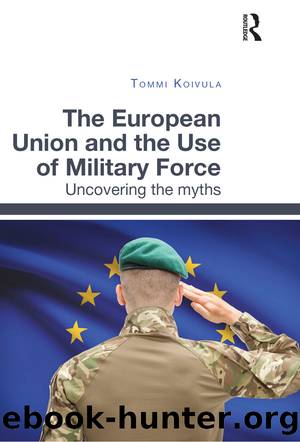
Author:Tommi Koivula [Koivula, Tommi]
Language: eng
Format: epub
Tags: Political Science, General
ISBN: 9781317032946
Google: vQI9DAAAQBAJ
Goodreads: 30423948
Publisher: Routledge
Published: 2016-05-26T00:00:00+00:00
Like many others, these quotations speak volumes of the EU approach to military enforcement after the post-9/11 turn in its security thinking. Military power is seen as something supportive and secondary rather than as a primary tool, as it was in the CSDP.
2009: Lisbon Treaty
The Lisbon Treaty, which entered into force on 1 December 2009, sought among other things to strengthen the foreign policy coherence of EU member states, to develop EU crisis management capabilities and to prepare for various kinds of security threats. Its major provisions included the reinforcement of the institutions and mechanisms of EU foreign policy, such as the double-hatted High Representative, the European External Action Service (EEAS), and Permanent Structural Cooperation (a mutual assistance obligation among member states and a solidarity clause obliging the member states to extensive cooperation should one of them become a victim of a terrorist attack or of a natural or human-made disaster). This was also when the European Security and Defence Policy (ESDP) was renamed the Common Security and Defence Policy (CSDP).
Regarding crisis management operations, the treaty extended the scope and range of the Petersberg tasks adopted by the EU in 1996 to include joint disarmament operations, humanitarian and rescue tasks, military advice and assistance tasks, conflict prevention and peacekeeping tasks, tasks of combat forces in crisis management, including peacemaking and post-conflict stabilisation. All these tasks were to contribute to the fight against terrorism, including supporting third countries in combating terrorism in their territories. This was not an exhaustive list, however, as from the legal point of view, the EU became authorised to launch all types of operations, with the sole exception of those linked to the collective defence of the territory of the member states (Biscop and Coelmont 2012: 50).
Indeed, for our purposes here, the issue of defending a member stateâs territory was the most significant question of the treaty. This issue was stipulated in the Mutual Defence (article 42.7) and Solidarity Clauses (article 222) of the Lisbon Treaty. The former was a curious revocation of the Maastricht Treatyâs indication of common defence â indicating that â[i]f a Member State is the victim of armed aggression on its territory, the other Member States shall have towards it an obligation of aid and assistance by all the means in their power, in accordance with Article 51 of the United Nations Charterâ (article 42.7). While the wording here compared to, say, NATOâs article V was strong, and the obligation of EU member states to assist each other with âall the means in their powerâ did seem to suggest a defence alliance, the article did also uphold the essential role of NATO in the defence of its members and did not specify any concrete measures with which the member states would prepare for mutual assistance in practical terms.
Another article discussing the defence â or protection â of member state sovereign territory was the so-called Solidarity Clause of article 222. According to it:
1âThe Union and its Member States shall act jointly in a spirit
Download
This site does not store any files on its server. We only index and link to content provided by other sites. Please contact the content providers to delete copyright contents if any and email us, we'll remove relevant links or contents immediately.
| Anthropology | Archaeology |
| Philosophy | Politics & Government |
| Social Sciences | Sociology |
| Women's Studies |
The Secret History by Donna Tartt(19058)
The Social Justice Warrior Handbook by Lisa De Pasquale(12187)
Thirteen Reasons Why by Jay Asher(8894)
This Is How You Lose Her by Junot Diaz(6877)
Weapons of Math Destruction by Cathy O'Neil(6267)
Zero to One by Peter Thiel(5789)
Beartown by Fredrik Backman(5737)
The Myth of the Strong Leader by Archie Brown(5500)
The Fire Next Time by James Baldwin(5432)
How Democracies Die by Steven Levitsky & Daniel Ziblatt(5216)
Promise Me, Dad by Joe Biden(5144)
Stone's Rules by Roger Stone(5081)
A Higher Loyalty: Truth, Lies, and Leadership by James Comey(4954)
100 Deadly Skills by Clint Emerson(4921)
Rise and Kill First by Ronen Bergman(4780)
Secrecy World by Jake Bernstein(4742)
The David Icke Guide to the Global Conspiracy (and how to end it) by David Icke(4709)
The Farm by Tom Rob Smith(4502)
The Doomsday Machine by Daniel Ellsberg(4485)
