The End of Democracy? by Douglas E. Schoen
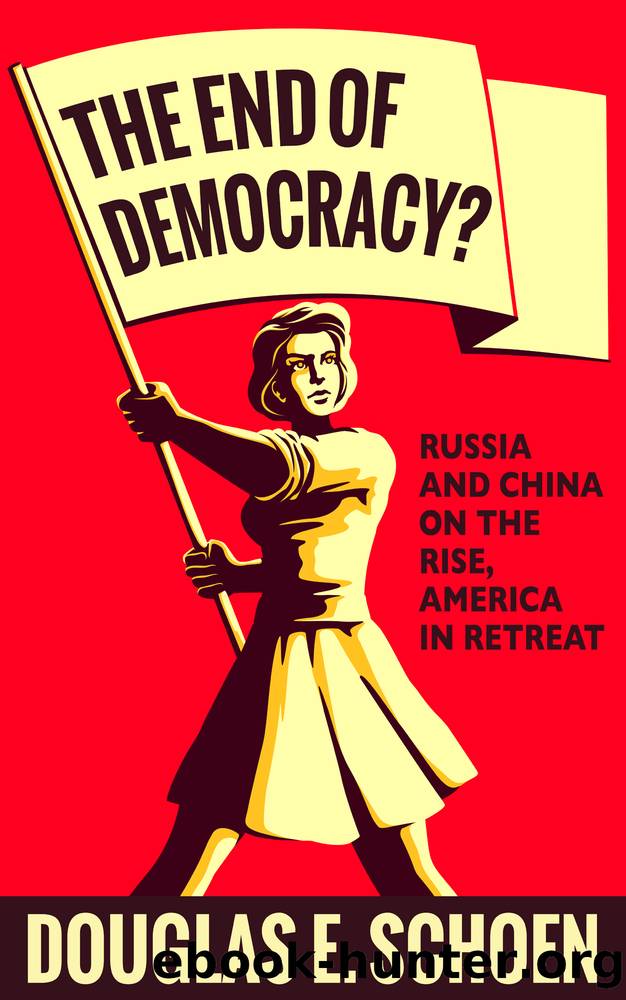
Author:Douglas E. Schoen
Language: eng
Format: epub
Publisher: Regan Arts.
Published: 2020-10-06T00:00:00+00:00
We Need Allies
Clearly, the United States has its work cut out for it in addressing the Russia/China military challenge, a key component of which will involve updating the American military posture, both strategically and materially. In this regard, the U.S.-led NATO training exercises in Eastern Europe, known as Defender 2020, promised to be an event of considerable importance for gauging preparedness and refining strategies. The exercises planned were to be the largest of their kind in 25 years; alas, the Army was forced to postpone them due to the coronavirus. Itâs not likely that they would be rescheduled before 2021.107
In chapter 9, Iâll offer some broad thoughts on the military posture of the United States as regards the challenge from Moscow and Beijing, but here let me offer a different closing thought: to confront successfully the hostile powers in Beijing and Moscow, the United States must strengthen partnerships with its allies. Unfortunately, Donald Trump has presided over a deterioration of these relationships on a scale that I donât find comparable to any postwar American administration. The positions he has taken on issues of geostrategic importance have often been at odds with our alliesâ understanding of these situations. He infamously mocked NATO as âobsolete,â a statement that reverberated around the world, troubling millions in Europe and making many wonder whether Trump truly understood the significance of NATO in the postwar world. Trumpâs evident contempt for the alliance system and the requirements it imposes on the United States has been evident from his first day in office, as his withdrawal from a series of arms control treaties has made clearâdecisions that make our allies more vulnerable.
Trumpâs withdrawal from the Open Skies Treaty in 2020 is a good example. Open Skies permits dozens of countries to conduct unarmed surveillance of one another, with the goal of improving transparency and lessening the chances of open military conflict. The administration cited Russiaâs violationsâMoscow has not been permitting flights over areas where military exercises take placeâin announcing its decision to leave the treaty. But Americaâs allies, including France, Germany, and Poland, did not feel that the Russian violations rose to the level of seriousness that would warrant this action, and I concur with that judgment. It is yet another move by the Trump administration that weakens our alliances at a time when we need to be strengthening them. The most effective way for the United States to counter Russian aggression is close partnership with our European allies. Leaving the Open Skies agreement only sows more division between America and Europeâprecisely the result that Putin seeks.
Trumpâs departure from Open Skies is just another exhibit of his scattered foreign policy, one in which America seems to lack overarching commitments to its partners, whether in Europe or elsewhere, but is rather guided by the erratic impulses and inconsistent decision-making priorities of the president. Faced with a mounting challenge from an adversarial axis, the United States needs not just a well-considered military response and strategic vision: it needs much better leadership.
Download
This site does not store any files on its server. We only index and link to content provided by other sites. Please contact the content providers to delete copyright contents if any and email us, we'll remove relevant links or contents immediately.
| Anthropology | Archaeology |
| Philosophy | Politics & Government |
| Social Sciences | Sociology |
| Women's Studies |
The Secret History by Donna Tartt(19475)
The Social Justice Warrior Handbook by Lisa De Pasquale(12296)
Thirteen Reasons Why by Jay Asher(9126)
This Is How You Lose Her by Junot Diaz(7058)
Weapons of Math Destruction by Cathy O'Neil(6470)
Zero to One by Peter Thiel(5953)
Beartown by Fredrik Backman(5946)
The Myth of the Strong Leader by Archie Brown(5630)
The Fire Next Time by James Baldwin(5592)
How Democracies Die by Steven Levitsky & Daniel Ziblatt(5333)
Promise Me, Dad by Joe Biden(5230)
Stone's Rules by Roger Stone(5195)
A Higher Loyalty: Truth, Lies, and Leadership by James Comey(5091)
100 Deadly Skills by Clint Emerson(5026)
Rise and Kill First by Ronen Bergman(4906)
Secrecy World by Jake Bernstein(4890)
The David Icke Guide to the Global Conspiracy (and how to end it) by David Icke(4854)
The Doomsday Machine by Daniel Ellsberg(4627)
The Farm by Tom Rob Smith(4614)
