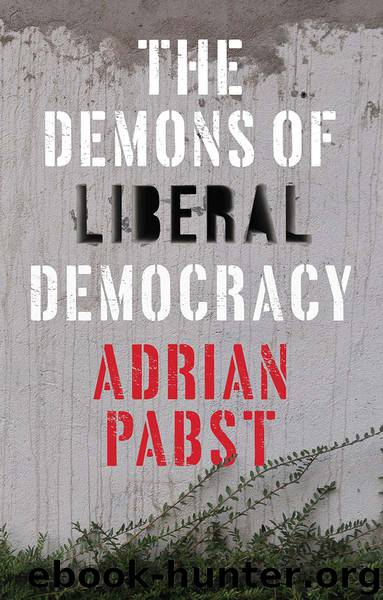
The Demons of Liberal Democracy by Adrian Pabst;
Author:Adrian Pabst;
Language: eng
Format: epub
ISBN: 9781509528486
Publisher: John Wiley & Sons, Inc.
Published: 2019-04-09T00:00:00+00:00
4 Social media manipulation
One key thing that has changed compared with earlier eras is how the internet and social media have transformed information, knowledge and public debate, with new communications and political technologies giving deception and demagogy added potency because the absence of gatekeepers eliminates accuracy, accountability and the differential status between lies and truth. As James Ball has shown, the economics of the web is undermining investigative journalism and accurate reporting in favour of sensationalism, hyperbole and hysteria.20 Once more, it is the oligarchy in charge of online information and social media that drives democracy’s descent into demagogy.
Even worse for democracy than the concentration of corporate control are the nature and level of social control exercised by the tech giants, notably social media. Facebook’s platform, with its 2 billion users, instead of binding people together and creating a global community, reinforces cultural tribalism and political polarisation by encouraging users to link up with others who agree with them. The combination of filter bubbles with echo chambers fragments the public sphere and undermines the bonds of citizenship and common culture. In turn, a more fragmented polity is further divided by manipulated opinion masquerading as official facts or ‘alternative facts’ – whether in the mainstream media or in the insurgent media. Politics has always been ideological and partisan, but now it is being privatised, and debate increasingly takes place in silos where deception and demagogy cannot be challenged so effectively.
The tech giants manipulate the public in other ways too. One way is by stripping content providers of their creation and thereby eliminating competition from alternative mechanisms of provision, which has squeezed the creative and media industries and thereby undermines the diversity of both products and services because it shuts down innovation and new human creativity. For example, the music industry has gone from being worth US$20 billion in 1999 to US$7 billion in 2014, depriving many musicians of their income and giving de facto control to YouTube, where music is available essentially for free.21 This goes against plurality and a balance of interests that are vital for democracy. The same applies to the tendency of internet corporations and chain stores to turn consumers into co-workers and exploit their free labour. As Jonathan Taplin reports, people on Facebook spent a combined 39,757 years on the site every day of 2014, when it had 1.2 billion users, producing content that is monetised by the corporation based on ‘almost fifteen million years of free labour per year’.22 This adds to the extraction of economic rent and further reinforces corporate control over people. The mechanism of controlling citizens as consumers and as users of social media is through the capture and sale of attention23 – an influence over people’s time and minds that far exceeds the power of government.
Indeed, tech platforms such as Facebook and Google are giant advertising companies that operate simultaneously like a media conglomerate and a political machine. In 2017, Facebook’s annual advertising revenue was US$40 billion and Google’s US$95 billion, while ad revenue for newspapers in the USA has fallen to under US$20 billion.
Download
This site does not store any files on its server. We only index and link to content provided by other sites. Please contact the content providers to delete copyright contents if any and email us, we'll remove relevant links or contents immediately.
| Anarchism | Communism & Socialism |
| Conservatism & Liberalism | Democracy |
| Fascism | Libertarianism |
| Nationalism | Radicalism |
| Utopian |
The Secret History by Donna Tartt(19103)
The Social Justice Warrior Handbook by Lisa De Pasquale(12197)
Thirteen Reasons Why by Jay Asher(8919)
This Is How You Lose Her by Junot Diaz(6894)
Weapons of Math Destruction by Cathy O'Neil(6284)
Zero to One by Peter Thiel(5808)
Beartown by Fredrik Backman(5768)
The Myth of the Strong Leader by Archie Brown(5513)
The Fire Next Time by James Baldwin(5454)
How Democracies Die by Steven Levitsky & Daniel Ziblatt(5225)
Promise Me, Dad by Joe Biden(5157)
Stone's Rules by Roger Stone(5091)
A Higher Loyalty: Truth, Lies, and Leadership by James Comey(4967)
100 Deadly Skills by Clint Emerson(4932)
Rise and Kill First by Ronen Bergman(4797)
Secrecy World by Jake Bernstein(4756)
The David Icke Guide to the Global Conspiracy (and how to end it) by David Icke(4723)
The Farm by Tom Rob Smith(4517)
The Doomsday Machine by Daniel Ellsberg(4493)
