The Definitions of Value (The Economic Definitions, #2) by Hest Kirian "Deso" van
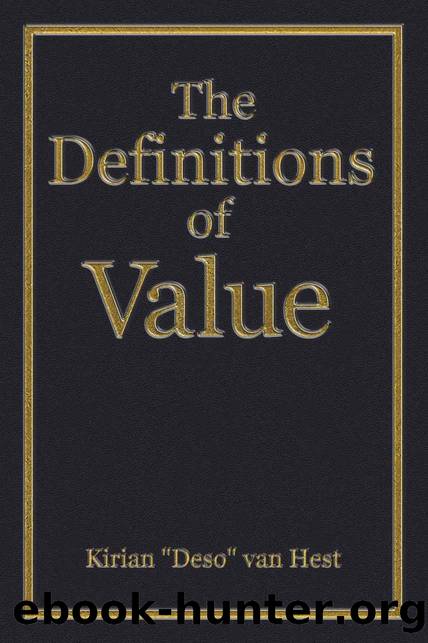
Author:Hest, Kirian "Deso" van
Language: eng
Format: epub
Tags: Economics, Value, Cryptocurrency, Behavior, Money
Publisher: Kirian "Deso" van Hest
Published: 2021-08-01T00:00:00+00:00
Chapter 6: Energy and Value Transference
Energy is one of the most important things in our society. Ever since we invented machine labor, the availability of cheap energy has become the number one reason why economies have been able to expand so drastically compared to anything that came before in history. First with steam power, then with the hydrocarbon economy, and soon with the fully electrified economy; Energy is at the basis of it all.
However, when you talk value, energy is a poor backing of value, and even harder to measure the value of. This goes to the fundamental nature of energy:
"Energy" doesn't exist. Much like money, it's an abstract term, this one invented to group anything that is capable of inducing kinetic motion. Afterall, a lump of coal and uranium are both considered part of the "energy" grouping, but are vastly different resources requiring different approaches and amount of effort to produce. Yet, "One Kilojoule of energy" can be extracted from both. This makes energy fungible, while the sources of energy most certainly are not.
And this is the reason why energy of itself has no value, but is included within "Utility value". Or in short:
Energy's purpose is to be consumed in productive venture.
As such, its part of the utility value of said productive venture. Or to put it another way, whenever you use an object for it's utility value, the energy consumption is taken into account as to the usefulness of that object when deciding the value of using the object; but it is not what determines the use, and thus value of the object itself.
For example, take a waterheater. Letâs say it consumed 1200 watts of electricity for 2 minutes to heat up a cup of water you want to heat up. No one ever thinks or considers the amount of power being used every time they make a cup of water. It's not the electricity's purpose to heat up the water, it is the water heater's purpose to heat up the water, and it consumes electricity to do so.
The reason for this disconnect is because we can use electricity for a lot of things, not just to heat up water. We value electricity and the availability of electricity, but we do not value electricity consumption per unit. We merely consume what we consume over a given period and pay the bill at the end of the month. Naturally, electricity needs to be generated, but we value the things that generate electricity, not the electricity they generate specifically.
Put differently, we've never valued a lump of coal for the electricity that lump of coal generated more or less than other lumps of coal. Current = Current, as far as we're concerned. Sure, there are things like emissions, but in practice that's for a few people at the plant to worry about, not the majority of humanity everywhere. Those emissions are taken into account when thinking about the utility value of the powerplant, not so much when talking the utility value of the electricity they generate.
Download
This site does not store any files on its server. We only index and link to content provided by other sites. Please contact the content providers to delete copyright contents if any and email us, we'll remove relevant links or contents immediately.
The Brazilian Economy since the Great Financial Crisis of 20072008 by Philip Arestis Carolina Troncoso Baltar & Daniela Magalhães Prates(333995)
International Integration of the Brazilian Economy by Elias C. Grivoyannis(111468)
The Art of Coaching by Elena Aguilar(53500)
Flexible Working by Dale Gemma;(23331)
How to Stop Living Paycheck to Paycheck by Avery Breyer(19799)
Thinking, Fast and Slow by Kahneman Daniel(12464)
The Acquirer's Multiple: How the Billionaire Contrarians of Deep Value Beat the Market by Tobias Carlisle(12397)
The Radium Girls by Kate Moore(12125)
The Art of Thinking Clearly by Rolf Dobelli(10650)
Hit Refresh by Satya Nadella(9216)
The Compound Effect by Darren Hardy(9100)
Tools of Titans by Timothy Ferriss(8531)
Atomic Habits: Tiny Changes, Remarkable Results by James Clear(8459)
Turbulence by E. J. Noyes(8152)
A Court of Wings and Ruin by Sarah J. Maas(8007)
Change Your Questions, Change Your Life by Marilee Adams(7883)
Nudge - Improving Decisions about Health, Wealth, and Happiness by Thaler Sunstein(7793)
How to Be a Bawse: A Guide to Conquering Life by Lilly Singh(7573)
Win Bigly by Scott Adams(7295)
