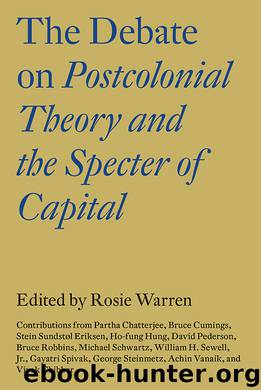
The Debate on Postcolonial Theory and the Specter of Capital by Rosie Warren
Author:Rosie Warren
Language: eng
Format: epub
Publisher: Verso Books
This precise targeting of a key dynamic in the colonial world—the importation of capital accumulation into peasant society and the class differentiation that follows—allows Chibber to demonstrate that rural conflicts were not “conservative” efforts built on the (already fractured) communal solidarity, but rather expressions of the growing class divisions created by the capitalist invasions.
But, at the same time, Chibber rushes past a crucial point which I think emanates from this insight. As he states in other contexts, the old communalism was not obliterated—but instead transmuted—during this process. Such pre-capitalist formations do not disappear; they adapt into the capitalist structure, creating a kind of mutual evolution in which the outcome structure will be unique in each country, and quite different between and within regions.5 For many pre-capitalist formations, this adaptation has little consequence for the outcome dynamics, but surely this communalism—and the shape of its altered role in the capitalized structure—is a causal vector in the resulting class dynamics. Put simply: what becomes of the communalistic ethos that Subaltern Studies valorizes? It arrives in the new formation in a variety of forms, and Chibber (and those of us who take up his argument) must offer an understanding of the dynamics that determine the outcome formation. Even more important is to codify and understand the varying structural trajectories characterizing the various outcome formations.
I want to offer one avenue of analysis regarding the afterlife of communalism in postcolonial society. From Chibber’s argument, we see one regularity that occurs wherever rural capital accumulation is set in motion: the creation of self-aggrandizing rich peasants who have abandoned (much of) the communalistic ethos. But what of the poor (and soon becoming landless) peasants? It seems to me that there is considerable work to be done to understand the circumstances under which they abandon the communalistic ethos and organize against the rich peasants, and those circumstances when they continue to embrace communalism and ally themselves with the jotedars (despite their growing contradictions of interest). I am particularly taken by the contrast between, say, Vietnam and China, which sustained insurrections of peasants against the rural elites, and the American South, where Southern tenants most often joined movements led by the same rural elites who had taken their land and/or exploited their labor. For me, we are sorely in need of an analysis that will allow us to understand what sorts of absorption processes—and related dynamics—yield one or another of these modalities. In India, it would appear that both modalities have developed in different regions and different times, and careful scrutiny using Chibber’s analytic tools could well unravel this critical dynamic.
The various strands in Chibber’s argument are woven together, and much is lost when we disentangle them. But we need to do so anyway, because leaving them undifferentiated conceals some of the most promising yet unexplored insights. Consider, for example, Chibber’s treatment of what he calls “the real engine of democratization.”6 Here he begins with the Subaltern Studies assertion that parliamentary democracy (including its essential accoutrements, such as free
Download
This site does not store any files on its server. We only index and link to content provided by other sites. Please contact the content providers to delete copyright contents if any and email us, we'll remove relevant links or contents immediately.
| Anthropology | Archaeology |
| Philosophy | Politics & Government |
| Social Sciences | Sociology |
| Women's Studies |
The Secret History by Donna Tartt(19387)
The Social Justice Warrior Handbook by Lisa De Pasquale(12267)
Thirteen Reasons Why by Jay Asher(9059)
This Is How You Lose Her by Junot Diaz(7008)
Weapons of Math Destruction by Cathy O'Neil(6419)
Zero to One by Peter Thiel(5901)
Beartown by Fredrik Backman(5880)
The Myth of the Strong Leader by Archie Brown(5591)
The Fire Next Time by James Baldwin(5545)
How Democracies Die by Steven Levitsky & Daniel Ziblatt(5299)
Promise Me, Dad by Joe Biden(5208)
Stone's Rules by Roger Stone(5162)
A Higher Loyalty: Truth, Lies, and Leadership by James Comey(5049)
100 Deadly Skills by Clint Emerson(4995)
Rise and Kill First by Ronen Bergman(4864)
Secrecy World by Jake Bernstein(4826)
The David Icke Guide to the Global Conspiracy (and how to end it) by David Icke(4805)
The Doomsday Machine by Daniel Ellsberg(4585)
The Farm by Tom Rob Smith(4574)
