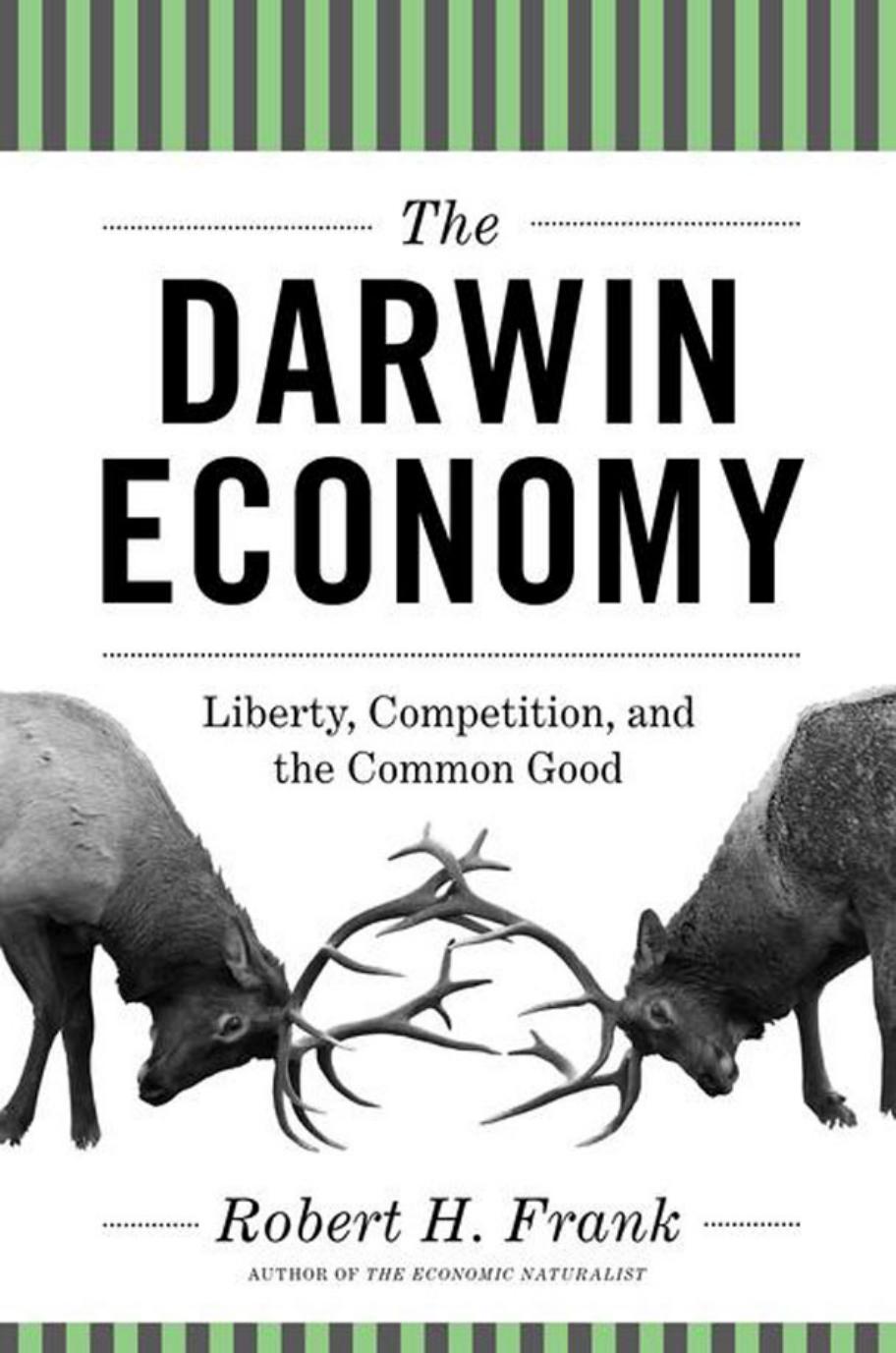
The Darwin Economy: Liberty, Competition, and the Common Good by Robert H. Frank
Author:Robert H. Frank
Language: eng
Format: mobi, pdf
Publisher: Princeton University Press
Published: 2012-09-15T14:00:00+00:00
NINE
Success and Luck
PEOPLE OFTEN SPEAK ABOUT THE EMOTIONAL BRAIN and the rational brain as if there really were two independent people housed within us—one driven by reason, the other by emotion. But neuroscientists stress that the brain's emotional circuits and cognitive circuits are richly interdependent.1
In exceptional circumstances, strong emotional reactions can occur even in the absence of significant cognitive processing. This happens, for example, at the sight of a snake-like object, which can provoke fear before the image even reaches the cognitive circuits of the brain.2 More generally, however, our emotional reactions to events depend critically on how we frame and interpret them cognitively.
To know whether someone's behavior constitutes a violation that merits an angry response, for example, we must first know a lot about the context in which the behavior occurred and the rules that apply in that context. In familiar settings, our emotional reactions to events are generally well calibrated. But misdirected emotional reactions are not uncommon, especially when we find ourselves in unfamiliar cultural settings.
A vivid case in point occurred during the sabbatical year my family and I spent in Paris. My youngest son, Hayden, was a fifth-grader in a French school in the city that year. One afternoon, he came home in a state of high indignation. He explained that he'd been given an avertissement—a school disciplinary notice—for something he hadn't done. The charge against him had been filed by a playground supervisor who said that a student had shouted an obscenity at him. The supervisor was unable to identify the specific offender, so he filed charges against all the children who were playing nearby, a group that included Hayden.
Insisting that he'd never said a word to the supervisor, Hayden wanted us to demand a hearing to set the record straight. I asked some friends for advice and was told that there was virtually no chance the school would conduct an investigation. I also learned, however, that there was no consequence from receiving an avertissement unless a student had already accumulated three previous ones during the same school year.
I explained to Hayden that the French system of school justice seemed to be a little different from the one we were used to at home. Rather than invest a lot of time and effort to uncover the specific facts surrounding every potential infraction, the French had adopted an alternative approach that produced roughly similar results. I explained that even a full-blown investigation might reach an erroneous conclusion, and that although the odds of making a mistake were obviously higher in the absence of an investigation, it was still very likely that a student who had managed to accumulate four avertissements in a single school year would be guilty in at least one instance. What struck me at the time was how quickly my son's sense of outrage evaporated when he considered this alternative way of thinking about the problem.
The cognitive frames within which we view taxes have similarly powerful effects on our emotional reactions to them. If
Download
The Darwin Economy: Liberty, Competition, and the Common Good by Robert H. Frank.pdf
This site does not store any files on its server. We only index and link to content provided by other sites. Please contact the content providers to delete copyright contents if any and email us, we'll remove relevant links or contents immediately.
| Anthropology | Archaeology |
| Philosophy | Politics & Government |
| Social Sciences | Sociology |
| Women's Studies |
The Secret History by Donna Tartt(19052)
The Social Justice Warrior Handbook by Lisa De Pasquale(12187)
Thirteen Reasons Why by Jay Asher(8893)
This Is How You Lose Her by Junot Diaz(6877)
Weapons of Math Destruction by Cathy O'Neil(6264)
Zero to One by Peter Thiel(5786)
Beartown by Fredrik Backman(5737)
The Myth of the Strong Leader by Archie Brown(5499)
The Fire Next Time by James Baldwin(5431)
How Democracies Die by Steven Levitsky & Daniel Ziblatt(5215)
Promise Me, Dad by Joe Biden(5141)
Stone's Rules by Roger Stone(5081)
A Higher Loyalty: Truth, Lies, and Leadership by James Comey(4954)
100 Deadly Skills by Clint Emerson(4921)
Rise and Kill First by Ronen Bergman(4779)
Secrecy World by Jake Bernstein(4741)
The David Icke Guide to the Global Conspiracy (and how to end it) by David Icke(4706)
The Farm by Tom Rob Smith(4502)
The Doomsday Machine by Daniel Ellsberg(4484)
