The Chastening by Paul Blustein
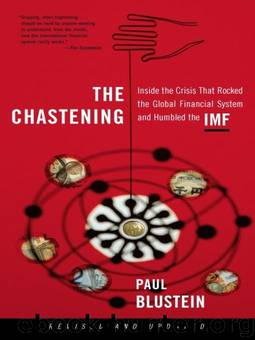
Author:Paul Blustein [Blustein, Paul]
Language: eng
Format: epub
Publisher: PublicAffairs
Published: 2011-02-15T05:00:00+00:00
Steve Hanke was in Istanbul, Turkey, delivering economics lectures at Bogazici University in late January 1998 when a fax arrived requesting that he fly to Jakarta. The fax came “from Suharto’s people,” he said, offering no further elaboration.
A few days later, Hanke, a professor of applied economics at Johns Hopkins University, was in Indonesia for the first time in his life, staying with his wife Liliane at the Shangri-La Hotel under the name “Simon Holland.” Most evenings, he went to Suharto’s home, where the fifty-five-year-old Hanke entranced the aging president with a plan for saving Indonesia’s economy. Word spread swiftly that Suharto had a new dukun, or medicine man, and the pair indeed seemed to be hitting it off. “See, Professor?” the Indonesian strongman chortled one evening, waving a copy of The Asian Wall Street Journal, which carried pictures of both men on the front page. “You’re a crony now.”
Hanke brimmed with the resentment of a man long treated as a bit of a crank by many of his professional colleagues. A pipe smoker who sported silk ascots and kept half-moon glasses perched on his nose, he had a penchant for hyperbole, exacerbated by his frequent abuse of the word “literally.” In conversations, he sometimes fumed that unless Indonesia adopted the policies he favored, the country was “literally going to blow up” or “literally going to go down the tubes”—conjuring up, albeit unintentionally, images such as a mass eruption among the archipelago’s many volcanoes.
The policy Hanke championed was a currency board, a monetary system that is analogous to putting an economy—or at least its money supply—on autopilot. A nation that adopts a currency board rigidly pegs its currency to another major currency, usually the U.S. dollar—and the operative word is “rigidly,” because a currency board affords no wiggle room, unlike the more flexible systems that linked the Thai baht and Indonesian rupiah to the dollar prior to their crises. For example, when Argentina established a currency board in 1991, the value of the peso was set at $1 per peso, and if anyone wanted to trade in pesos, the central bank was bound by law to hand over an equal amount of dollars. Further, it was required to back the supply of pesos in circulation with dollars held in its reserves, so the peso supply could increase only if reserves increased. In adopting a currency board, a government essentially admits that it has lost all credibility with financial markets, so to restore faith in its currency, it hands over its monetary controls to a credibility-laden foreigner (in Argentina’s case, Alan Greenspan, the man in charge of the world’s supply of dollars).
One huge downside—and the main reason few economists share Hanke’s ardor—is that the central bank completely surrenders its power to respond to booms and busts. Even when the economy slumps and Joblessness soars, the monetary authorities can’t pump up the money supply and drive down interest rates if doing so would violate the rules of the currency board.
In Hanke’s view, such drawbacks amounted to nothing more than minor nuisances.
Download
This site does not store any files on its server. We only index and link to content provided by other sites. Please contact the content providers to delete copyright contents if any and email us, we'll remove relevant links or contents immediately.
The Brazilian Economy since the Great Financial Crisis of 20072008 by Philip Arestis Carolina Troncoso Baltar & Daniela Magalhães Prates(371377)
International Integration of the Brazilian Economy by Elias C. Grivoyannis(111664)
The Art of Coaching by Elena Aguilar(53729)
Flexible Working by Dale Gemma;(23366)
How to Stop Living Paycheck to Paycheck by Avery Breyer(19842)
Thinking, Fast and Slow by Kahneman Daniel(12562)
The Acquirer's Multiple: How the Billionaire Contrarians of Deep Value Beat the Market by Tobias Carlisle(12441)
The Radium Girls by Kate Moore(12217)
The Art of Thinking Clearly by Rolf Dobelli(10743)
Hit Refresh by Satya Nadella(9270)
The Compound Effect by Darren Hardy(9177)
Tools of Titans by Timothy Ferriss(8626)
Atomic Habits: Tiny Changes, Remarkable Results by James Clear(8538)
Turbulence by E. J. Noyes(8237)
A Court of Wings and Ruin by Sarah J. Maas(8143)
Change Your Questions, Change Your Life by Marilee Adams(7949)
Nudge - Improving Decisions about Health, Wealth, and Happiness by Thaler Sunstein(7874)
How to Be a Bawse: A Guide to Conquering Life by Lilly Singh(7655)
Win Bigly by Scott Adams(7360)
