The Calamity Form by Anahid Nersessian;
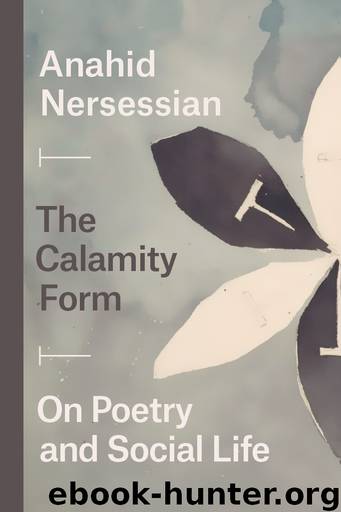
Author:Anahid Nersessian;
Language: eng
Format: epub
Tags: LIT000000 Literary Criticism / General
Publisher: University of Chicago Press
Published: 2020-08-11T16:00:00+00:00
Love! thou art leading me from wintry cold,
Lady! thou leadest me to summer clime,
And I must taste the blossoms that unfold
In its ripe warmth this gracious morning time
So said, his erewhile timid lips grew bold,
And poesied with hers in dewy rhyme:
Great bliss was with them, and great happiness
Grew, like a lusty flower in June’s caress. (I, 65–72)
So Lorenzo and Isabella kiss—but when, or where? The best we have is that highly artificial metaphor catching lips in the swing of mutual versification, poesy-ing in rhyme. Thereafter tumbles forth a quartet of words that do, in fact, either rhyme or chime with the word that says what Keats will not: “bliss,” “happiness,” “lusty,” “caress,” these last two pointing us upward even to “leadest,” “gracious,” “lips,” “taste,” and “blossom.” “Blossom” is especially striking because it is to a blossom that Lorenzo compares Isabella’s lips, so that “taste the blossoms” makes a statement nearly identical to “poes[y] . . . in dewy rhyme.” It is even more striking because the first syllable of “blossom” is so close to “bliss,” the only word here that rhymes faithfully with the occluded “kiss.” In sum, this emphatically catachrestic stanza, with its jarring, even mawkish comparisons of lips to flowers and kissing to rhyming, has also hidden the kiss—put it out of place—somewhere between “blossom” and “bliss.” It’s an ambush, a sonic displacement that realizes Keats’s famous maxim that heard melodies are sweet but those unheard are sweeter, if by “unheard” we understand caught in the act of their withdrawal, accessible only through attention to the same dampened sounds that make those melodies almost inaudible.
This is far from the only poem in which Keats gets some of his words to stand shushingly in place for others. Not two years later, the temple of the mind erected at the end of “Ode to Psyche” all but evaporates “in the midst of this wide quietness,” “dress[ed]/With the wreath’d trellis of a working brain” (“P,” 58–60). This more supple application of the same technique doesn’t take a conspicuous word like fane or sanctuary and melt it into rhyme’s surround but instead conjures the object—Psyche’s temple—only to expose it to a series of gentle abrasions. “Psyche” is a progress poem, but the prosodic movement of Isabella is declerative, using the hum of words lazily or sluggishly heard to bind its horticultural economy to its erotic one, its blossoms and basil to its blisses and kisses. Given the economic context Keats insists on assigning to the poem, this studied slowness and faintness implies or at least aspires to a circumvention of industrial time, while the retreat of single words into shared phonemes ducks away from the onomatopoetic shrieks of those lines on the brothers’ enterprise. Gone silent are the swelting and torching and stinging, the barking, seething, pinching, and peeling, muzzled by a louder peace, or the dream of one.
The body that loses itself through catachresis, that becomes unfixed from its ontological parameters, is the historical body, belonging to an age and hurting in it.
Download
This site does not store any files on its server. We only index and link to content provided by other sites. Please contact the content providers to delete copyright contents if any and email us, we'll remove relevant links or contents immediately.
The Fine Print (Dreamland Billionaires Book 1) by Lauren Asher(2548)
Fury of Magnus by Graham McNeill(2438)
The Last House on Needless Street by Catriona Ward(2382)
The Rose Code by Kate Quinn(2192)
A Little Life: A Novel by Hanya Yanagihara(2102)
Malibu Rising by Taylor Jenkins Reid(1902)
The God of the Woods by Liz Moore(1896)
Luster by Raven Leilani(1894)
Transcendent Kingdom by Yaa Gyasi(1851)
Moonflower Murders by Anthony Horowitz(1842)
The Lost Book of the White (The Eldest Curses) by Cassandra Clare & Wesley Chu(1683)
This Changes Everything by Unknown(1499)
The Midwife Murders by James Patterson & Richard Dilallo(1476)
The New Wilderness by Diane Cook(1438)
The Lying Life of Adults by Elena Ferrante(1425)
Wandering in Strange Lands by Morgan Jerkins(1408)
Written in the Stars by Alexandria Bellefleur(1391)
Ambition and Desire: The Dangerous Life of Josephine Bonaparte by Kate Williams(1380)
The Lying Life of Adults by Elena Ferrante;(1303)
