The Bourgeois Interior by Brown Julia Prewitt;
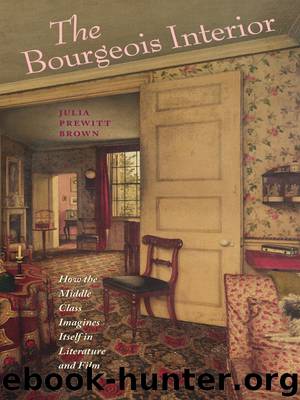
Author:Brown, Julia Prewitt;
Language: eng
Format: epub
Publisher: University of Virginia Press
Published: 2012-03-02T16:00:00+00:00
Virginia Woolf and the Passing of Victorian Domesticity
The fate of Poynton in James’s story suggests the imperiled state of the Victorian home. It is almost as if Poynton were “unable to survive the passage to Modernity,”1 so rooted is it in what James called the “Old Things” of the past. Howards End, in E. M. Forster’s novel by that name, also has difficulty making the transition to modernity and does so only after sacrificing its bourgeois character. At the end of Howards End (1910) an unconventional family—an illegitimate child its heir—has replaced the traditional family that once occupied the domestic interior. In To the Lighthouse, published seventeen years after Howards End, a house deteriorates with the death of the Victorian mother, and the world is reimagined by an unmarried woman artist who lives in rooms “off the Brompton Road” that we never see.2
After World War I, the bourgeois home as mythological configuration came to an end. While the bourgeois class continued in full force, the domestic interior was reconceived by the antibourgeois energies of Bloomsbury, as recent work on the Omega workshops, the design collective active between 1913 and 1919, has shown.3 The domestic interior now becomes the explicit imaginative space, or space for experimentation in living, that earlier novelists had shown us it always implicitly was. As the art historian Christopher Reed suggests, Bloomsbury painters and writers attempted to create domestic environments suitable to their aspirations for new and unconventional ways of life.4
In the domain of architecture, Le Corbusier launched another sort of attack on the Victorian interior. First appearing in the 1920s, Le Corbusier’s writings articulate the modernist antagonism to the conventional function of the Victorian home as a private refuge. With their lightness, airiness, and continuity of inner and outer space, his buildings defied the monumentality of the Victorian home and its protectively enclosed interior.5 If the Corbusian metaphor for the house is industrial, a “machine for living in,” the Victorian metaphor for the home is organic. “The traces of its inhabitants are molded into the interior,” writes Benjamin.6 The Victorian interior wears the physiognomy of its occupants, especially its female occupants.
As we have seen, domestic space was not always the provenance of the woman. Robinson Crusoe is identified with his well-stocked cave, Darcy with the tasteful furnishings of Pemberley, but in the process of industrialization the husband’s labor was removed from the home and the specifically feminine domesticity of the Victorians arose.7 As industrial management came to dominate the work life of middle- and upper-class men, “so the family, and by extension the house, expanded in tandem to act as an emotional counterweight.” The home became “the source of refuge and retreat but also strength and renewal,”8 its regenerative emotional energies arising from what Coventry Patmore called “the angel in the house.” In his best-selling work by that name, Patmore describes the domestic angel as the “aim” and the “epitome” of womanhood, a figure who typifies the entire gender.9 The publication of The Angel in the
Download
This site does not store any files on its server. We only index and link to content provided by other sites. Please contact the content providers to delete copyright contents if any and email us, we'll remove relevant links or contents immediately.
| African | Asian |
| Australian & Oceanian | Canadian |
| Caribbean & Latin American | European |
| Jewish | Middle Eastern |
| Russian | United States |
4 3 2 1: A Novel by Paul Auster(12359)
The handmaid's tale by Margaret Atwood(7737)
Giovanni's Room by James Baldwin(7308)
Asking the Right Questions: A Guide to Critical Thinking by M. Neil Browne & Stuart M. Keeley(5745)
Big Magic: Creative Living Beyond Fear by Elizabeth Gilbert(5731)
Ego Is the Enemy by Ryan Holiday(5400)
The Body: A Guide for Occupants by Bill Bryson(5067)
On Writing A Memoir of the Craft by Stephen King(4923)
Ken Follett - World without end by Ken Follett(4712)
Adulting by Kelly Williams Brown(4557)
Bluets by Maggie Nelson(4539)
Eat That Frog! by Brian Tracy(4505)
Guilty Pleasures by Laurell K Hamilton(4430)
The Poetry of Pablo Neruda by Pablo Neruda(4084)
Alive: The Story of the Andes Survivors by Piers Paul Read(4013)
White Noise - A Novel by Don DeLillo(3998)
Fingerprints of the Gods by Graham Hancock(3981)
The Book of Joy by Dalai Lama(3964)
The Bookshop by Penelope Fitzgerald(3831)
