The Austro-Marxists 1890--1918 by Mark E. Blum;
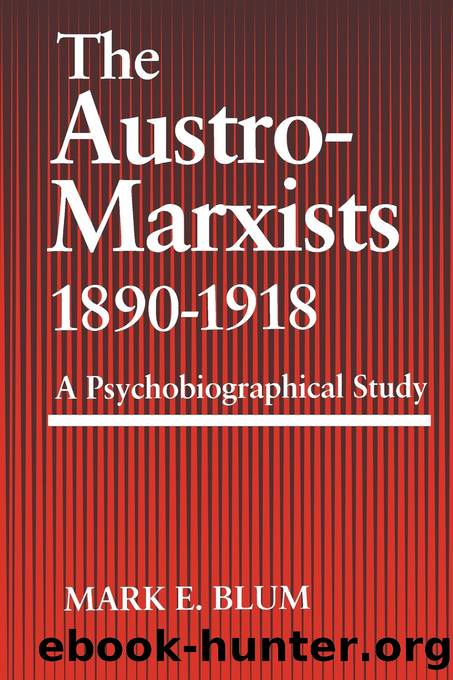
Author:Mark E. Blum; [Mark E. Blum]
Language: eng
Format: epub
ISBN: 9780813185859
Publisher: UP of Kentucky
Published: 2021-09-15T00:00:00+00:00
Marxâs notion of alienation would also classify as a schematism for he develops it within his writings as both a social-psychological consequence of human transactions and an ontological condition of human creativity.35 The schematism provides a logical form of human operation with a universality that allows it to be found in any culture; it reflects the processes of human consciousness in their interaction with reality. The goal of social scientists or natural scientists who accept the possibility of identifying the schemata of human operation in the world is to arrive at laws that are anthropologically definite, not relative to the conditions and forces of a specific culture. Kant, Marx, and Max Adler shared a belief that the individual found his full capacities, thus health, within the social milieu. Marx defined the individual as ânot the particular being that he considers himself to be, but a total being whose needs stand in the relationship . . . to another.â Kant said the same thing when he described how one must associate with others as a condition of his full capacities. Adlerâs potential phenomenological psychology would have been identification of the schemata that constitute the necessary interaction between the individual and his milieu and identification of abnormal forms of that interaction within any given culture.
Adlerâs brief published flirtation with artistic criticism might have been an avenue whereby he could have solved the relationship between the teleological judgment of the individual against the background of the causal forms of understanding. The arts, according to Kant, contain perhaps the truest expression, in symbolic form, of the union of the teleological judgment and the causal forms of the understanding, arrived at in the free play of the artistic imagination.36 The artistic judgment seems to capture a vision of temporal-spatial organization that is true for its age and perhaps for every age. The sensous elements of the medium allow a concrete, individual relationship yet carry an idea that may be applied in countless individual judgments to different times and places. The schemata of an a priori would have to have both the timeless quality of idea and the temporal-spatial sensuousness in its articulation that allowed individuals to find their particular relation to things with its guidance. Adler could appreciate the timeless quality of an art work, but for him that quality was found not in the material senuousness of its form, but rather in its idea. The idea of the artist linked him to all active minds, not the colorful vision by which that idea was expressed. As Adler exclaimed: âIt is the thought, the idea itself, which forces its way to appearanceâ.37
Art, then, is for Adler a means of selection and orientation that saves man from the colorful manifold of life. To strengthen this aesthetic criterion Adler brought some of his German fathers into the lists with him: he quoted Schiller and Grillparzer in an attempt to give added value to the notion that the idea is the prime moment of art, but as will
Download
This site does not store any files on its server. We only index and link to content provided by other sites. Please contact the content providers to delete copyright contents if any and email us, we'll remove relevant links or contents immediately.
| Anthropology | Archaeology |
| Philosophy | Politics & Government |
| Social Sciences | Sociology |
| Women's Studies |
The Secret History by Donna Tartt(19088)
The Social Justice Warrior Handbook by Lisa De Pasquale(12190)
Thirteen Reasons Why by Jay Asher(8910)
This Is How You Lose Her by Junot Diaz(6887)
Weapons of Math Destruction by Cathy O'Neil(6280)
Zero to One by Peter Thiel(5802)
Beartown by Fredrik Backman(5754)
The Myth of the Strong Leader by Archie Brown(5507)
The Fire Next Time by James Baldwin(5446)
How Democracies Die by Steven Levitsky & Daniel Ziblatt(5219)
Promise Me, Dad by Joe Biden(5153)
Stone's Rules by Roger Stone(5088)
A Higher Loyalty: Truth, Lies, and Leadership by James Comey(4964)
100 Deadly Skills by Clint Emerson(4925)
Rise and Kill First by Ronen Bergman(4789)
Secrecy World by Jake Bernstein(4753)
The David Icke Guide to the Global Conspiracy (and how to end it) by David Icke(4720)
The Farm by Tom Rob Smith(4512)
The Doomsday Machine by Daniel Ellsberg(4490)
