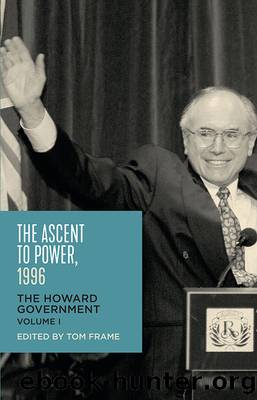
The Ascent to Power 1996 by Frame Tom;
Author:Frame, Tom;
Language: eng
Format: epub
Publisher: University of New South Wales Press
Published: 2017-09-26T00:00:00+00:00
12
THE NEW GOVERNMENTâS AGENDA
KEVIN ANDREWS
All governments are shaped by their context including the first government led by John Howard. The recession of the early 1990s, 13 years of Labor government, the narrow loss in the 1993 Fightback! election, and the subsequent leadership transition from John Hewson through Alexander Downer to Howard were key com- ponents of the background to the election of the Coalition in 1996.
The loss of the 1993 election was felt deeply. When I was elected in 1991, there was a strong mood for economic reform in the party room. I recall vividly the two-day party meeting at which the Fightback! package was discussed and settled. Apart from a few remaining protectionists, such as the South Australian Steele Hall, the policy struggle to open the economy had been won. This was due in no small part to Howardâs advocacy during the previous decade. The senior leadership of the Liberal Party, including Hewson, Downer, Peter Reith and Peter Costello, all shared the same view. There was general support for opening up the economy within the HawkeâKeating governments and the Labor leadership achieved many lasting reforms. But there was also a strong sentiment that other areas, especially the labour market, had been protected from the flexibility that would drive productivity and further economic growth that would, in turn, sustain employment and rising standards of living. Advocacy by small business was in the ascendancy, so much so that I ensured I had the backing of key members of the Australian Small Business Association (ASBA) in my preselection bid in 1991.
This attitude was reflected in the Fightback! package. As I recall, there was really only one aspect that attracted widespread criticism â a proposal to move mothers from the support pension to unemployment benefits when their children attended school. It was abandoned. In fact, it was not until a decade later, when I was the minister for employment, that the changes were finally introduced. Although I supported Fightback!, I had a strange feeling about the package at the time. I was the rapporteur for the party room, and recorded in my notes that the atmosphere was surreal. I wondered if the prevailing optimism during the two-day meeting was overly sanguine. My reservations were mollified by the recep-tion Fightback! received in the weeks and months after its release. It appeared that we would win the 1993 election until the campaign faltered in the last week.
The narrow loss of the 1993 election and the transition to Howard led to a more pragmatic approach to policy, including changes to health proposals and a retreat from the Goods and Services Tax (GST), the modification of the Telstra sale plans and the industrial relations ideas. These changes fed claims that Howard, as opposition leader, had adopted a small-target approach and had no policies in the lead-up to the 1996 election. It is true that he withstood the pressure from Labor and the media to release pol- icies early. But Howard had already set out a clear approach to his leadership of the Liberal Party.
Download
This site does not store any files on its server. We only index and link to content provided by other sites. Please contact the content providers to delete copyright contents if any and email us, we'll remove relevant links or contents immediately.
| Anthropology | Archaeology |
| Philosophy | Politics & Government |
| Social Sciences | Sociology |
| Women's Studies |
The Secret History by Donna Tartt(19090)
The Social Justice Warrior Handbook by Lisa De Pasquale(12190)
Thirteen Reasons Why by Jay Asher(8910)
This Is How You Lose Her by Junot Diaz(6887)
Weapons of Math Destruction by Cathy O'Neil(6281)
Zero to One by Peter Thiel(5802)
Beartown by Fredrik Backman(5755)
The Myth of the Strong Leader by Archie Brown(5508)
The Fire Next Time by James Baldwin(5446)
How Democracies Die by Steven Levitsky & Daniel Ziblatt(5219)
Promise Me, Dad by Joe Biden(5153)
Stone's Rules by Roger Stone(5088)
A Higher Loyalty: Truth, Lies, and Leadership by James Comey(4964)
100 Deadly Skills by Clint Emerson(4926)
Rise and Kill First by Ronen Bergman(4789)
Secrecy World by Jake Bernstein(4753)
The David Icke Guide to the Global Conspiracy (and how to end it) by David Icke(4720)
The Farm by Tom Rob Smith(4514)
The Doomsday Machine by Daniel Ellsberg(4490)
