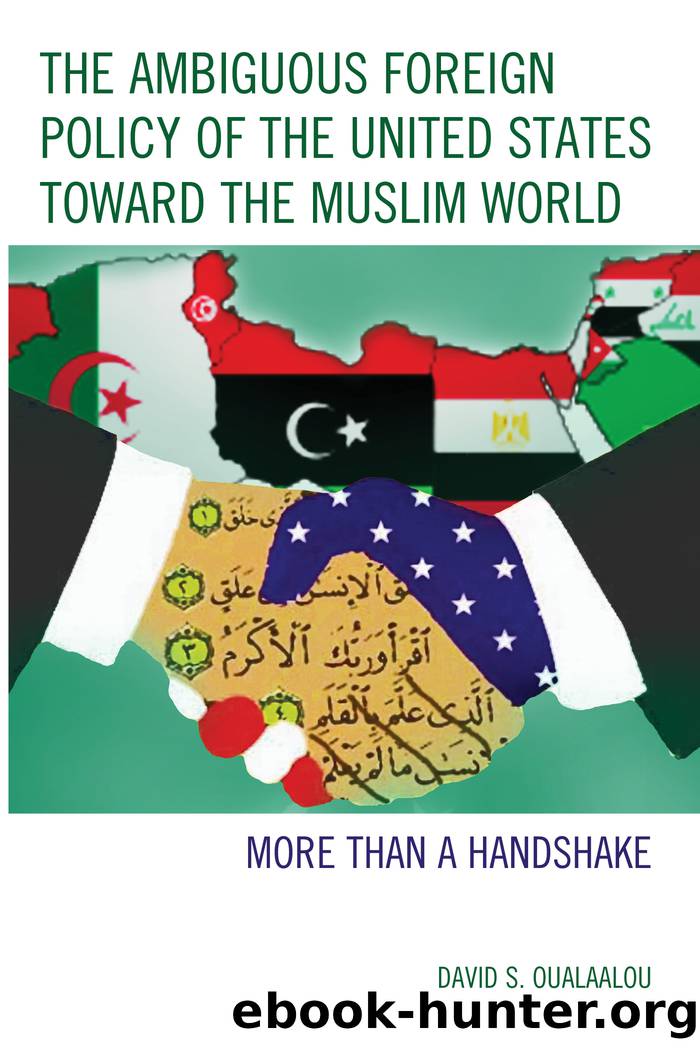
The Ambiguous Foreign Policy of the United States toward the Muslim World by Oualaalou David S.;
Author:Oualaalou, David S.;
Language: eng
Format: epub
Tags: undefined
Publisher: Lexington Books
Published: 2012-08-15T00:00:00+00:00
As stated earlier, Russiaâs reentry into Middle Eastern politics is not only caused by economic opportunities but also guided by ongoing chaos that allows it to sell its advanced weapon systems to Iran, Syrian, and Hezbollah. The longer the conflicts persist, the better it is for Russia to sustain its presence in the region. What continues to be of great debate is whether Russiaâs presence in the Middle East is an attempt by Mr. Putin to regain the influence Russia once had under the flag of the USSR or merely a way for it to assert itself as a major global player that wields power and influence like the United States. Recent analyses derived from different sources in Western capitals suggest it is the case.
There is, however, a different camp suggesting that Russia benefited from a militarized and radicalized US foreign policy in the Middle East, especially in the post 9/11 era. US wars in Afghanistan and Iraq failed to achieve their stated objective: the introduction of democracy. For instance, the invasion of Iraq led to sectarian violence on a massive scale that continues to tear apart the fabric of the Iraqi society. When countries in the Middle East realized the failure of US policy in Iraq, they start to consider Russia as a potential source, along with China, for their economic and military needs. The argument was that the United States failed to realize that the appointment of the former prime minister, Nuri Kamal Al-Malik, a Shiâa ideologue, contributed to this failure. As a result, Sunni governments in the Middle East felt the United States intentionally marginalized the majority Sunnis in that country. These events provided Russia a greater opportunity, politically, to engage the Middle East.
Besides the Iraq invasion, Iranâs nuclear standoff with the West and ongoing civil war in Syria accelerated Russiaâs resurgence in the Middle East, a region in constant flux. Despite Russiaâs support of Western initiatives including (a) cancellation of the delivery of the S-300 missile system to Iran at the request of the US and Israel, and (b) support of additional sanctions on Iran imposed by the UN, in 2010, Russia appeared willing to reverse its position. That was then. Now, Russia is taking a different approach, one that considers its geopolitical interests first. Further, the ongoing tensions with the United States are only making the situation tenser. Given these dynamics, one should conclude that Russiaâs presence in the Middle East and support for Iran and Syria is part of a long-term strategy.
As part of a broader strategy, Russiaâs engagement with Iran and Syria suggests that Russia will continue to have considerable interests in the Middle East. This interest grew considerably in the last several years because of the US invasion of Iraq, the Arab Spring, the ongoing Iranian nuclear program, and the shifts in geopolitical priorities of countries within the region. Besides Iran and Syria, Russiaâs trade with the Arab world is not very significant in comparison to Chinaâs, for instance. It is safe
Download
This site does not store any files on its server. We only index and link to content provided by other sites. Please contact the content providers to delete copyright contents if any and email us, we'll remove relevant links or contents immediately.
| Arms Control | Diplomacy |
| Security | Trades & Tariffs |
| Treaties | African |
| Asian | Australian & Oceanian |
| Canadian | Caribbean & Latin American |
| European | Middle Eastern |
| Russian & Former Soviet Union |
The Secret History by Donna Tartt(19053)
The Social Justice Warrior Handbook by Lisa De Pasquale(12187)
Thirteen Reasons Why by Jay Asher(8894)
This Is How You Lose Her by Junot Diaz(6877)
Weapons of Math Destruction by Cathy O'Neil(6267)
Zero to One by Peter Thiel(5789)
Beartown by Fredrik Backman(5737)
The Myth of the Strong Leader by Archie Brown(5500)
The Fire Next Time by James Baldwin(5431)
How Democracies Die by Steven Levitsky & Daniel Ziblatt(5216)
Promise Me, Dad by Joe Biden(5144)
Stone's Rules by Roger Stone(5081)
A Higher Loyalty: Truth, Lies, and Leadership by James Comey(4954)
100 Deadly Skills by Clint Emerson(4921)
Rise and Kill First by Ronen Bergman(4780)
Secrecy World by Jake Bernstein(4741)
The David Icke Guide to the Global Conspiracy (and how to end it) by David Icke(4709)
The Farm by Tom Rob Smith(4502)
The Doomsday Machine by Daniel Ellsberg(4484)
