Take Back Our Future by Ching Kwan Lee;Ming Sing;
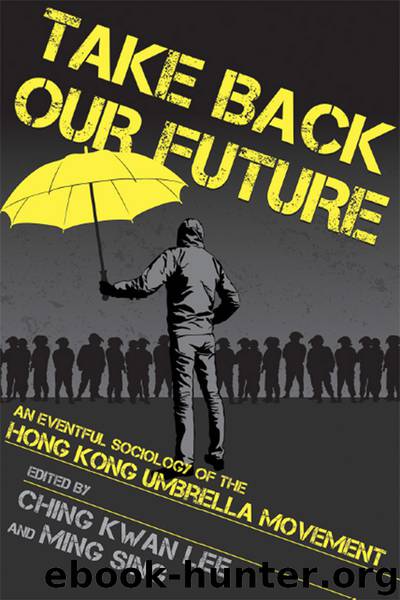
Author:Ching Kwan Lee;Ming Sing;
Language: eng
Format: epub
Publisher: Lightning Source Inc. (Tier 3)
Published: 2019-07-21T16:00:00+00:00
NOTES
1. William A. Gamson and Gadi Wolfsfeld, “Movements and Media As Interacting Systems,” Annals of the American Academy of Political and Social Science 528, no. 1 (1993): 114–25.
2. Joseph Man Chan and Chin-Chuan Lee, “Journalistic Paradigms on Civil Protests: A Case Study of Hong Kong,” in The News Media in National and International Conflict, ed. Andrew Arno and Wimal Dissanayake. (Boulder, CO: Westview, 1984), 183–202; Melvin Small, Covering Dissent: The Media and the Anti-Vietnam War Movement (New Brunswick, NJ: Rutgers University Press, 1994).
3. John Downing, Radical Media: Rebellious Communication and Social Movements (Thousand Oaks, CA: Sage, 2001).
4. Susan Forde, Challenging the News: The Journalism of Alternative and Community Media (New York: Palgrave McMillan, 2011).
5. W. Lance Bennett and Alexandra Segerberg, The Logic of Connective Action: Digital Media and the Personalization of Contentious Politics (New York: Cambridge University Press, 2013).
6. Bart Cammaerts, “Protest Logics and the Mediation Opportunity Structure,” European Journal of Communication 27, no. 2 (2012): 117–34.
7. These five members are: (1) Victor Li, elder son of tycoon Li Ka-shing, who is group co–managing director of CK Hutchinson Holdings, which owns Metro Radio (his younger brother Richard Li owns NOW TV, a paid television service in Hong Kong, and the influential financial newspaper Hong Kong Economic Journal), (2) Peter Woo, head of the Woo family, which owns Wharf Holdings, which in turn owns Cable TV, another paid television service, (3) Charles Ho, chairperson of Sing Tao News Corporations, which runs the daily newspapers Sing Tao Daily and Headline Daily, (4) Chan Wing-kei, formerly CEO of free television broadcaster Asia Television Ltd., and (5) Liu Changle, CEO of Phoenix TV, a television broadcaster stationed in Hong Kong though targeting mainly Mainland audiences.
8. See Francis L. F. Lee, “Press Freedom and Political Change in Hong Kong,” in The Routledge Handbook of Chinese Media, ed. Gary D. Rawnsley and Ming-Yeh T. Rawnsley (London: Routledge, 2015), 131–44.
9. Francis L. F. Lee and Angel M. Y. Lin, “Newspaper Editorial Discourse and the Politics of Self-Censorship in Hong Kong,” Discourse & Society 17, no. 3 (2006): 331–58.
10. Francis L. F. Lee, Talk Radio, the Mainstream Press, and Public Opinion in Hong Kong (Hong Kong: Hong Kong University Press, 2014).
11. Joseph Man Chan, Francis L. F. Lee, and Clement Y. K. So, “Journalists in Hong Kong: A Decade after the Transfer of Sovereignty,” in The Global Journalist in the 21st Century, ed. David H. Weaver and Lars Willnat (New York: Routledge, 2012), 22–35.
12. Allan K. L. Au, “Institutional Logics as Constitutive Censorship: The Case in Hong Kong Broadcast News Media” (PhD diss., The Chinese University of Hong Kong, 2016).
13. Francis L. F. Lee and Joseph Man Chan, “The Organizational Production of Self-Censorship in the Hong Kong Media,” International Journal of Press/Politics 14, no. 1 (2009): 112–33.
14. The figures were derived from the website http://www.internetlivestats.com/internet-users/china-hong-kong-sar/.
15. See http://www.statistics.gov.hk/pub/B11302592016XXXXB0100.pdf, accessed on October 15, 2018.
16. Nick Couldry and James Curran, eds., Contesting Media Power: Alternative Media in a Networked World (Lanham, MD: Rowman & Littlefield, 2003).
17. Forde, Challenging the News.
18. Dennis K.
Download
This site does not store any files on its server. We only index and link to content provided by other sites. Please contact the content providers to delete copyright contents if any and email us, we'll remove relevant links or contents immediately.
| Arms Control | Diplomacy |
| Security | Trades & Tariffs |
| Treaties | African |
| Asian | Australian & Oceanian |
| Canadian | Caribbean & Latin American |
| European | Middle Eastern |
| Russian & Former Soviet Union |
The Secret History by Donna Tartt(19025)
The Social Justice Warrior Handbook by Lisa De Pasquale(12182)
Thirteen Reasons Why by Jay Asher(8883)
This Is How You Lose Her by Junot Diaz(6869)
Weapons of Math Destruction by Cathy O'Neil(6260)
Zero to One by Peter Thiel(5782)
Beartown by Fredrik Backman(5733)
The Myth of the Strong Leader by Archie Brown(5491)
The Fire Next Time by James Baldwin(5422)
How Democracies Die by Steven Levitsky & Daniel Ziblatt(5210)
Promise Me, Dad by Joe Biden(5139)
Stone's Rules by Roger Stone(5078)
A Higher Loyalty: Truth, Lies, and Leadership by James Comey(4946)
100 Deadly Skills by Clint Emerson(4911)
Rise and Kill First by Ronen Bergman(4775)
Secrecy World by Jake Bernstein(4737)
The David Icke Guide to the Global Conspiracy (and how to end it) by David Icke(4696)
The Farm by Tom Rob Smith(4500)
The Doomsday Machine by Daniel Ellsberg(4480)
