Surviving Suicide Bereavement by McManus SJ Brendan;McManus Brendan;
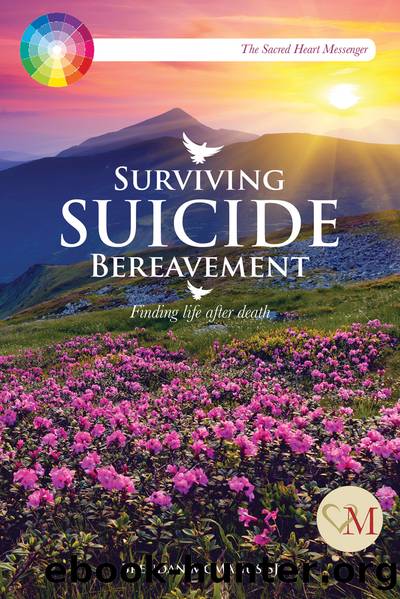
Author:McManus SJ, Brendan;McManus, Brendan;
Language: eng
Format: epub
Tags: RELIGION / Christian Living / General
Publisher: Messenger Publications
Are they in Hell?
âIs my brother in Hell?â are the most chilling words from a family member that stay with me from the funeral. Worry about negative religious consequences and eternal punishment for the person is par for the course and needs to be addressed. Some theological assistance and pastoral guidance is helpful here, in many cases old theological attitudes and negative âdivineâ judgments revolve around suicide survivors.15 Unfortunately it is still the case that feelings of shame and social stigma can prevent many people from getting the support they need, particularly getting free of guilt.
It is true that without the insights of modern psychology, suicide was seen in a harsh way (eternal damnation). However, the New Catechism of the Catholic Church has a helpful statement: âGrave psychological disturbances, anguish, or grave fear of hardship, suffering, or torture can diminish the responsibility of the one committing suicide. We should not despair of the eternal salvation of persons who have taken their own lives.16â The role of depression17, so obvious in the case of my brother, was clearly a major contributor for this self-destructive act that largely reduced his responsibility and therefore the implication of serious mortal sin. I believe that anyone who takes their life is not in their right mind and normally is acting under extreme mental anguish.
Technically, for a sin to be mortal (meriting damnation) the act of taking oneâs own life has to meet three conditions18: it must be a grave or serious issue; the person must know that this is wrong; and the person must intentionally consent to this action. In many cases of suicide, the person is not in their right mind to give full consent. Recent studies highlight the social and personal circumstances in suicides and show that they are rarely voluntary acts and so, while they may be mistaken and morally wrong, they are not always blameworthy. Fear, pressure, ignorance, addiction, and psychological problems can impede the exercise of the will so that a person may not be fully responsible for an action. While suicide can be judged immoral, the degree of responsibility for suicide depends upon the state of the personâs mind.
Think of a fire emergency in a tower block where desperate people are forced to jump out windows to escape the inferno. They donât want to die, but have no choice as they are in an intolerably extreme situation. Similarly in suicide, the personâs mind is in such a state of chaos and frenzy that they want to escape it at all costs, even if it means destroying themselves. The internal agony caused by the âfireâ of negativity, ruminations and self-hate can never be underestimated.
The Irish Catholic Bishops adopt a similar line: âWhile we believe that God is the giver of life, and he alone has the right to decide when that life should end we also realise that God can look deep within the human heart, recognise its difficulties, understand and forgive.â19 Helpful as these sources are, it is still
Download
This site does not store any files on its server. We only index and link to content provided by other sites. Please contact the content providers to delete copyright contents if any and email us, we'll remove relevant links or contents immediately.
Professional Troublemaker by Luvvie Ajayi Jones(29668)
Empire of the Sikhs by Patwant Singh(23089)
Twilight of the Idols With the Antichrist and Ecce Homo by Friedrich Nietzsche(18638)
Plagued by Fire by Paul Hendrickson(17416)
The Sun and Her Flowers by Rupi Kaur(14526)
Norse Mythology by Gaiman Neil(13372)
A Journey Through Charms and Defence Against the Dark Arts (Harry Potter: A Journey Throughâ¦) by Pottermore Publishing(9276)
Fangirl by Rainbow Rowell(9259)
Adultolescence by Gabbie Hanna(8929)
Wonder by R.J. Palacio(8584)
Tools of Titans by Timothy Ferriss(8402)
Becoming Supernatural by Dr. Joe Dispenza(8223)
How to Bang a Billionaire by Alexis Hall(8160)
Wonder by R. J. Palacio(8115)
Crystal Healing for Women by Mariah K. Lyons(7932)
The Road Less Traveled by M. Scott Peck(7605)
The Lost Art of Listening by Michael P. Nichols(7507)
The Witchcraft of Salem Village by Shirley Jackson(7277)
The Institute by Stephen King(7043)
