Subjecting Verses by Miller Paul Allen; Miller Paul Allen Allen;
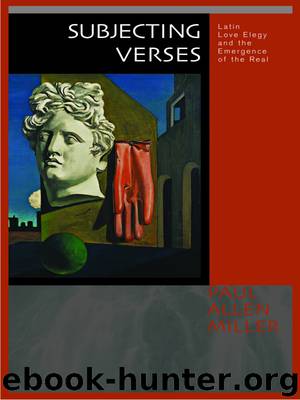
Author:Miller, Paul Allen; Miller, Paul Allen Allen;
Language: eng
Format: epub
Publisher: Princeton University Press
Published: 2009-03-21T16:00:00+00:00
Chapter Six
DECONSTRUCTING THE VIR :
LAW AND THE OTHER IN THE AMORES
Transgression is neither violence in a divided world (in an ethical world) nor a victory over limits (in a dialectical or revolutionary world); and exactly for thisreason its role is to measure the excessive distance that opens at the heart of the limit and to trace the flashing line that causes the limit to arise. Transgression contains nothing negative, but affirms limited being—affirms the limitlessness into which it leaps as it opens this zone to existence for the first time.
—Foucault 1977b: 35
The new or postmodern development, indeed, remains progressive to the degree to which it dispels any last illusions as to the autonomy of thought, even though the dissipation of those illusions may reveal a wholly positivist landscape from which the negative has evaporated altogether, beneath the steady clarity of what has been identified as “cynical reason.”
—Jameson 1991: 323
OVID IS IN MANY WAYS our intellectual contemporary, an ironist at the end of history. While everyone from Perry Anderson (1992) to Jacques Derrida (1993: 104) has raised theoretical objections to Francis Fukuyama’s thesis (1992) that history has reached its telos with the collapse of communism as a viable form of opposition to liberal capitalism, nonetheless credible alternatives to the world domination of American consumer society and its commodified politics are woefully thin on the ground. The position of externality on which the stance of critique depends has evaporated beneath our feet. There is no obvious outside to the present system (Hardt and Negri 2000: 45; Rabasa 2001: 12). The contemporary social critic is reduced to the position of an ironist whose jibes are as much selfconsuming artifacts as catalysts for social change. This is a fair description of Ovid and his relation to Augustan ideology as well. Ovidian transgression, like that described by Foucault, “incessantly crosses and recrosses a line which closes up behind it in a wave of extremely short duration”(Foucault 1977b: 34).
In chapter 4, we argued that the postmodern age had better positioned us to understand Tibullus’s repetitive and dreamlike poetics. There, following Žižek’s definitions of modernism and postmodernism, we contended that Tibullus could be seen as a postmodernist in the same sense as Kafka or Philip Glass (in opposition to the more modernist Propertius, so dear to the heart of Pound and his followers). In that same chapter, we observed that postmodernism as an artistic style dilates on the abundance of the absurd and the unintelligible, rather than examining the lack at the heart of signification after the fashion of modernism. From this perspective, Ovid is a postmodernist of a uniquely contemporary stripe, more along the lines of Andy Warhol than Samuel Beckett or Eugene Ionesco.He is an author of works whose resistance to the dominant mode of the Symbolic is to be found in their uncanny re-production of it. Ovid on this view is more a deconstructionist than a Brechtian poet of Revolution.1
Born in 43 B.C.E., the year after Julius Caesar’s assassination, Ovid was but twelve at the battle of Actium.
Download
This site does not store any files on its server. We only index and link to content provided by other sites. Please contact the content providers to delete copyright contents if any and email us, we'll remove relevant links or contents immediately.
| Ancient & Classical | Arthurian Romance |
| Beat Generation | Feminist |
| Gothic & Romantic | LGBT |
| Medieval | Modern |
| Modernism | Postmodernism |
| Renaissance | Shakespeare |
| Surrealism | Victorian |
4 3 2 1: A Novel by Paul Auster(12554)
The handmaid's tale by Margaret Atwood(7869)
Giovanni's Room by James Baldwin(7475)
Big Magic: Creative Living Beyond Fear by Elizabeth Gilbert(5859)
Asking the Right Questions: A Guide to Critical Thinking by M. Neil Browne & Stuart M. Keeley(5858)
Ego Is the Enemy by Ryan Holiday(5574)
The Body: A Guide for Occupants by Bill Bryson(5216)
On Writing A Memoir of the Craft by Stephen King(5022)
Ken Follett - World without end by Ken Follett(4817)
Adulting by Kelly Williams Brown(4648)
Bluets by Maggie Nelson(4641)
Eat That Frog! by Brian Tracy(4633)
Guilty Pleasures by Laurell K Hamilton(4536)
The Poetry of Pablo Neruda by Pablo Neruda(4196)
Alive: The Story of the Andes Survivors by Piers Paul Read(4103)
Fingerprints of the Gods by Graham Hancock(4081)
The Book of Joy by Dalai Lama(4071)
White Noise - A Novel by Don DeLillo(4061)
The Bookshop by Penelope Fitzgerald(3912)
