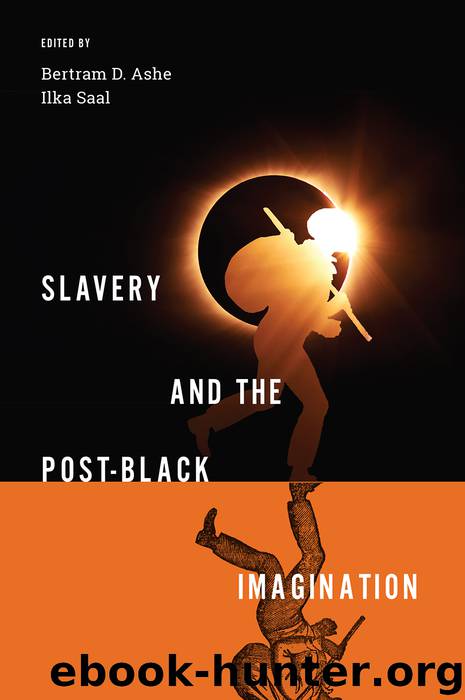
Slavery and the Post-Black Imagination by Bertram D. Ashe;Ilka Saal;
Author:Bertram D. Ashe;Ilka Saal;
Language: eng
Format: epub
ISBN: 9780295746654
Publisher: University of Washington Press
Published: 2020-03-02T16:00:00+00:00
Although written with both slavery and the prison-industrial complex in mind, rather than offer an ending that would more readily highlight how disposable black life truly is, Peele chooses an ending that considers the affective needs of black audiences at this historical juncture. McKittrick explains, “We tested the movie with the original ‘sad truth’ ending where, when the cop shows up, it’s an actual cop and Chris goes to jail. . . . [I]t was like we punched everybody in the gut. You could feel the air being sucked out of the room. The country was different. We weren’t in the Obama era, we were in this new world where all the racism crept out from under the rocks again.”49
The ending Peele ultimately chooses is a compromise between social realism and a utopian vision. Chris might inevitably end up in prison regardless of Rod’s act of camaraderie and heroism. Therefore, Peele’s choice to spare black viewers the trauma of Chris’s death or incarceration is an act of cinematic resistance that can best be understood in the context of black fugitivity. Tina Campt argues that fugitivity “highlights the tense relations between acts of flights and escape, and creative practices of refusal—nimble and strategic practices that undermine the category of the dominant.”50 Chris’s avoidance of a prison sentence, no matter how temporary his freedom, is Peele’s way of undercutting Hollywood’s tendency toward objectifying black bodies either through “racialized aesthetic framing” or “commodification.”51 Staging Chris’s escape, even if momentary, is a post-black gesture toward radical hope, while the alternate ending’s insistence upon realism hinders scopophilic pleasure on the part of black audiences.
Black viewers leave the theater temporarily satiated, even if we understand the similarity between Chris’s precarious fugitivity and our own. Ending with Rod’s admonishment, “I mean, I told you not to go in that house” and “Sikiliza Kwa Wahenga” as a nondiegetic framing device reminds black audiences that we can never get too comfortable. As he has done throughout Get Out, Peele beseeches us one final time to “stay woke.”
Download
This site does not store any files on its server. We only index and link to content provided by other sites. Please contact the content providers to delete copyright contents if any and email us, we'll remove relevant links or contents immediately.
| African | Asian |
| Australian & Oceanian | Canadian |
| Caribbean & Latin American | European |
| Jewish | Middle Eastern |
| Russian | United States |
4 3 2 1: A Novel by Paul Auster(12365)
The handmaid's tale by Margaret Atwood(7752)
Giovanni's Room by James Baldwin(7319)
Big Magic: Creative Living Beyond Fear by Elizabeth Gilbert(5753)
Asking the Right Questions: A Guide to Critical Thinking by M. Neil Browne & Stuart M. Keeley(5752)
Ego Is the Enemy by Ryan Holiday(5412)
The Body: A Guide for Occupants by Bill Bryson(5077)
On Writing A Memoir of the Craft by Stephen King(4925)
Ken Follett - World without end by Ken Follett(4719)
Adulting by Kelly Williams Brown(4564)
Bluets by Maggie Nelson(4544)
Eat That Frog! by Brian Tracy(4518)
Guilty Pleasures by Laurell K Hamilton(4437)
The Poetry of Pablo Neruda by Pablo Neruda(4090)
Alive: The Story of the Andes Survivors by Piers Paul Read(4017)
White Noise - A Novel by Don DeLillo(4001)
Fingerprints of the Gods by Graham Hancock(3985)
The Book of Joy by Dalai Lama(3970)
The Bookshop by Penelope Fitzgerald(3843)
