Six Amendments: How and Why We Should Change the Constitution by Stevens John Paul
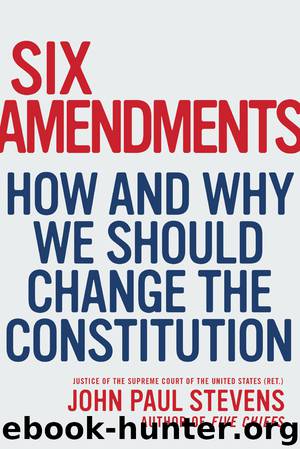
Author:Stevens, John Paul [Stevens, John Paul]
Language: eng
Format: epub
Tags: Political Science / American Government / Judicial Branch, Political Science / American Government / National, Political Science / Constitutions
Amazon: B00GM0P55M
Publisher: Little, Brown and Company
Published: 2014-04-22T06:00:00+00:00
During the decades between the withdrawal of Union troops from the South in 1877 and President Nixon’s appointment of William H. Rehnquist to the Supreme Court in 1972, the judge-made sovereign immunity defense was applied in several cases not described in the text of the Eleventh Amendment—for example, a suit brought by the Principality of Monaco seeking recovery from Mississippi on defaulted bonds and an admiralty proceeding brought by the owner of a barge damaged by a vessel owned by the state of New York—but I am quite sure the defense was never even raised in any case seeking recovery against a state or its agents for the violation of an act of Congress.
The defense was, however, raised by the United States in a case decided in 1882 involving the ownership of the land in Virginia where the Arlington National Cemetery is located. The two opinions in that case, which rejected the defense by a five-to-four vote, may well be the most scholarly discussion of the defense contained in the U.S. Reports. I am sure that few of the thousands of tourists who have visited the cemetery are familiar with the history of the case.
The tract of land of about eleven hundred acres had been owned by George Washington Parke Custis, the adopted son of President Washington; Custis executed a will devising a life estate to his daughter, who in 1831 became the wife of a young army officer named Robert E. Lee in a marriage ceremony conducted in the “Custis-Lee Mansion” on the premises. At the expiration of the life estate, her son George W. P. C. Lee acquired ownership of the property. While the elder Lee was commanding the Confederate armies during the Civil War, Congress enacted a statute imposing a new tax on properties in the “insurrectionary districts within the United States,” which, of course, included the younger Lee’s Arlington estate.
The tax on the property not having been paid, the commissioners appointed under the federal statute held a sale at which they purchased the property on behalf of the United States. Lee challenged the validity of the tax deed in an action filed against two federal officials, Kaufman and Strong, in a Virginia court, but the case was promptly removed to the federal court, where the attorney general filed a motion advising the Court that the property in controversy had been occupied by the United States, through its officers and agents, for over ten years as a military station and national cemetery for the burial of deceased soldiers and sailors, and requesting that the suit be dismissed. The motion did not take any position on the validity of the tax deed. The judge denied the motion and held a trial at which the jury concluded that the tax deed was invalid because the agents of the plaintiff had tried to pay the tax, but the commissioners had insisted that Lee make the payment himself.
Even though the United States was not a party to the trial court proceedings, it prosecuted an appeal in its own name, as did the two individual defendants.
Download
This site does not store any files on its server. We only index and link to content provided by other sites. Please contact the content providers to delete copyright contents if any and email us, we'll remove relevant links or contents immediately.
| Anthropology | Archaeology |
| Philosophy | Politics & Government |
| Social Sciences | Sociology |
| Women's Studies |
The Secret History by Donna Tartt(19480)
The Social Justice Warrior Handbook by Lisa De Pasquale(12301)
Thirteen Reasons Why by Jay Asher(9135)
This Is How You Lose Her by Junot Diaz(7072)
Weapons of Math Destruction by Cathy O'Neil(6488)
Zero to One by Peter Thiel(5956)
Beartown by Fredrik Backman(5952)
The Myth of the Strong Leader by Archie Brown(5633)
The Fire Next Time by James Baldwin(5598)
How Democracies Die by Steven Levitsky & Daniel Ziblatt(5339)
Promise Me, Dad by Joe Biden(5239)
Stone's Rules by Roger Stone(5197)
A Higher Loyalty: Truth, Lies, and Leadership by James Comey(5092)
100 Deadly Skills by Clint Emerson(5034)
Rise and Kill First by Ronen Bergman(4911)
Secrecy World by Jake Bernstein(4899)
The David Icke Guide to the Global Conspiracy (and how to end it) by David Icke(4857)
The Doomsday Machine by Daniel Ellsberg(4633)
The Farm by Tom Rob Smith(4614)
