Simple Not Easy by Roberts Terrence J.;
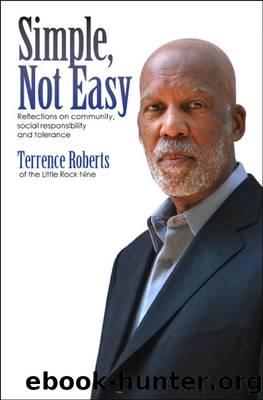
Author:Roberts, Terrence J.;
Language: eng
Format: epub
Publisher: Parkhurst Brothers, Incorporated, Publishers
Relationships across Lines of Demarcation
Presentation to San Bernardino City Unified School District
August 18, 2000
In his discussion of how true community is built, the author Scott Peck speaks about the need to foster chaos as a way of dismantling the veneer of pseudo-community in which most of us live. His thesis is simply this, if we care enough about living in true community with each other, we will risk going through chaos to make it happen.
The truth is, we donât have to manufacture chaos, it is upon us each and every day. So far, however, we have not figured out how to use the chaos as a springboard to something more substantive. Most of our energy goes into reacting to the events of the day; we donât have much left to put into creative thinking about how to develop viable, healthy communities.
And yet, your school district is very much involved in preparing community members to engage in the kind of work necessary to achieve the goal of true community. The supporters of true community in my Little Rock neighborhood offered a steady chorus of âBoy, get your education!â Following their advice contributed greatly to my determination to secure a formal education. I obtained a bachelorâs degree in sociology; I earned an MSW at UCLA, and finished my formal work at Southern Illinois University in Carbondale, Illinois, where I was awarded a Ph.D. in psychology.
I have often dreamed about a society of individuals dedicated to learning, who will participate in relationships devoted to mutual growth and development; who will form communities of like-minded others; who will work toward building strong nations; who will actively seek to create a world based on cooperation and team effort with a goal of minimizingâdare I say eliminatingâall urges toward destruction, selfishness and greed. A bit lofty perhaps, but worth a daydream or two.
One of the barriers to true community is our tendency to judge difference harshly. Coping positively with difference is not something that seems to arise naturally among populations of people. If anything, the reverse is true. The stage is set then for the school district to help students and community members learn how to deal with difference in ways that are healthy and productive.
In California, difference abounds. I would venture to say that every single person present here today can list ad hoc the various and sundry differences in race, culture, ethnicity, language, country of origin, and other such identifying characteristics that define your student population. It is within this mix that we find the seeds of change that can help the participants learn to honor and embrace difference, rather than vilify or judge harshly when a difference is perceived.
The schools are an ideal resource for helping community members confront issues about difference. Typically neighbors who are different, as measured by one dimension or another, will be classmates; they can learn directly how to communicate with each other. Programs especially designed for particular communities can be mounted on the campus of the local schools.
Download
This site does not store any files on its server. We only index and link to content provided by other sites. Please contact the content providers to delete copyright contents if any and email us, we'll remove relevant links or contents immediately.
The Secret History by Donna Tartt(19088)
The Social Justice Warrior Handbook by Lisa De Pasquale(12190)
Thirteen Reasons Why by Jay Asher(8910)
This Is How You Lose Her by Junot Diaz(6887)
Weapons of Math Destruction by Cathy O'Neil(6280)
Zero to One by Peter Thiel(5802)
Beartown by Fredrik Backman(5754)
The Myth of the Strong Leader by Archie Brown(5508)
The Fire Next Time by James Baldwin(5446)
How Democracies Die by Steven Levitsky & Daniel Ziblatt(5219)
Promise Me, Dad by Joe Biden(5153)
Stone's Rules by Roger Stone(5088)
A Higher Loyalty: Truth, Lies, and Leadership by James Comey(4964)
100 Deadly Skills by Clint Emerson(4925)
Rise and Kill First by Ronen Bergman(4789)
Secrecy World by Jake Bernstein(4753)
The David Icke Guide to the Global Conspiracy (and how to end it) by David Icke(4720)
The Farm by Tom Rob Smith(4513)
The Doomsday Machine by Daniel Ellsberg(4490)
