Should We Fear Russia? by Dmitri Trenin
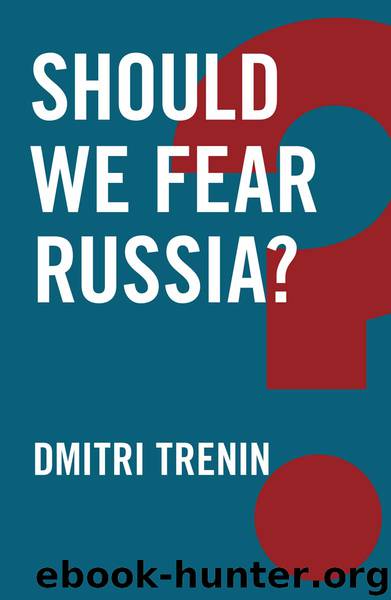
Author:Dmitri Trenin
Language: eng
Format: epub
ISBN: 9781509510948
Publisher: Wiley
Published: 2016-10-26T00:00:00+00:00
2
The Russia Challenge
US Secretary of Defense Ashton Carter has put Russia at the top of the list of security challenges and threats to the United States, ahead of China, Iran, North Korea and ISIL.10 So, what is Russia’s challenge to the West?
What does Russia want?
Vladimir Putin’s long leadership is essentially about two things: first, to keep Russia in one piece and, second, to return it to the ranks of the world’s great powers. By the mid-2010s the first mission looked accomplished, with the country not merely united under the imperial presidency but with the president’s personal popularity – or public acquiescence in him – standing at well above 80 percent. As for the second, in the Ukraine conflict Russia shook off the constraints imposed on it by the post-Cold War system; and, through its direct military intervention and parallel diplomatic activity in Syria, Russia has suddenly become indispensable in the issues of war and peace in one of the world’s most turbulent regions – the Middle East. If there is a strategy behind the Kremlin’s actions, here is its main objective.
In the past decade and a half, Russia’s self-image has changed considerably. Putin and his entourage still view the country as European in origin, a successor to the Eastern Christian Byzantine tradition, but they see it primarily as fully sovereign – on a par with the rest of Europe, rather than an associate of the EU. A continent-size country, uniting Slavic, Turkic and scores of other ethnic elements, a home to four religions legally deemed indigenous – Orthodox Christianity, Islam, Judaism and Buddhism – Russia appears to these individuals a distinct geopolitical, economic and cultural unit, a potential center of attraction for neighbors in Eurasia, and a partner to those in the non-West advocating a multipolar world order.
In geopolitical and geostrategic terms, the Kremlin posits Russia as a great power with a global reach. It rejects as ludicrous or malicious any attempts to put Russia into a category of regional powers. Geography is the Kremlin’s major asset: a country which borders directly on Norway and North Korea – as well as on America, China and Japan – and whose reach extends from the icy Arctic to the approaches to the Middle East and Afghanistan, cannot easily be boxed in. Russia’s modest economic and demographic weight, the Kremlin argues, does not tell the whole story: the country has immense potential for growth and its demographics are improving. What is more important is the fact that Russia, alongside the United States and China, is at the moment one of the world’s only three major independent military powers.
Russian official views on the global order traditionally favor great-power concert as the best means of managing the international system. Russia’s Alexander I was one of the key players at the Vienna Congress of 1815, which ushered in the Concert of Europe and the Holy Alliance; thereafter, he and his successor Nicholas I were the dominant figures in Central and Eastern Europe. Joseph Stalin, in
Download
This site does not store any files on its server. We only index and link to content provided by other sites. Please contact the content providers to delete copyright contents if any and email us, we'll remove relevant links or contents immediately.
| Arms Control | Diplomacy |
| Security | Trades & Tariffs |
| Treaties | African |
| Asian | Australian & Oceanian |
| Canadian | Caribbean & Latin American |
| European | Middle Eastern |
| Russian & Former Soviet Union |
The Secret History by Donna Tartt(19027)
The Social Justice Warrior Handbook by Lisa De Pasquale(12182)
Thirteen Reasons Why by Jay Asher(8883)
This Is How You Lose Her by Junot Diaz(6871)
Weapons of Math Destruction by Cathy O'Neil(6260)
Zero to One by Peter Thiel(5782)
Beartown by Fredrik Backman(5734)
The Myth of the Strong Leader by Archie Brown(5491)
The Fire Next Time by James Baldwin(5423)
How Democracies Die by Steven Levitsky & Daniel Ziblatt(5211)
Promise Me, Dad by Joe Biden(5139)
Stone's Rules by Roger Stone(5078)
A Higher Loyalty: Truth, Lies, and Leadership by James Comey(4946)
100 Deadly Skills by Clint Emerson(4911)
Rise and Kill First by Ronen Bergman(4775)
Secrecy World by Jake Bernstein(4738)
The David Icke Guide to the Global Conspiracy (and how to end it) by David Icke(4696)
The Farm by Tom Rob Smith(4500)
The Doomsday Machine by Daniel Ellsberg(4481)
