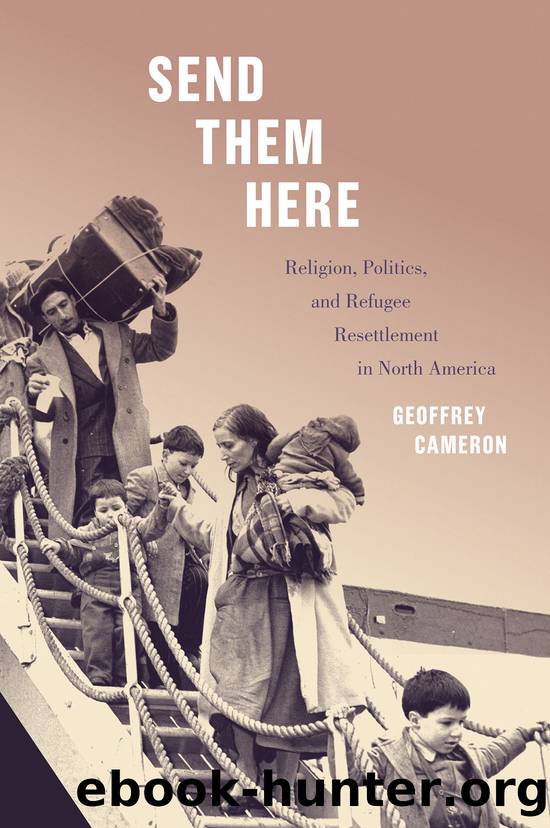
Send Them Here: Religion, Politics, and Refugee Resettlement in North America by Geoffrey Cameron
Author:Geoffrey Cameron [Cameron, Geoffrey]
Language: eng
Format: epub
Tags: political science, Public Policy, Immigration, Social Science, Emigration & Immigration
ISBN: 9780228006008
Google: zh8OEAAAQBAJ
Publisher: McGill-Queen's Press - MQUP
Published: 2021-02-15T00:27:09.026550+00:00
5
Coming Full Circle
Indochina, Legislative Reform,
and the Post-War Legacy
The debates over refugee legislation in the 1970s were propelled by unsustainable contradictions and tensions between existing statutes and what the American and Canadian governments were doing. The law had to catch up with government practice. Accordingly, the law was amended to provide a more stable framework for the ongoing practice of refugee resettlement. Legislators were also influenced by an evolving crisis in Indochina, as a consequence of an international conflict that displaced hundreds of thousands of people from the region.
In the United States, the demand for refugee resettlement from Indochina â especially from U.S.-allied South Vietnam â was met with a massive program of executive parole, carried out in partnership with religious and voluntary groups. The magnitude of this program reinforced a growing tide of discontent within Congress at the contradictions between immigration law and well-established practices of refugee resettlement.1 It erased any question of the need to clarify, regularize, and make permanent the entire process and authority for resettlement of refugees from abroad.
For Canada, the change to refugee law was accomplished together with major immigration reform in 1976. This reform included a provision for private sponsorship, which was recognized by lawmakers as an historical aspect of Canadaâs refugee-resettlement programs. At that time, Canadaâs commitment to resettling refugees from Indochina was comparatively small. However, as the act came into effect in 1978, the âboat peopleâ crisis began to impress itself more forcefully onto the public consciousness â especially following the Hai Hong incident in November of that year.2 The mobilization of Canadian religious groups and civil-society coalitions in response to this crisis led to negotiations over the implementation of previously undefined private- sponsorship provisions of the new legislation.3 The first major sponsorship agreements were signed with a number of Canadaâs religious bodies, around which Canada proceeded to structure its private-public partnership to resettle 60,000 Indochinese refugees.4
UNITED STATES
The conditions leading to the passage of the 1980 Refugee Act were created by repeated conflict between the executive branch and Congress over the deviation of refugee-admissions procedure from legal statutes â conditions that were amplified in the context of the massive Indochinese resettlement program.5 In one influential article, Arnold Leibowitz contends, âIt was the 1965 amendments to the Immigration and Nationality Act and the very broad use of executive parole authority that led to the Refugee Act of 1980.â6 This statement, taken literally, exaggerates the causal influence of the repeated use of executive parole by several administrations. The leadership of Senator Ted Kennedy, an enduring Democratic majority in both Houses of Congress, and a favourable foreign-policy environment also helped set the stage for legislative reform in the late 1970s.7
Although the conditions for reform were set by these interlocking variables, the major aspects of the legislation had already been formed along a developmental pathway that reached back to the end of the Second World War. As Deborah Anker and Michael Posner conclude, the Refugee Act was âthe product of years of debate and compromise,â in which the religious and voluntary groups were major actors.
Download
This site does not store any files on its server. We only index and link to content provided by other sites. Please contact the content providers to delete copyright contents if any and email us, we'll remove relevant links or contents immediately.
| Anthropology | Archaeology |
| Philosophy | Politics & Government |
| Social Sciences | Sociology |
| Women's Studies |
Born to Run: by Christopher McDougall(7121)
The Leavers by Lisa Ko(6945)
iGen by Jean M. Twenge(5409)
Sapiens by Yuval Noah Harari(5366)
Spare by Prince Harry The Duke of Sussex(5180)
The Kite Runner by Khaled Hosseini(5170)
Machine Learning at Scale with H2O by Gregory Keys | David Whiting(4295)
Bullshit Jobs by David Graeber(4179)
Never by Ken Follett(3937)
Goodbye Paradise(3802)
Livewired by David Eagleman(3765)
Fairy Tale by Stephen King(3370)
A Dictionary of Sociology by Unknown(3077)
Harry Potter 4 - Harry Potter and The Goblet of Fire by J.K.Rowling(3061)
The Social Psychology of Inequality by Unknown(3019)
The Club by A.L. Brooks(2919)
Will by Will Smith(2911)
0041152001443424520 .pdf by Unknown(2843)
People of the Earth: An Introduction to World Prehistory by Dr. Brian Fagan & Nadia Durrani(2733)
