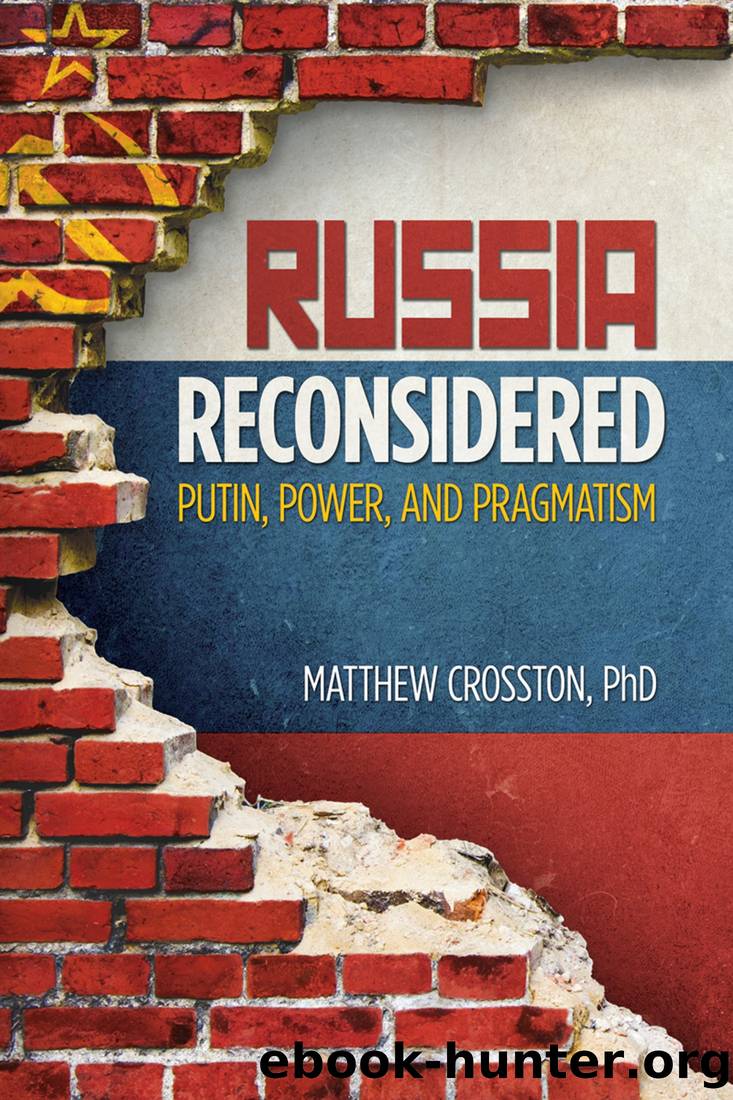
Russia Reconsidered: Putin, Power, and Pragmatism by Matthew Crosston
Author:Matthew Crosston [Crosston, Matthew]
Language: eng
Format: epub
Tags: International Relations, History & Theory, Political Science, World, General, Russian & Former Soviet Union
ISBN: 9781612543420
Google: YKKRxgEACAAJ
Goodreads: 52354989
Publisher: Brown Books Publishing
Published: 2019-06-19T00:00:00+00:00
PART V
EDUCATION, MEDIA, AND ANALYSIS
COLD WAR TRIUmpHALISM AND CHICKEN-AND-EGG DILEMMAS
FEBRUARY 5, 2015
There is a decided chicken-and-egg question when it comes to trying to unravel Russian-American relations. The general pessimism and pejorative characterizations that come from the US Congress clearly have a negative influence on Putinâs strident bravado and dismissive arrogance to the United States. What is perplexing is how this dilemma, which implies that it is difficult to figure out which truly came first, never seems to be an actual problem for American politicians: the Russian corrupt and violent chicken always comes before the calm and diplomatic American egg.
Of course Russia feels equally strongly that the American oppressive and interfering egg came well before the Russian self-defense chicken. It refuses to accept sole blame for all of the bombastic rhetoric. In this particular case reality better supports the Russian side: it is more accurate to describe Putinâs hostility toward America as one far more deeply rooted in frustration. But instead, America characterizes Russia as having an unstable mania that is obsessed with remaining a great Derzhava (powerful state) and will not recognize its culpability in creating its own future political cataclysm.
The failure of America to move past the crowing Cold War triumphalism has produced a decided negative impact on Russian-American relations that precludes a new era from developing. It is as if Russia is being criticized that it simply does not know its place or will not accept its role, both of which, of course, are decided by America and are not open to negotiation. Prominent thinkers and players like John McCain, Charles Krauthammer, Ariel Cohen, Hillary Clinton, George Will, Alexander Motyl, and Fiona Hill are quick to damn âRussian provocationsâ (such as the Chechen conflict, the Crimean annexation, the intimidation of Russian journalists, and oil/gas gamesmanship with the European Union) as moving the country toward becoming a de facto âfascistâ state. In reality no such explicit initiatives can be found backing up such radical accusations. More calm analyses find that Russia is simply not accepting being told what to do on the world stage, and that general position (operating in its own interests for its own interests) is so incredibly basic and elementary for all nations it is perplexing how much kvetching happens in America when Russia does it.
This is especially true when one considers that Russia feels, with some validation, that it has been incredibly nonconfrontational with the United States on many issues since the end of the Cold War that have not necessarily been aligned with its own national interests. As a result, it is not uncommon to find Russian political players quite adamant that the United States âowesâ it for accepting moves that could have easily exploded into formal conflict between the two sides after the Cold War.
Americans at times can play too fast and loose with semantics. As long as the United States does not actively try to create political discord in a country like Russia, it thinks it cannot possibly be seen as a
Download
This site does not store any files on its server. We only index and link to content provided by other sites. Please contact the content providers to delete copyright contents if any and email us, we'll remove relevant links or contents immediately.
| Arms Control | Diplomacy |
| Security | Trades & Tariffs |
| Treaties | African |
| Asian | Australian & Oceanian |
| Canadian | Caribbean & Latin American |
| European | Middle Eastern |
| Russian & Former Soviet Union |
The Secret History by Donna Tartt(19046)
The Social Justice Warrior Handbook by Lisa De Pasquale(12186)
Thirteen Reasons Why by Jay Asher(8892)
This Is How You Lose Her by Junot Diaz(6875)
Weapons of Math Destruction by Cathy O'Neil(6264)
Zero to One by Peter Thiel(5786)
Beartown by Fredrik Backman(5737)
The Myth of the Strong Leader by Archie Brown(5496)
The Fire Next Time by James Baldwin(5429)
How Democracies Die by Steven Levitsky & Daniel Ziblatt(5213)
Promise Me, Dad by Joe Biden(5141)
Stone's Rules by Roger Stone(5080)
A Higher Loyalty: Truth, Lies, and Leadership by James Comey(4950)
100 Deadly Skills by Clint Emerson(4919)
Rise and Kill First by Ronen Bergman(4778)
Secrecy World by Jake Bernstein(4740)
The David Icke Guide to the Global Conspiracy (and how to end it) by David Icke(4699)
The Farm by Tom Rob Smith(4502)
The Doomsday Machine by Daniel Ellsberg(4484)
