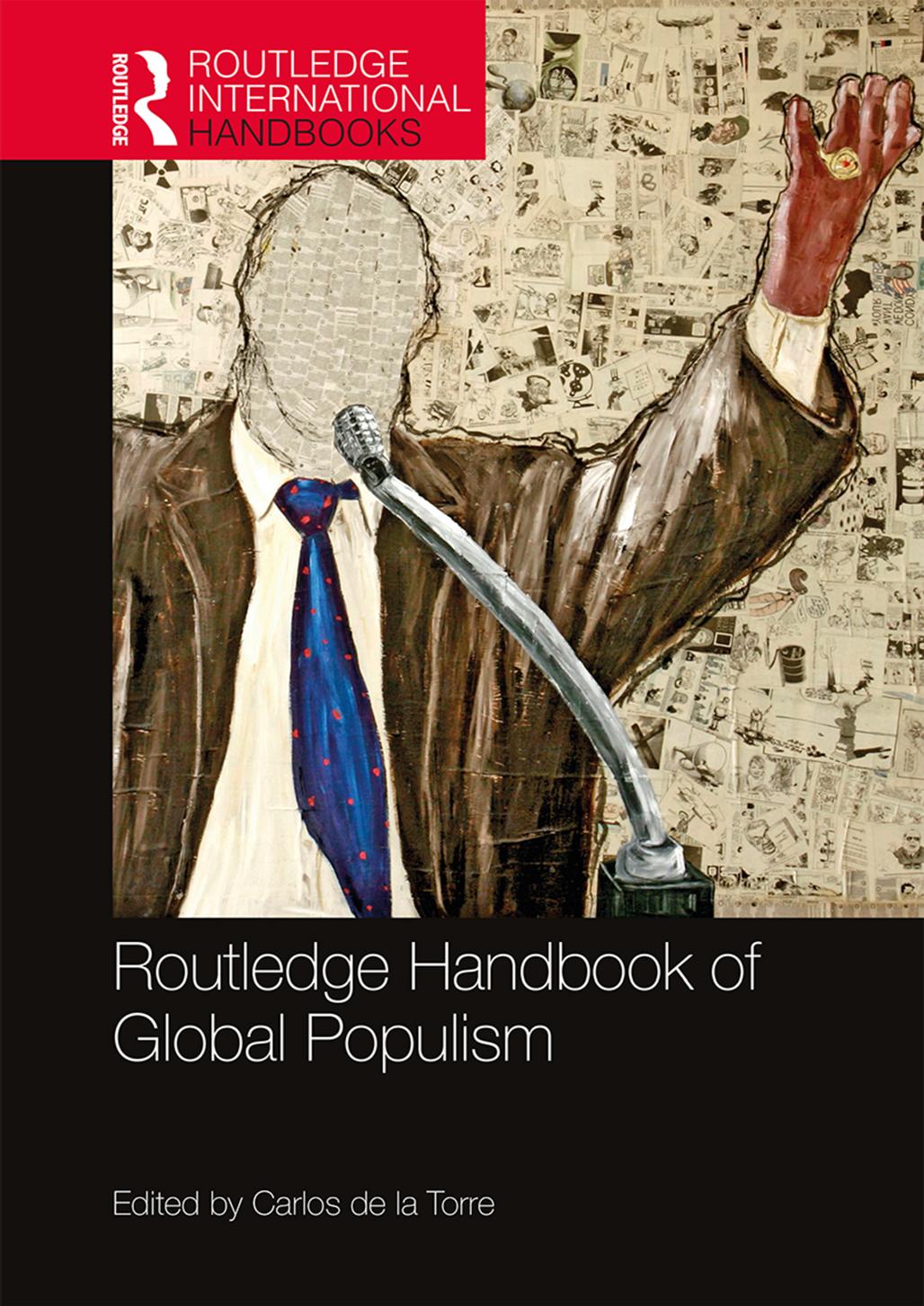
Routledge Handbook of Global Populism by Carlos de la Torre
Author:Carlos de la Torre [Torre, Carlos de la]
Language: eng
Format: epub, pdf
Publisher: Taylor & Francis (CAM)
The hybridization of populist political communication in Western Europe
Where is the confluence of populism and media heading in Western Europe? Let us take their separate trajectories first. In regards to the former, populism in Western Europe seems to be on the rise â and if one does not wish to subscribe to such a strong claim, it is at very least in the process of being âmainstreamedâ, having proven itself to not be a temporary phenomenon, but rather a seemingly permanent feature of contemporary democratic politics in the region. In regards to the latter, the contemporary media landscape in Western Europe (and elsewhere) is in serious flux. Traditional or old forms of media are facing decreasing circulation or viewership, changing modes of consuming news, less advertising profits, and more broadly, less trust in âmainstreamâ outlets that previously held a fair degree of prestige as purveyors of âthe truthâ. On the other hand, the rise of the internet, âfake newsâ, social networks, on-demand viewing, Web 2.0, the proliferation and ubiquity of mobile devices and more generally a more multi-directional and segmented media landscape has disrupted the media and political landscape irrevocably.
Drawing these two disparate trends together, it is clear that populists have not been immune to changes in the media landscape. We can still, to some extent, identify a divide in Western Europe between âold mediaâ and ânew mediaâ populists â the former including figures like Silvio Berlusconi or parties like the SVP, who rely heavily on television, newspapers and the mass media; the latter including M5S, Podemos and DiEM25, whose appeal to âthe peopleâ strongly relies on appearing as âdirectlyâ in touch with âthe peopleâ through online channels. To some extent, this divide appears to be generational as well as ideological, with the old media populists mainly appearing on the radical right, while new media populists tend to appear on the left (or in the case of M5S, as more ideologically ambiguous) (see Bennett et al. 2017).
This old media/new media divide is unlikely to hold for much longer when it comes to populism: the likely trajectory is that these modes of political communication by populists are going to necessarily converge. Populists who have relied on old media â particularly television and talk radio â will unavoidably also have to adopt an online presence, especially if they wish to court younger, more technologically adept voters who are increasingly eschewing television for on-demand viewing or social network platforms. Similarly, we can likely expect to stop fetishizing âonlineâ parties as somehow novel or unusual â online populist parties like Podemos and M5S (as well as non-populist online parties like Pirate Parties across Europe) are now relatively well-established and have been around for around a decade, proving themselves less as flash-in-the-pan parties and more as parties with electoral staying power. These parties are similarly realizing, however, that online mobilization and communication with their âpeopleâ is not enough, and that âmainstreamâ coverage by traditional media is important in reaching new voters and legitimizing the party
Download
Routledge Handbook of Global Populism by Carlos de la Torre.pdf
This site does not store any files on its server. We only index and link to content provided by other sites. Please contact the content providers to delete copyright contents if any and email us, we'll remove relevant links or contents immediately.
| Anthropology | Archaeology |
| Philosophy | Politics & Government |
| Social Sciences | Sociology |
| Women's Studies |
The Secret History by Donna Tartt(19114)
The Social Justice Warrior Handbook by Lisa De Pasquale(12198)
Thirteen Reasons Why by Jay Asher(8924)
This Is How You Lose Her by Junot Diaz(6895)
Weapons of Math Destruction by Cathy O'Neil(6287)
Zero to One by Peter Thiel(5809)
Beartown by Fredrik Backman(5770)
The Myth of the Strong Leader by Archie Brown(5514)
The Fire Next Time by James Baldwin(5457)
How Democracies Die by Steven Levitsky & Daniel Ziblatt(5226)
Promise Me, Dad by Joe Biden(5160)
Stone's Rules by Roger Stone(5092)
A Higher Loyalty: Truth, Lies, and Leadership by James Comey(4969)
100 Deadly Skills by Clint Emerson(4936)
Rise and Kill First by Ronen Bergman(4802)
Secrecy World by Jake Bernstein(4757)
The David Icke Guide to the Global Conspiracy (and how to end it) by David Icke(4725)
The Farm by Tom Rob Smith(4518)
The Doomsday Machine by Daniel Ellsberg(4494)
