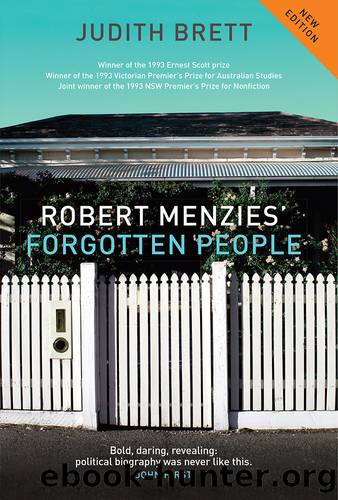
Robert Menzies' Forgotten People by Judith Brett
Author:Judith Brett [Brett, Judith]
Language: eng
Format: epub
Tags: Politics, History
ISBN: 9780522853919
Google: dmEoGQAACAAJ
Goodreads: 7764389
Publisher: Melbourne University
Published: 2007-01-15T13:32:38+00:00
The anecdote displays, as well, a central characteristic of the young Menziesâthe evasion of actual experience through comparison with some more intense, imagined reality.
His parents both worked hard, his mother frequently serving in the shop, but the new settlers often had little money and had to rely on credit. âLife for my parents was, in a financial sense, difficult and even grim.â17 Menziesâ parents occupied the classic position of the petit bourgeoisieâsmall shopkeepers juggling debtors and creditors, forced to practise selfdenial through thrift and hard work in order to survive. But the denials of their class position were increased by their geographical location. For a pioneer family on the edges of Empire and of settlement, the costs and renunciations of a settlerâs life in the New World amplified the petit bourgeois ideology of the Old. Not only had these pioneering families to struggle for their financial security, they had to struggle for it in an alien and often hostile nature far from their worldâs centre.
And who would witness their struggle? One obvious association to âforgottenâ in the Menzies familyâs experience was the sense of being on the edges of Empire. The books the family read all referred to a land which none of them had experienced. Menziesâ parents were Australians not through choice but because of their parentsâ decision to emigrate. Here, in this distant outpost, were they forgotten, despite their virtuous upholding of the moral and cultural traditions they ascribed to the centre and their careful learning of the Kingâs English? And would the centre recognise them if they ever got there? To address the Australian middle class as forgotten was to evoke fears of neglect that went beyond their apprehension at the growing power of socialism to the core of their unease and insecurity about their place on the globe.
In this hostile, distant, alien place, the home became both a refuge and the major source of cultural meaning. Menzies refers often to the closeness and security of this childhood home. His most frequent picture is of the family gathered around to listen to one of the members reading from the books he lists so carefully in his speech in 1950. These books appear, minus the Bible, in Afternoon Light, and in the biographies, for which Menzies, his brother Frank and sister Isabel were major sources.18 Speaking in 1967 at the unveiling of the spire built in Jeparit to commemorate his achievements, Menzies said of Jeparit, âIt was a great place in which a family might grow up . . . we lived at home, we became fond of reading, and reading for each other, and discussing matters with each other. This produced a very well-knit family atmosphere and has encouraged me, in particular, to be a studentâ. Growing up in that circle âwe got to learn something about the things that mattered in the world . . . we acquired some moral and spiritual standardsâ. Looking back on his life, Menzies liked to recall that:
it was here at
Download
This site does not store any files on its server. We only index and link to content provided by other sites. Please contact the content providers to delete copyright contents if any and email us, we'll remove relevant links or contents immediately.
| Anthropology | Archaeology |
| Philosophy | Politics & Government |
| Social Sciences | Sociology |
| Women's Studies |
The Secret History by Donna Tartt(19092)
The Social Justice Warrior Handbook by Lisa De Pasquale(12190)
Thirteen Reasons Why by Jay Asher(8912)
This Is How You Lose Her by Junot Diaz(6887)
Weapons of Math Destruction by Cathy O'Neil(6281)
Zero to One by Peter Thiel(5802)
Beartown by Fredrik Backman(5755)
The Myth of the Strong Leader by Archie Brown(5508)
The Fire Next Time by James Baldwin(5447)
How Democracies Die by Steven Levitsky & Daniel Ziblatt(5219)
Promise Me, Dad by Joe Biden(5154)
Stone's Rules by Roger Stone(5088)
A Higher Loyalty: Truth, Lies, and Leadership by James Comey(4964)
100 Deadly Skills by Clint Emerson(4926)
Rise and Kill First by Ronen Bergman(4790)
Secrecy World by Jake Bernstein(4753)
The David Icke Guide to the Global Conspiracy (and how to end it) by David Icke(4720)
The Farm by Tom Rob Smith(4514)
The Doomsday Machine by Daniel Ellsberg(4490)
