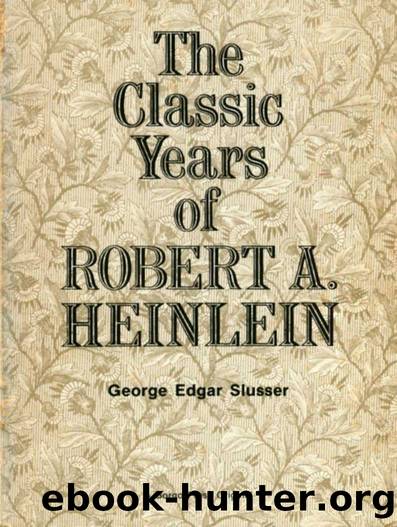
Robert A. Heinlein by The Classic Years of Robert A. Heinlein # George Edgar Slusser
Author:The Classic Years of Robert A. Heinlein # George Edgar Slusser
Language: eng
Format: mobi
Published: 2012-01-04T08:56:59+00:00
Heinlein’s early tales and novellas are perhaps best treated as allegories. To critics, his latest “philosophical” novels also have seemed parables of the same sort—different only in that they are more protracted and offensively didactic. It is tempting to leap in this way from early works to late. However, this slurs over important differences between the two periods. The emphasis in Stranger and its progeny has definitely shifted. The collective group may still be present, but the individual hero now takes precedence over it. In parallel fashion, epiphanic grace—direct contact between this individual and the predestined plan itself—supplants the elaborate machinery of common grace. If there is still interest in the problem of covenants, or the workings of elect groups and societie s, it is now secondary to the emergence of a super hero. Moreover, such a leap obscures the fact that this shift is the result of a natural process—one that occurs subtly yet pervasively throughout Heinlein’s novels of the 1950s. It is possible that this change in structural and thematic emphasis stems from tension on the narrative level itself. On one hand, there are the conventional patterns Heinlein inherits along with the particular form of adventure novel he adopts—intrigue and initiation. In his early tales, if these appear at all, they are embryonic at best. On the other hand, there is Heinlein’s own belief-impelled logic of storytelling, fixed and immovable from the start. At many points, these are mutually exclusive. Are deeds, for example, to be meaningful or inconsequential? Are they essential to the outcome of the action, or superfluous to it? Does an individual become a hero through interaction with events, or by resisting and defying fate? Or is he chosen, shown to be part of some higher plan irrespective of his decisions and desires? Throughout the period of the juveniles, the Calvinist base refuses to yield. The result of this friction is the gradual alteration of the conventions of intrigue and initiation. In novel after novel, the hero only appears to be the product of his acts. Enemies are defeated, men come of age—but these only seem to result from individual effort. More and more, there are ellipses, inexplicable changes of state. Subtly, will is replaced by predisposition to election, the process of formation by that of memory. The hero becomes not what he makes himself but what he was all along, hidden until the inner self is finally revealed.
In practice, the patterns of intrigue and initiation are inseparable. Yet for the sake of analysis we must cut them apart. Episodic adventure in Heinlein is invariably shaped by a particular kind of intrigue. A problem arises, in the form of an aggressive enemy cabal, some secret society that seeks to usurp power. The actions ofthis false group force the true body ofthe elect to form, and to enter into protracted battle, until the last of the enemy is destroyed. Development is linear, and apparently causal. In contrast, a novella like “Gulf” (1949) is an anatomy of election.
Download
This site does not store any files on its server. We only index and link to content provided by other sites. Please contact the content providers to delete copyright contents if any and email us, we'll remove relevant links or contents immediately.
4 3 2 1: A Novel by Paul Auster(12554)
The handmaid's tale by Margaret Atwood(7871)
Giovanni's Room by James Baldwin(7477)
Asking the Right Questions: A Guide to Critical Thinking by M. Neil Browne & Stuart M. Keeley(5860)
Big Magic: Creative Living Beyond Fear by Elizabeth Gilbert(5859)
Ego Is the Enemy by Ryan Holiday(5576)
The Body: A Guide for Occupants by Bill Bryson(5216)
On Writing A Memoir of the Craft by Stephen King(5024)
Ken Follett - World without end by Ken Follett(4819)
Adulting by Kelly Williams Brown(4649)
Bluets by Maggie Nelson(4641)
Eat That Frog! by Brian Tracy(4633)
Guilty Pleasures by Laurell K Hamilton(4536)
The Poetry of Pablo Neruda by Pablo Neruda(4197)
Alive: The Story of the Andes Survivors by Piers Paul Read(4107)
Fingerprints of the Gods by Graham Hancock(4084)
The Book of Joy by Dalai Lama(4073)
White Noise - A Novel by Don DeLillo(4062)
The Bookshop by Penelope Fitzgerald(3913)
