Revenge and Gender in Classical, Medieval, and Renaissance Literature by Lesel Dawson Fiona McHardy
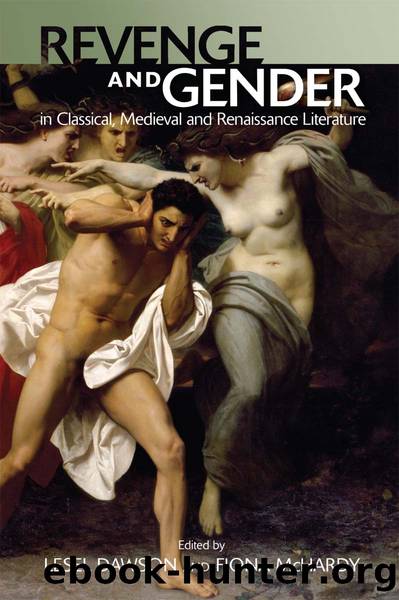
Author:Lesel Dawson,Fiona McHardy
Language: eng
Format: epub
Publisher: Edinburgh University Press
CHAPTER 9
âWomenâs Weaponsâ: Education and Female Revenge on the Early Modern Stage
Chloe Kathleen Preedy
âMy tables! Meet it is I set it downâ, exclaims the most famous revenger of the early modern theatre, as he employs the study methods he has acquired at university to record a ghostâs lesson of murder and retribution.1 While initially promising that âthy commandment all alone shall live / Within the book and volume of my brainâ (1.5.102â3), Hamlet will later rely on his prior learning to test the truth of his uncleâs guilt, composing âa speech of some dozen linesâ that, inserted into The Murder of Gonzago, enables him to try the king and âtent him to the quickâ (2.2.477, 532). This association between words and violent action, the humanist education system and the pursuit of revenge, became even more emphatic in Jacobean drama, when the figure of the malcontent â often depicted as a socially ambitious scholar whose prospects for advancement have been blocked by entrenched aristocratic privilege â gained in popularity.2 From De Flores in The Changeling and Bosola in The Duchess of Malfi, to Vindice in The Revengerâs Tragedy and the eponymous protagonist of Antonioâs Revenge, Jacobean revengers invite audiences to reflect on the relationship between humanist learning, with its emphasis on proper governance and moral education, and the violent retribution that they enact upon corrupt rulers and unjust societies. Hinting at early modern doubts about whether humanism would be able to live up to its ideals in practice,3 such characters are credited with the ability to âmanipulate a fluid and contingent world with a dramatistâs inventiveness and authorityâ; as John Kerrigan has shown, the early modern revenger becomes a âsurrogate artistâ, âtransmuting creative ambition into narrative and stage actionâ.4 The educational heritage that these fictional characters share with their creators is especially significant. Early modern playwrights and their metatheatrical protagonists both drew inspiration from classical models: the Roman author Senecaâs influence on Elizabethan and Jacobean revenge drama has long been recognised by critics, while Tanya Pollardâs chapter in this collection demonstrates how early modern authors responded to and reworked the legacy of ancient Greek tragedy.5 Yet the significance of the associations between humanist education and revenge action for the female avengers of sixteenthand seventeenth-century drama have not yet been fully addressed. Examining the revenge plots of Shakespeareâs Titus Andronicus, Kydâs The Spanish Tragedy and Chapmanâs The Revenge of Bussy DâAmbois, this chapter argues that womenâs literacy and classical knowledge play a crucial role in scripting vengeance, enabling educated women to participate actively in the process of revenge rather than being banished to the margins.6
If the consequences of humanist learning concerned some sixteenth- and seventeenth-century writers, womenâs education was an especially controversial topic. Although some humanist commentators suggested that education would aid a female pupilâs moral development, others argued that there was something âintrinsically indecorousâ about a woman who violated the âsocial code of modest silenceâ.7 The educated woman was often ambiguously portrayed in humanist texts, popular pamphlets, and plays as a potentially unruly figure: âa threat in the social and sexual sphereâ.
Download
This site does not store any files on its server. We only index and link to content provided by other sites. Please contact the content providers to delete copyright contents if any and email us, we'll remove relevant links or contents immediately.
| Anthropology | Archaeology |
| Philosophy | Politics & Government |
| Social Sciences | Sociology |
| Women's Studies |
Born to Run: by Christopher McDougall(7121)
The Leavers by Lisa Ko(6945)
iGen by Jean M. Twenge(5408)
Sapiens by Yuval Noah Harari(5366)
Spare by Prince Harry The Duke of Sussex(5176)
The Kite Runner by Khaled Hosseini(5170)
Machine Learning at Scale with H2O by Gregory Keys | David Whiting(4293)
Bullshit Jobs by David Graeber(4179)
Never by Ken Follett(3937)
Goodbye Paradise(3799)
Livewired by David Eagleman(3764)
Fairy Tale by Stephen King(3370)
A Dictionary of Sociology by Unknown(3073)
Harry Potter 4 - Harry Potter and The Goblet of Fire by J.K.Rowling(3061)
The Social Psychology of Inequality by Unknown(3018)
The Club by A.L. Brooks(2919)
Will by Will Smith(2910)
0041152001443424520 .pdf by Unknown(2843)
People of the Earth: An Introduction to World Prehistory by Dr. Brian Fagan & Nadia Durrani(2728)
