Retiring Retirement by Rodney Macready
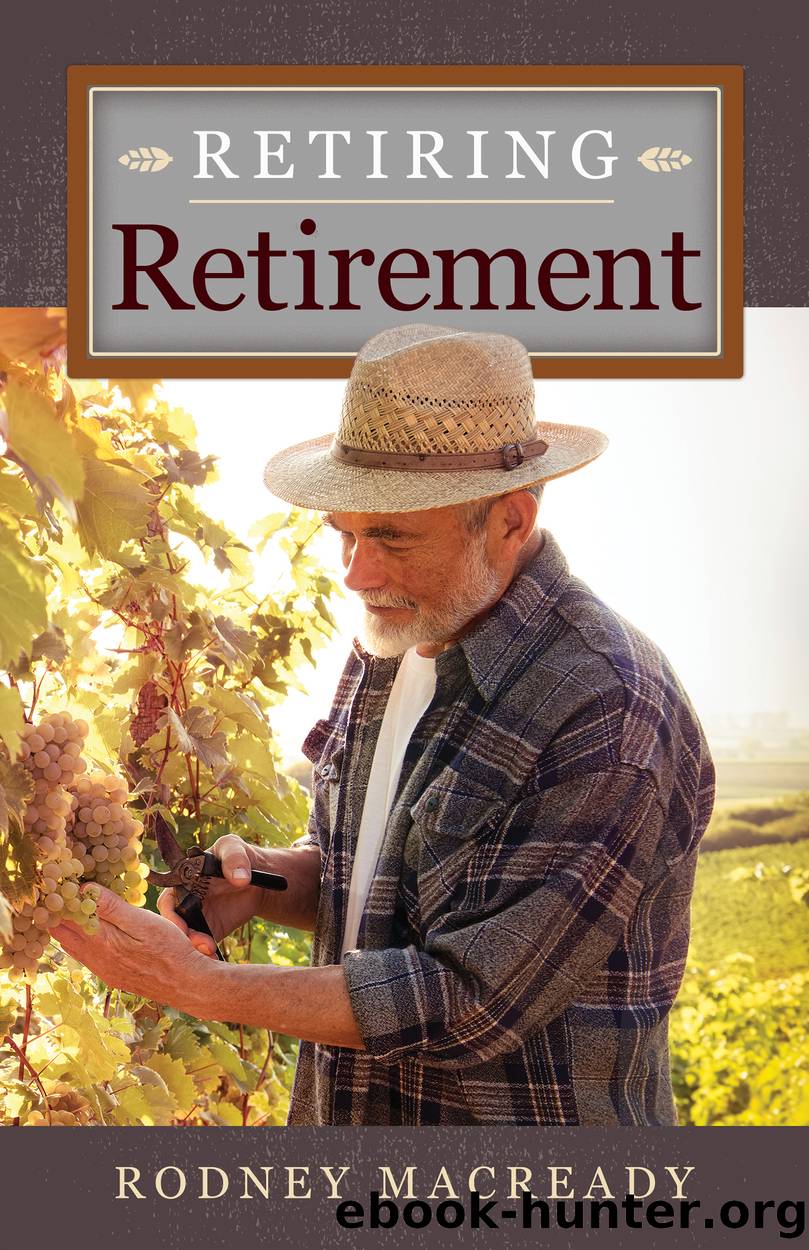
Author:Rodney Macready
Language: eng
Format: epub
Tags: Christian retirement;Church community;Church growth;discipleship strategies
ISBN: 9781683070337
Publisher: Hendrickson Publishers
Published: 2016-11-16T19:35:41+00:00
Summary
In these last three chapters Iâve tried to present an overall vision of Godâs rest. That vision differs from the one I picked up during my church upbringing (which may not be identical with the one I was intended to acquire!). I now see Godâs rest not as inactivity, but as shalomâthe idea that everything is as God intended it should be and that all are together enjoying the goodness of Godâs creation within the context of Godâs perfect rule. I now also see our participation in Godâs rest as including human workâthat work in itself, as one of Godâs good gifts to us within his creation, is not inconsistent with the idea of enjoying Godâs rest.
Iâve also tried to demonstrate how the institutions of the Sabbath, the Sabbatical Year, and the Year of Jubilee fit within that framework and how Jesus fulfills them. I believe they too are primarily about the pursuit of shalom. They remind us of Godâs original intentions and call us to work toward those intentions in our lives. That includes working in a way that enables others to join us in the celebration and enjoyment of Godâs good creation.
Willard Swartley notes some of the implications of this interpretation of the Sabbath legislation:
He declared himself Lord of the Sabbath, calling people to live all of life for the well-being of others. The true purpose of the Sabbath found its clear expression in the life and death of Jesus, a man for others; Jesus extended Godâs jubilean grace to all people.
By fulfilling the humanitarian purpose of the Sabbath, rest and equality for the servants, Jesus inaugurated a continuous practice of Sabbath, sabbatical, and jubilean ethics.[7]
Within that context, I believe that the Sabbath principles canât be used to justify a concept of retirement, especially the self-indulgent version currently encouraged by our Western culture. The latter promotes the pursuit of personal leisure experiences rather than a desire to contribute to the communityâs well-being. It promotes a carefree focus on fulfilling my own wants rather than accepting the responsibility of serving others. As in the garden, it offers me the opportunity to rule my own kingdomâit asks me to substitute that paltry self-centered dream for Godâs glorious vision of shalom.
Swartley rightly claims that the sabbatical vision calls us to live for the well-being of others. That vision doesnât change when people reach a certain age. The way we act on that vision varies with our life circumstances at any particular time: our abilities, our training, our family situations, our circumstances, the opportunities that present themselves to us, and so on. And, yes, the aging process does impact that with the result that our opportunities may change. Weâll discuss some of the specifics of this in the final chapter, but the overall vision remains the same throughout. That vision remains just as relevant after we reach some government-defined retirement age.
Download
This site does not store any files on its server. We only index and link to content provided by other sites. Please contact the content providers to delete copyright contents if any and email us, we'll remove relevant links or contents immediately.
Professional Troublemaker by Luvvie Ajayi Jones(29763)
Empire of the Sikhs by Patwant Singh(23206)
Twilight of the Idols With the Antichrist and Ecce Homo by Friedrich Nietzsche(18782)
Plagued by Fire by Paul Hendrickson(17540)
The Sun and Her Flowers by Rupi Kaur(14633)
Norse Mythology by Gaiman Neil(13571)
Fangirl by Rainbow Rowell(9473)
A Journey Through Charms and Defence Against the Dark Arts (Harry Potter: A Journey Throughâ¦) by Pottermore Publishing(9340)
Adultolescence by Gabbie Hanna(9022)
Wonder by R.J. Palacio(8725)
Tools of Titans by Timothy Ferriss(8595)
Becoming Supernatural by Dr. Joe Dispenza(8375)
How to Bang a Billionaire by Alexis Hall(8275)
Wonder by R. J. Palacio(8244)
Crystal Healing for Women by Mariah K. Lyons(8009)
The Road Less Traveled by M. Scott Peck(7731)
The Lost Art of Listening by Michael P. Nichols(7622)
The Witchcraft of Salem Village by Shirley Jackson(7434)
The Institute by Stephen King(7153)
