Resuming Maurice by Philip Mosley
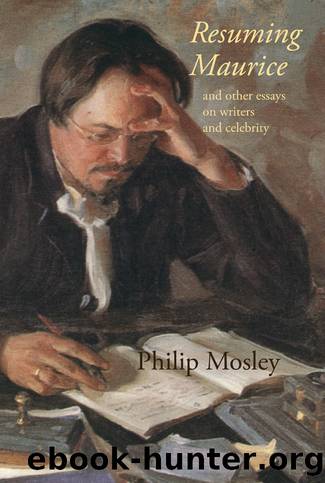
Author:Philip Mosley
Language: eng
Format: epub
Tags: HISTORY / Ancient / General
Publisher: Dufour Editions
Published: 2020-03-24T00:00:00+00:00
5
Modern romantics: Dylan Thomas and George Barker
Dylan Thomas and George Barker were true contemporaries whose personal backgrounds and literary careers ran much on parallel lines, and their similarities considerably outweigh their differences. Both left school early and were largely self-taught, though Thomas completed a secondary school education at Swansea Grammar under the gaze of his father, who taught English there. Thomas senior inculcated a taste for the sound as much as the sight of literature in a precocious son who otherwise hated the institution. Both poets were anti-academic from an early age, sharing a deep-seated belief that academic criticism was incompatible with creativity. Though both were prime épateurs du bourgeois, they showed little social or political mindedness, a detachment unusual for poets budding in the 1930s. Thomas wrote, âItâs the poetry ⦠that counts, not ⦠continent, country, island, race, class, or political persuasion.â
Barkerâs Calamiterror (1937), written under the sign of Blake, Wordsworth, and Shelley, as war clouds gathered, insisted nonetheless on the moral imperative of the poet, while its ominous tone echoed Yeats in âThe second comingâ rather than the more ideological line taken by W. H. Auden and his cohorts. Furthermore, The True Confession of George Barker, Book One (1950) appeared in the âKey Poetsâ booklet series of a communist outfit, Fore Publications, though the publisherâs broad outlook, which dismayed its more doctrinaire adherents, accounts for this work of philosophical subjectivism appearing on its list. Much later, Anno Domini (1983) carried an implicit critique of that decadeâs Thatcherite politics in the United Kingdom, but it was not Barkerâs way to be direct about such matters. Even so, in that volume, as a dedicated pleasure seeker living in rural retreat from the world at large, he could send himself up: âin a time of hedonists and belly dancers / wise men draw the blinds and bolt the doorsâ.
Neither poet saw active service in the Second World War. Barker was mostly in the United States after a brief spell of teaching in Japan, and Thomas, who had been rejected for duty on grounds of physical unfitness, worked in the film industry and later at the BBC, where writer and broadcaster Wynford Vaughan-Thomas introduced him to freelance radio work boosting national morale.
Both men had already decided anyway to live as poets alone. Totally dedicated to their vocation, they were literary mavericks for whom the play of words was everything. Barker was uninterested in self-promotion, fame, or adulation; by contrast, Thomas found them rather alluring, ultimately to his cost. According to critic, fellow poet, and fellow Norfolk resident Anthony Thwaite, Barker âlooked and sounded and behaved exactly as a poet shouldâ. And Thomasâs magnetic presence, as Karl Shapiro wrote in the mid-1950s, was already creating âa general audience for a barely understandable poetâ. Both were as excessive in their lives as in their verses. Serious drinkers and frequently in equally serious need of money, they could be arrogant, rude, and hurtful. Then again, they could be generous, tender, and charming. Their habitual
Download
This site does not store any files on its server. We only index and link to content provided by other sites. Please contact the content providers to delete copyright contents if any and email us, we'll remove relevant links or contents immediately.
The Fine Print (Dreamland Billionaires Book 1) by Lauren Asher(2548)
Fury of Magnus by Graham McNeill(2438)
The Last House on Needless Street by Catriona Ward(2382)
The Rose Code by Kate Quinn(2192)
A Little Life: A Novel by Hanya Yanagihara(2102)
Malibu Rising by Taylor Jenkins Reid(1902)
The God of the Woods by Liz Moore(1896)
Luster by Raven Leilani(1894)
Transcendent Kingdom by Yaa Gyasi(1851)
Moonflower Murders by Anthony Horowitz(1842)
The Lost Book of the White (The Eldest Curses) by Cassandra Clare & Wesley Chu(1683)
This Changes Everything by Unknown(1499)
The Midwife Murders by James Patterson & Richard Dilallo(1476)
The New Wilderness by Diane Cook(1438)
The Lying Life of Adults by Elena Ferrante(1425)
Wandering in Strange Lands by Morgan Jerkins(1408)
Written in the Stars by Alexandria Bellefleur(1391)
Ambition and Desire: The Dangerous Life of Josephine Bonaparte by Kate Williams(1380)
The Lying Life of Adults by Elena Ferrante;(1303)
