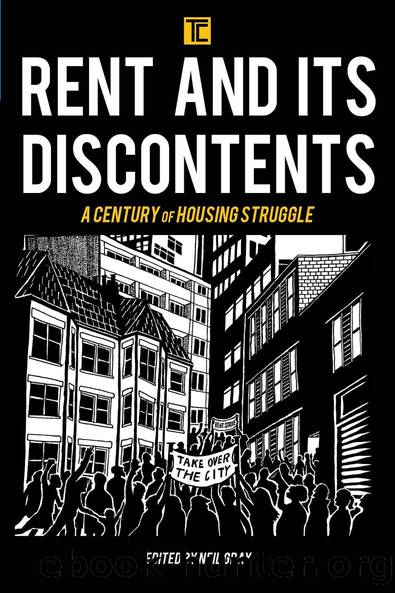
Rent and its Discontents by Neil Gray
Author:Neil Gray [Gray, Neil]
Language: eng
Format: epub
ISBN: 9781786605757
Barnesnoble:
Publisher: Rowman & Littlefield Publishers, Inc.
Published: 2018-09-16T00:00:00+00:00
Figure 8.1âAnti-HAT protest outside Nicholas Ridleyâs home, November 1988. Courtesy of Ocean Estate Tenants Association.
People were very happy [that the HAT was dropped] because they all kept their secure tenancy. See, the campaign really was about assured tenancy and secure tenancy, and people were just petrified of assured tenancies, they can chuck you out, canât they, if you live with your parents and they both die then you are on your own, on your bike, canât hand down the [tenancy].
HATs evolved over time but only a few went ahead in London (Tiesdell 2001). Far more significant for the cityâs housing landscape and struggles is housing stock transfer to which I now turn.
âVote No to Privatizationâ: Campaign against Stock Transfers
Large-scale voluntary transfer (LSVT)âthe stock transfer process whereby a local authority landlord sells the stock of rented housing to a housing association on the basis of a tenantsâ ballotâbegan nationally in 1988, but only became significant in Londonâs housing struggles during the late 1990sâlate 2000s. Stock transfer had limited impact in London until 1997, after which it formed a key plank in New Labourâs âmodernizationâ agenda for the welfare state (Watt 2009a, 2009b). In introducing its Decent Homes initiative, New Labour tied local authority funding for improvements to three âoptionsâ: stock transfer, Armâs Length Management Organization (ALMO) or Private Finance Initiative (PFI) (Hodkinson et al. 2013). LSVT forms part of the neoliberalization of housing because it ensures marketization, either directly or indirectly, by ruling out direct public investment by councils in their stock, that is, the âfourth optionâ (HOCCHG 2009; Hodkinson et al. 2013). Opponents regard stock transfer as the âprivatization of council housingâ and argue thatâwhen comparing local authority âsecureâ tenancies to housing association âassuredâ tenanciesâit results in higher rents, lower security and lack of democratic accountability. Large anti-transfer campaigns arose in cities such as Birmingham, Edinburgh and Glasgow, as well as London, while the national Defend Council Housing (DCH) campaign was formed in London during the late 1990s. A cross-party House of Commons Council Housing Group was formed at which DCH, Austin Mitchell, the Labour Member of Parliament (MP) for Hull and other MPs held a series of meetings at the House of Commons, which provided a forum for council tenants from all over the country to highlight the problems of stock transfer and to argue for, direct public investment in council housing (HOCCHG 2009).
As several London councils put forward proposals to transfer slices of their stock during the late 1990s and early 2000s, so tenants, community and political groups established borough-wide, anti-transfer campaigns. In addition to national concerns regarding rents and security, London anti-transfer campaigns were spurred by the very real potential for transfer to enhance gentrification via âstate-led gentrificationâ (Watt 2009a). A major part of DCHâs grassroots strength lay in London and especially in inner London boroughs such as Camden, Southwark and Tower Hamlets (Watt 2009a, 2009b). Each of these boroughs had prominent successful anti-transfer campaigns. In Southwark, campaigners famously voted against stock transfer at the Aylesbury estate
Download
This site does not store any files on its server. We only index and link to content provided by other sites. Please contact the content providers to delete copyright contents if any and email us, we'll remove relevant links or contents immediately.
| Anthropology | Archaeology |
| Philosophy | Politics & Government |
| Social Sciences | Sociology |
| Women's Studies |
Born to Run: by Christopher McDougall(7131)
The Leavers by Lisa Ko(6949)
iGen by Jean M. Twenge(5418)
Sapiens by Yuval Noah Harari(5374)
Spare by Prince Harry The Duke of Sussex(5200)
The Kite Runner by Khaled Hosseini(5184)
Machine Learning at Scale with H2O by Gregory Keys | David Whiting(4315)
Bullshit Jobs by David Graeber(4195)
Never by Ken Follett(3961)
Goodbye Paradise(3812)
Livewired by David Eagleman(3776)
Fairy Tale by Stephen King(3401)
A Dictionary of Sociology by Unknown(3086)
Harry Potter 4 - Harry Potter and The Goblet of Fire by J.K.Rowling(3076)
The Social Psychology of Inequality by Unknown(3037)
Will by Will Smith(2928)
The Club by A.L. Brooks(2927)
0041152001443424520 .pdf by Unknown(2849)
People of the Earth: An Introduction to World Prehistory by Dr. Brian Fagan & Nadia Durrani(2739)
