Regulating Low-Skilled Immigration in the United States by Hanson Gordon H.;Hanson Gordon H;
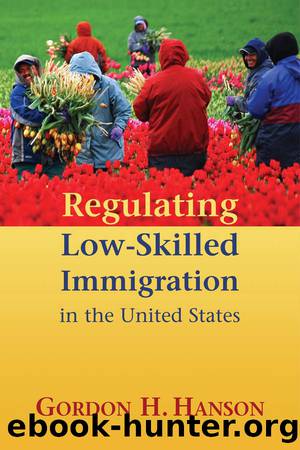
Author:Hanson, Gordon H.;Hanson, Gordon H;
Language: eng
Format: epub
Publisher: AEI Press
Summary
The emergence of large-scale illegal immigration in the United States can be understood as the result of a conflict between two conflicting desires: to allow immigration of low-skilled individuals while maintaining a welfare state. The mechanisms that govern illegal immigration select individuals with a strong motivation to work while restricting their access to government benefits. The advantage of such a system is that it subjects immigration to market forces, producing a level of foreign labor inflows and a composition of immigrants that reflect relative economic opportunities in sending and receiving countries. In practice, illegal immigration appears to be more flexible and more responsive to economic conditions than legal immigration (Hanson 2007).
Yet, clear disadvantages to illegal immigration exist. Illegal immigration creates a class of individuals with poorly defined residency rights, who, in the absence of occasional amnesties, lack a defined path to citizenship. The presence of a large population of individuals without official resident status implicitly undermines civil society in the United States by weakening democratic norms and reducing the incentive of politicians to respond to the needs of their constituents (Huntington 2004). The challenge for policymakers is to design an immigration regime that has the appealing efficiency properties of illegal immigrationâin terms of its flexibility, screening mechanisms, and relatively low fiscal costâbut lacks its negative consequencesâthe undermining of U.S. law and civil society and the lack of many protections for immigrants.
Download
This site does not store any files on its server. We only index and link to content provided by other sites. Please contact the content providers to delete copyright contents if any and email us, we'll remove relevant links or contents immediately.
| Anthropology | Archaeology |
| Philosophy | Politics & Government |
| Social Sciences | Sociology |
| Women's Studies |
The Secret History by Donna Tartt(19052)
The Social Justice Warrior Handbook by Lisa De Pasquale(12187)
Thirteen Reasons Why by Jay Asher(8893)
This Is How You Lose Her by Junot Diaz(6877)
Weapons of Math Destruction by Cathy O'Neil(6264)
Zero to One by Peter Thiel(5786)
Beartown by Fredrik Backman(5737)
The Myth of the Strong Leader by Archie Brown(5499)
The Fire Next Time by James Baldwin(5431)
How Democracies Die by Steven Levitsky & Daniel Ziblatt(5215)
Promise Me, Dad by Joe Biden(5141)
Stone's Rules by Roger Stone(5081)
A Higher Loyalty: Truth, Lies, and Leadership by James Comey(4954)
100 Deadly Skills by Clint Emerson(4921)
Rise and Kill First by Ronen Bergman(4779)
Secrecy World by Jake Bernstein(4741)
The David Icke Guide to the Global Conspiracy (and how to end it) by David Icke(4706)
The Farm by Tom Rob Smith(4502)
The Doomsday Machine by Daniel Ellsberg(4484)
