Recovering Biblical Manhood & Womanhood by John Piper & Wayne Gruden
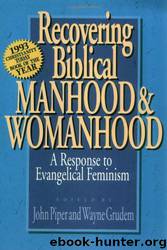
Author:John Piper & Wayne Gruden
Language: eng
Format: mobi, epub, azw3
Tags: Spirituality, Non-Fiction, manhood womanhood Bible, Religion
ISBN: 9780891075868
Publisher: Crossway Books
Published: 1991-04-28T00:00:00+00:00
person who is to be recognized as such-as a man or a woman, an older person or younger, an adult or a child.
Must the church’s leaders or overseers be men? The Apostle Paul assumes that they are to be men rather than women when he describes them as “the husband of but one wife” (1 Timothy 3:2). But could not this expression be incidental? We must consider carefully whether Paul’s rule here is intended to be absolute.
According to Paul, the fundamental principles regarding the structures of the human family are to be applied to the church as God’s household (1 Timothy 3:15). Our personal relations to others in God’s household should take into account what kind of persons they are, whether young or old, male or female (1 Timothy 5:1-2). In particular, the structure of family leadership is to be carried over into God’s household: qualified men are to be appointed as overseers, that is, fathers of the church. A woman, however capable and gifted she may be, can never become a father of a family. As a woman, she is simply not so constituted. Likewise, a woman may never become a father in God’s household. She may indeed become a “mother” in God’s household, and exercise the roles indicated in 1
Timothy 5:2; 3:11; 5:9-10, 14; Titus 2:3-5; 2 Timothy 1:5. The life of the church never overthrows but rather enhances the life of the family, based on God’s design from creation.
Such reasoning on Paul’s part is the best context for understanding Paul’s teaching in 1 Timothy 2:8-15. There Paul sets out distinctive responsibilities for men (2:8) and women (2:9-15). The necessity of such distinction is best understood as flowing from the fact that men and women are not interchangeable within God’s household, just as they are not within human families. Under the topic of women’s responsibilities, beginning in 2:9, Paul includes the statement that a woman is not “to teach or to have authority over a man” (2:12). According to our previous arguments, this conclusion is a natural outcome of the analogy between the church and the human family, in which the wife is not to have authority over her husband (Ephesians 5:22-24). Paul then appeals to the background of the order of creation (2:13), in which the pattern for a husband’s authority is initially established.9 He also appeals to the fall (2:14), in which male and female roles were not identical. Paul concludes with a reminder of one of the central and proper services of women, the bearing of children (2:15). This particular distinctive service by women reminds us more broadly of the larger responsibilities that women have in rearing
children within a family.10 Thus the whole passage organizes itself naturally once we
understand the centrality of the idea of family and the fruitfulness of using human households as a basis for discerning people’s responsibilities within God’s household.
In sum, Paul bases his reasoning on general principles, going back ultimately to the Biblical account in Genesis 2 and 3. Paul has an understanding of God’s plans and purposes in creating marriage and the family.
Download
Recovering Biblical Manhood & Womanhood by John Piper & Wayne Gruden.epub
Recovering Biblical Manhood & Womanhood by John Piper & Wayne Gruden.azw3
This site does not store any files on its server. We only index and link to content provided by other sites. Please contact the content providers to delete copyright contents if any and email us, we'll remove relevant links or contents immediately.
Professional Troublemaker by Luvvie Ajayi Jones(29651)
Empire of the Sikhs by Patwant Singh(23074)
Twilight of the Idols With the Antichrist and Ecce Homo by Friedrich Nietzsche(18624)
Plagued by Fire by Paul Hendrickson(17405)
The Sun and Her Flowers by Rupi Kaur(14510)
Norse Mythology by Gaiman Neil(13349)
A Journey Through Charms and Defence Against the Dark Arts (Harry Potter: A Journey Throughâ¦) by Pottermore Publishing(9273)
Fangirl by Rainbow Rowell(9229)
Adultolescence by Gabbie Hanna(8922)
Wonder by R.J. Palacio(8572)
Tools of Titans by Timothy Ferriss(8368)
Becoming Supernatural by Dr. Joe Dispenza(8204)
How to Bang a Billionaire by Alexis Hall(8146)
Wonder by R. J. Palacio(8098)
Crystal Healing for Women by Mariah K. Lyons(7928)
The Road Less Traveled by M. Scott Peck(7594)
The Lost Art of Listening by Michael P. Nichols(7494)
The Witchcraft of Salem Village by Shirley Jackson(7257)
The Institute by Stephen King(7025)
