R N Kao by Nitin A Gokhale
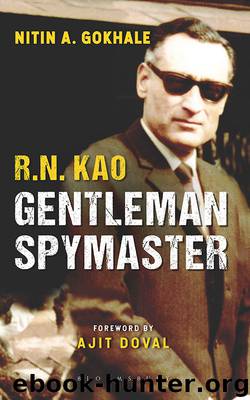
Author:Nitin A Gokhale
Language: eng
Format: azw3
ISBN: 9789389449303
Publisher: Bloomsbury Publishing
Published: 2019-11-18T05:00:00+00:00
NINE
The Pressing Need for a Foreign Intelligence Agency
The 22-day war between India and Pakistan in September 1965 is a largely forgotten period of India’s politico-military-diplomatic history. It happened in less than four years after the Chinese debacle and immediately after India’s first prime minister, Jawaharlal Nehru, had died heartbroken and defeated by what he thought was the Chinese betrayal.
Most popular accounts about the 1965 war have spoken about it being a stalemate, but a more detailed reading and subsequent assessment shows that India not only turned the tables on Pakistan which, at that point in history, had superior military hardware and was backed by major powers. India, on the other hand, was economically weak and was passing through an uncertain political phase following the death of Pandit Nehru and was yet to fully recover from the politico-military-diplomatic humiliation of 1962.
Under the circumstances, Lal Bahadur Shastri’s steely resolve, Y.B. Chavan’s pragmatic leadership in the defence ministry and the courage and fortitude of the Indian military not only withstood Pakistan’s aggression but, in the end, forced Pakistan on the defensive. In pure statistical terms too, Pakistan lost more territory, more tanks and more men in the war.
In 1965: Turning the Tide: How India Won the War, I wrote the following on the 1965 war—‘Looking back, India could have done better by being bolder in the field and by better appreciating the operational and strategic context. It could have, for instance, deployed its navy in an offensive mode but it did not… But this is a judgement in retrospect, 50 years later. At that time, it was the best India as a nation could have done. More importantly, if the Indian military had not gone through the baptism of 1965, it could not have done as spectacularly as it did in 1971 in breaking up Pakistan and help create Bangladesh, a new nation.’1
Fifty years after, it is clear that India not only thwarted the Pakistani designs but also inflicted unacceptable losses on the Pakistani military triggering many changes within that country’s politico-military structure. Even Ayub’s own son, Gauhar Ayub Khan, has admitted that the war should not have taken place. In an interview to Outlook, he said, ‘It was a war which should not have taken place. It set Pakistan back and was also costly for India. It led from events in Kashmir which Pakistan considered would be contained there and not turn into an open conflict between the two countries. But when India attacked Lahore and other fronts, it led to a general war between India and Pakistan. Ayub Khan was not looking for a war with India.’2
An unintended consequence of the 1965 war was the boost that the opposition leaders in East Pakistan (now Bangladesh) received to their demand for more autonomy to the eastern wing. When asked what the security guarantees for the eastern part of undivided Pakistan against an Indian military campaign were, Ayub or his military commanders had no convincing reply. This encouraged Sheikh Mujibur Rahman, leader of
Download
This site does not store any files on its server. We only index and link to content provided by other sites. Please contact the content providers to delete copyright contents if any and email us, we'll remove relevant links or contents immediately.
| Anthropology | Archaeology |
| Philosophy | Politics & Government |
| Social Sciences | Sociology |
| Women's Studies |
The Secret History by Donna Tartt(19010)
The Social Justice Warrior Handbook by Lisa De Pasquale(12179)
Thirteen Reasons Why by Jay Asher(8878)
This Is How You Lose Her by Junot Diaz(6865)
Weapons of Math Destruction by Cathy O'Neil(6253)
Zero to One by Peter Thiel(5774)
Beartown by Fredrik Backman(5722)
The Myth of the Strong Leader by Archie Brown(5484)
The Fire Next Time by James Baldwin(5418)
How Democracies Die by Steven Levitsky & Daniel Ziblatt(5207)
Promise Me, Dad by Joe Biden(5135)
Stone's Rules by Roger Stone(5070)
A Higher Loyalty: Truth, Lies, and Leadership by James Comey(4942)
100 Deadly Skills by Clint Emerson(4902)
Rise and Kill First by Ronen Bergman(4766)
Secrecy World by Jake Bernstein(4733)
The David Icke Guide to the Global Conspiracy (and how to end it) by David Icke(4691)
The Farm by Tom Rob Smith(4494)
The Doomsday Machine by Daniel Ellsberg(4477)
